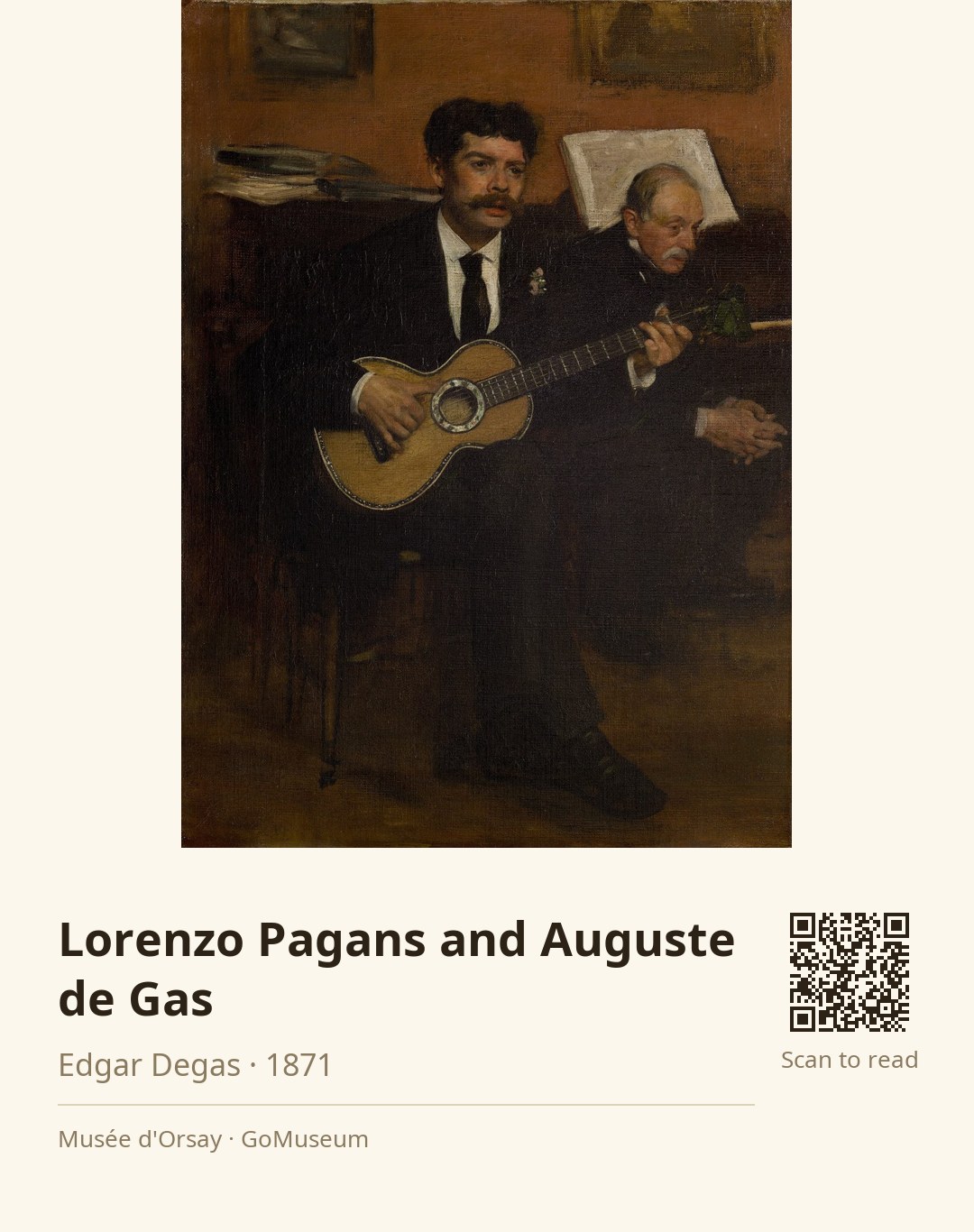
Lorenzo Pagans and Auguste de Gas
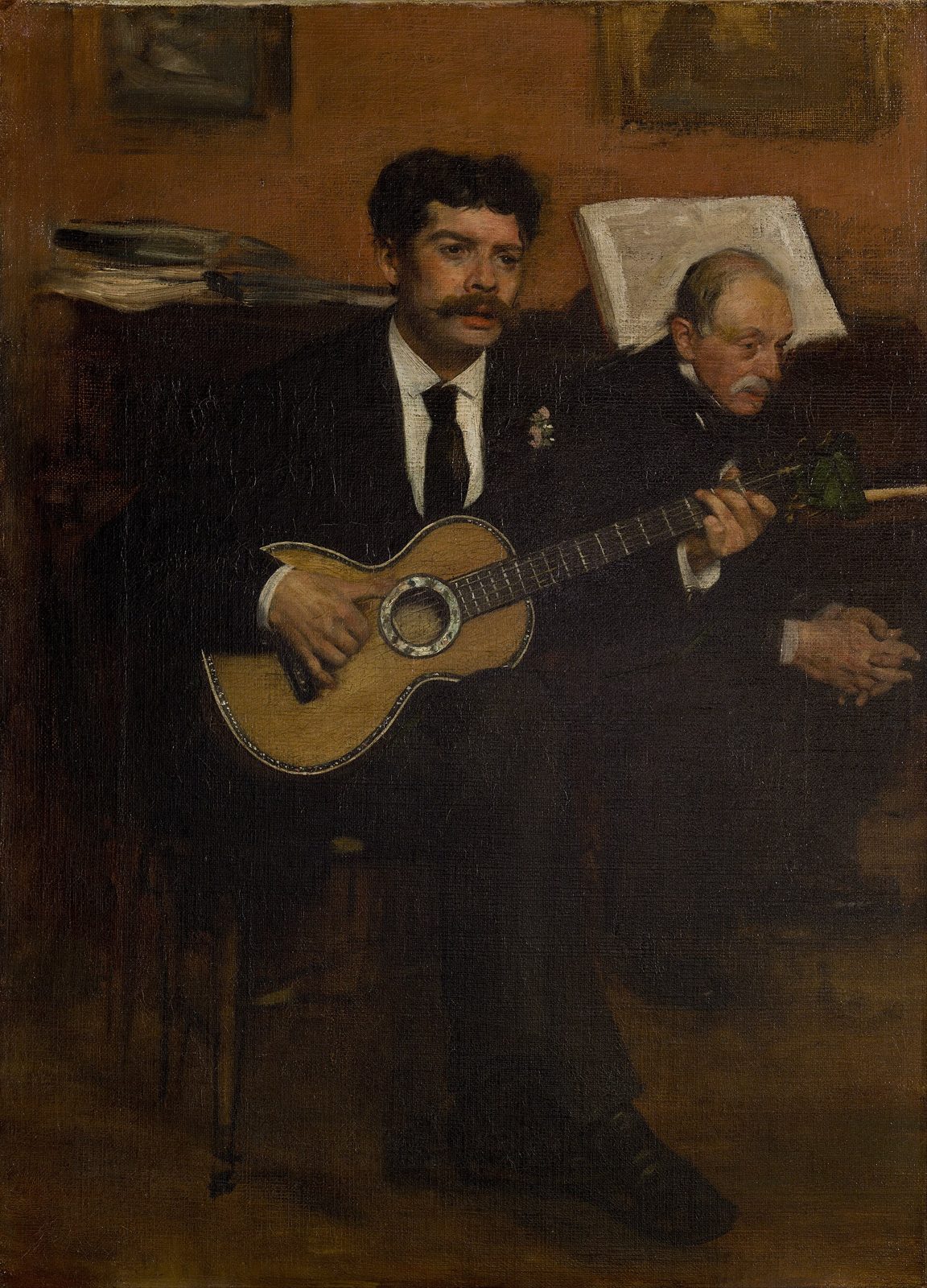
🎧 This work has audio narration — listen in the appTake a moment to really look at this painting, "Lorenzo Pagans and Auguste de Gas" by Edgar Degas. Notice how the young tenor, Lorenzo Pagans, is front and center, his guitar resting on his lap, while his dark suit contrasts sharply with the light wood of the instrument. His expression is captivating—halfway between concentration and performance, as if he’s about to share a song that resonates beyond this canvas. Now, shift your gaze to Auguste de Gas, Edgar’s father, seated behind him. His posture is hunched, his gaze downward, embodying the attentive listener. This contrast between the vibrant energy of the young musician and the quiet contemplation of the older man speaks volumes about the relationship between performer and audience. It’s a moment frozen in time, capturing not just a performance, but the deep connection that music fosters between people. Degas painted this around 1871, during a time when he was exploring the world of musicians, a subject that reveals his fascination with the human experience. As you stand here, think about the music that fills your life. What stories do you carry with you, and who are the listeners in your own performances?
Edgar Degas, born on July 19, 1834, in Paris, was a pivotal figure in the Impressionist movement, though he preferred to be labeled a realist. Known for his exceptional skill in drawing, Degas focused on capturing movement, particularly in his depictions of dancers, which constitute over half of his oeuvre. His works also include racehorses and portraits that reveal psychological depth and human isolation.
Degas came from a cultured, affluent family; his mother was a Creole from New Orleans, and his father was a banker. After his mother's death, he pursued art against his father's wishes, studying at the École des Beaux-Arts and drawing inspiration from classical masters during his time in Italy. His early ambition to be a history painter shifted as he embraced contemporary subjects, influenced by artists like Édouard Manet.
Despite being a founding member of the Impressionists, Degas's approach diverged from his peers, as he often worked in his studio rather than en plein air. His innovative techniques and themes sparked debate among critics and continue to influence art history today. Degas passed away on September 27, 1917, leaving behind a legacy that challenges traditional boundaries in art.
Edgar Degas painted 'Lorenzo Pagans and Auguste de Gas' between 1871 and 1872, during a period when he was deeply engaged with the theme of musicians. This double portrait was created as part of a series that explored the intimate relationship between performers and their audiences. The painting was eventually acquired by the Musée d'Orsay in Paris, where it has been part of the collection since 1986, following a donation by the Société des amis du Louvre in 1933. It was showcased in a significant exhibition at the Grand Palais in Paris in 1988, where it was listed as number 102. The painting's provenance traces back to Degas himself, then to his family, and through various collectors before reaching its current home.
Degas's technique in 'Lorenzo Pagans and Auguste de Gas' showcases his mastery of oil paint and his keen eye for detail. Notice how he contrasts the precise rendering of the figures—especially the faces and hands—with a looser, more impressionistic style in the background. The brushwork feels restless, almost as if it captures the very essence of the music being played. The light falls dramatically on the guitar and the faces, creating a focal point that draws your eye to the emotional exchange between the two men. The composition is carefully structured; Pagans occupies the foreground, his body language exuding confidence, while Auguste de Gas leans forward, embodying the attentive listener. This arrangement not only highlights their relationship but also invites you into the intimate atmosphere of the performance.
Interestingly, around the same time Degas painted this work, he created a variation titled 'Degas' Father Listening to Lorenzo Pagans.' In this version, the focus shifts more towards Auguste de Gas, who is illuminated in brighter light, while Pagans is relegated to the shadows. This shift in perspective highlights Degas's ongoing exploration of the dynamics between light, focus, and the roles of the figures within the frame.
The guitar features a dark green ribbon tied to its head, which is barely noticeable against the darker tones of the painting, adding a subtle touch of color that might be overlooked at first glance.
Degas came from a cultured family with a strong appreciation for music and art, which likely inspired his frequent exploration of musical themes in his work, reflecting the intimate connections between performance and audience.
The open music book on the piano behind Auguste de Gas not only frames his head but also suggests that the performance is part of a larger musical context, hinting at the ongoing nature of the music and the shared experience between the performer and the listener.