 Image: Didier Descouens
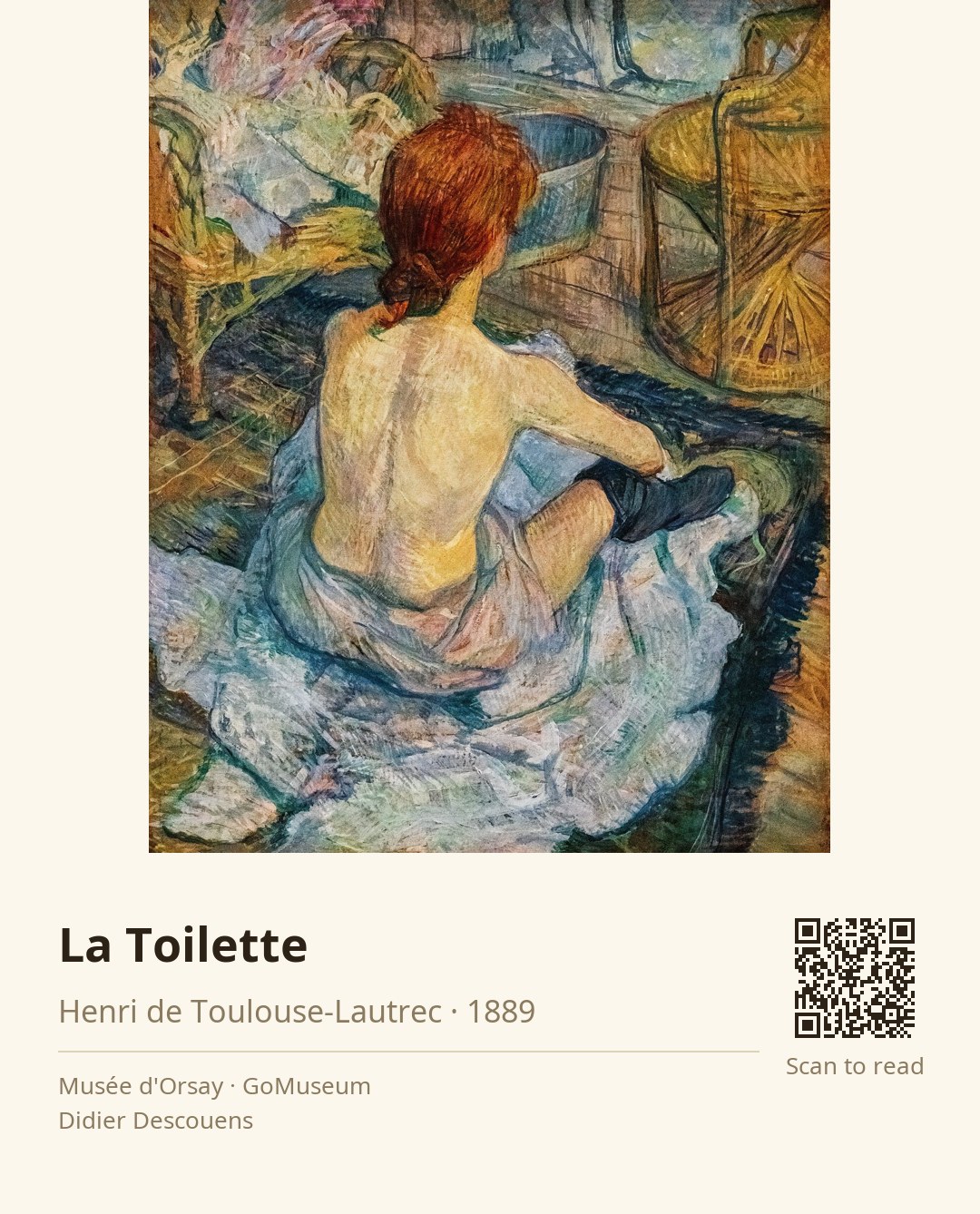
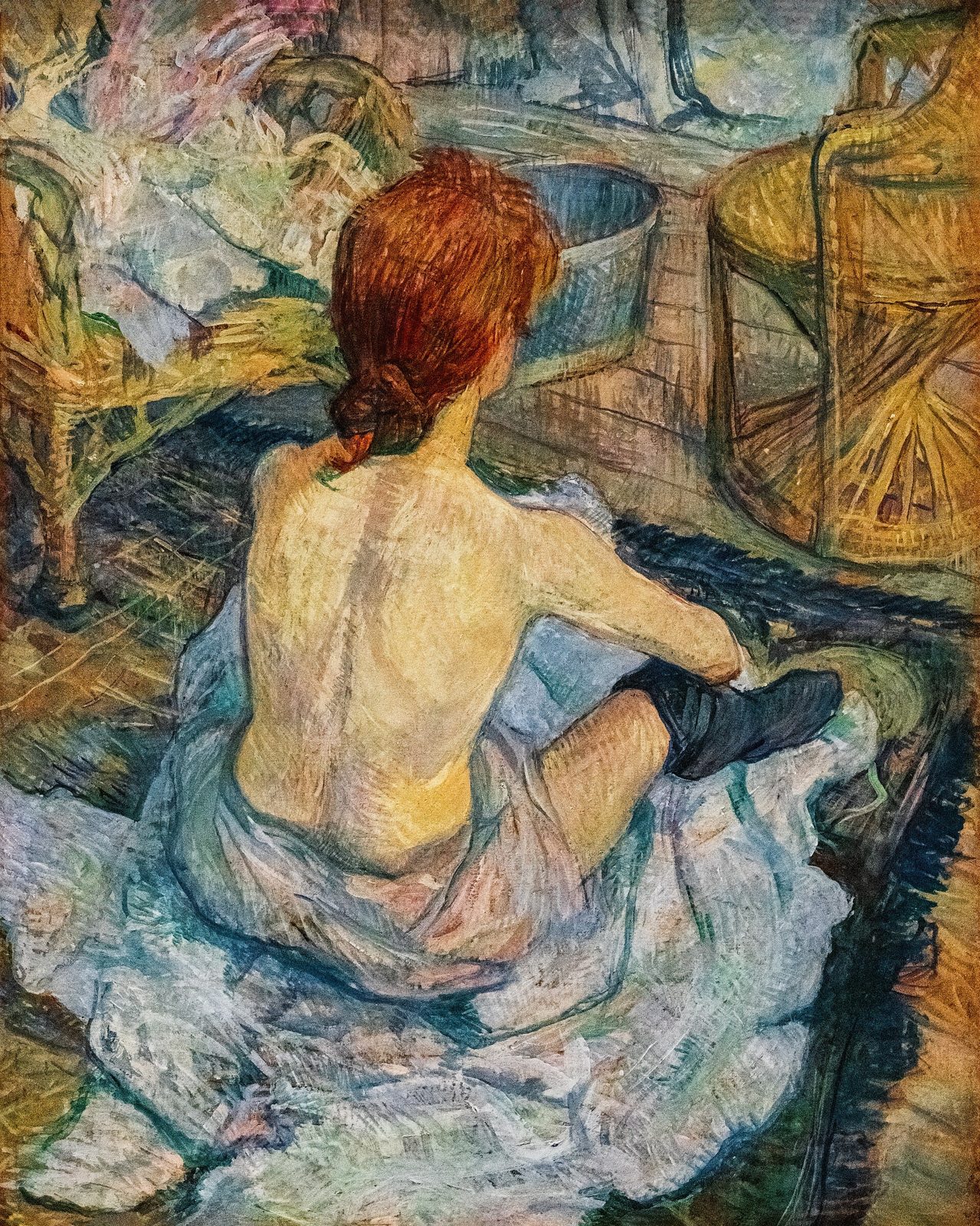
Take a moment to really look at "La Toilette" by Henri de Toulouse-Lautrec. Notice how the red-haired woman is seated on the floor, her back turned to us, as if she’s caught in a private moment just after bathing. The way her bare skin contrasts with the dark rug beneath her creates an intimate atmosphere, almost like we’re intruding on a quiet ritual. Now, focus on the fabric wrapped around her waist and the black stocking on her leg. These details matter because they hint at her vulnerability and the everyday reality of her life, a life that Toulouse-Lautrec often captured with a sense of empathy. The simplicity of her surroundings—a plain towel on the floor, a wicker chair, and a bathtub—speaks volumes about the domestic space she occupies, grounding her in a relatable moment rather than an idealized portrayal. Painted in 1889, this work reflects Toulouse-Lautrec's fascination with the human form and the intimate moments of life, influenced by the Impressionist movement and artists like Edgar Degas. It’s a snapshot of a woman’s world, painted directly from life, likely in one sitting, showcasing his skill in capturing fleeting moments. As you stand here, think about the story behind this scene.
Henri de Toulouse-Lautrec, born on November 24, 1864, in Albi, France, was a pivotal figure in the Post-Impressionist movement. Despite his aristocratic background, his life was marked by physical challenges, including a genetic disorder that stunted his growth. This condition shaped his unique perspective and deep empathy for the marginalized, particularly the vibrant characters of Paris's Belle Époque, including prostitutes and performers.
Toulouse-Lautrec's artistic journey began in earnest when he moved to Paris, where he immersed himself in the bohemian lifestyle of Montmartre. His work, characterized by bold colors and dynamic compositions, captured the essence of nightlife, cabarets, and the human condition. He became known for his posters and illustrations, which brought the world of the Moulin Rouge to life. His relationships with fellow artists, such as Vincent van Gogh, and his romantic entanglements, notably with Suzanne Valadon, influenced his creative output.
His legacy endures as he is celebrated for his innovative approach to art and his ability to convey the spirit of an era. Toulouse-Lautrec's works continue to resonate, offering a glimpse into the exuberance and struggles of a society on the brink of modernity, solidifying his place in art history as a masterful chronicler of the human experience. He passed away on September 9, 1901, leaving behind a rich body of work that remains influential to this day.
Henri de Toulouse-Lautrec painted 'La Toilette' in 1889, during a vibrant period of his life in Paris. This intimate scene was likely captured in a single session at his studio on rue Caulaincourt, where he often painted his favorite models. The painting was first exhibited in 1890 at an avant-garde exhibition called Les XX in Brussels, where it was titled 'Rousse'—a nod to the red-haired subject. The work remained in private hands until it was donated to France by Pierre Goujon upon his death in 1914. Since then, it has been housed in various prestigious locations, including the Musée du Luxembourg and the Musée National d'Art Moderne, before finding its home at the Musée d'Orsay in 1983. This journey through different collections reflects its growing recognition and the evolving appreciation of Toulouse-Lautrec's work over the decades.
In 'La Toilette', Toulouse-Lautrec employs a loose and fluid brushwork that captures the spontaneity of the moment. The oil paint, thinned with turpentine, creates a delicate texture that feels almost ephemeral, as if the scene could dissolve at any moment. Notice how he uses a light color palette dominated by soft blues and greens, which contrasts beautifully with the vibrant red of the woman's hair. This choice not only highlights her figure but also evokes a sense of warmth and intimacy. The elevated viewpoint, reminiscent of Edgar Degas's style, invites you into the scene, making you feel like a silent observer in this private moment. The composition is structured yet relaxed, with the woman's body forming a gentle curve against the stark lines of the wicker chair and bathtub, grounding the painting in a domestic reality. It’s this interplay of softness and structure that gives the work its emotional weight.
Painted in 1889, this piece reflects a shift towards a more personal and domestic portrayal of female subjects, moving away from the grand historical narratives that dominated earlier art. Toulouse-Lautrec's elevated viewpoint and loose brushwork echo the influence of Edgar Degas, who similarly explored the theme of women in private spaces. This painting not only showcases Toulouse-Lautrec's unique style but also paved the way for future artists to embrace the everyday and the mundane as worthy subjects of art, marking a significant evolution in genre painting. Remember, it's not just a depiction of a woman at her toilette; it's a window into the private lives of women, challenging societal norms and inviting viewers to witness their vulnerability and strength.
Interestingly, 'La Toilette' was once misdated to 1896 based on earlier catalog entries. However, recent research has clarified that it was actually painted in 1889, a time when Toulouse-Lautrec was not yet focused on the more scandalous aspects of Parisian life, such as brothels. This painting reflects a more personal and tender side of his artistic exploration.
His stunted growth and physical disabilities led him to identify with marginalized individuals, such as the women he often painted, allowing him to capture their vulnerability and strength with a deep sense of empathy.