The Ballet Class
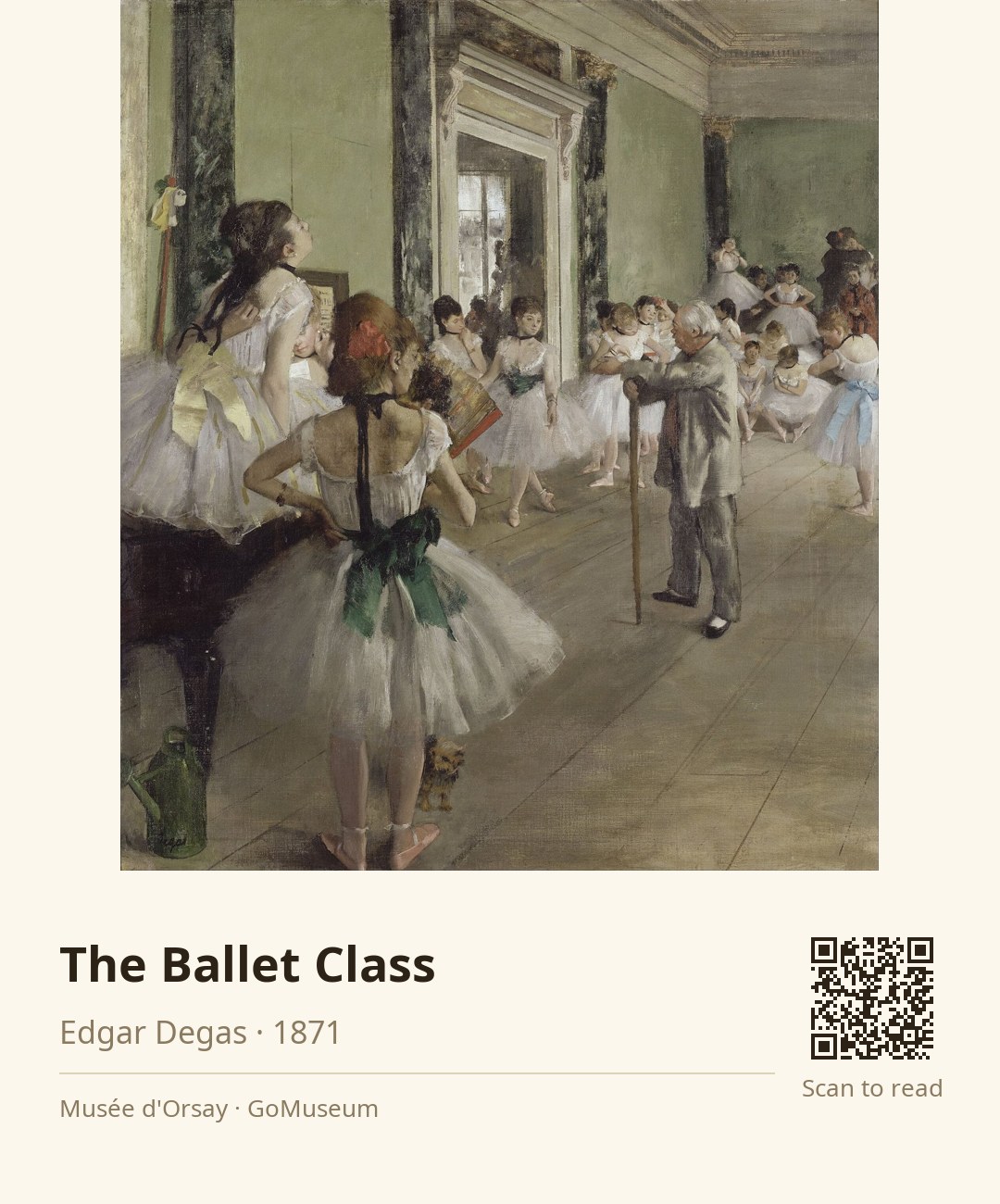
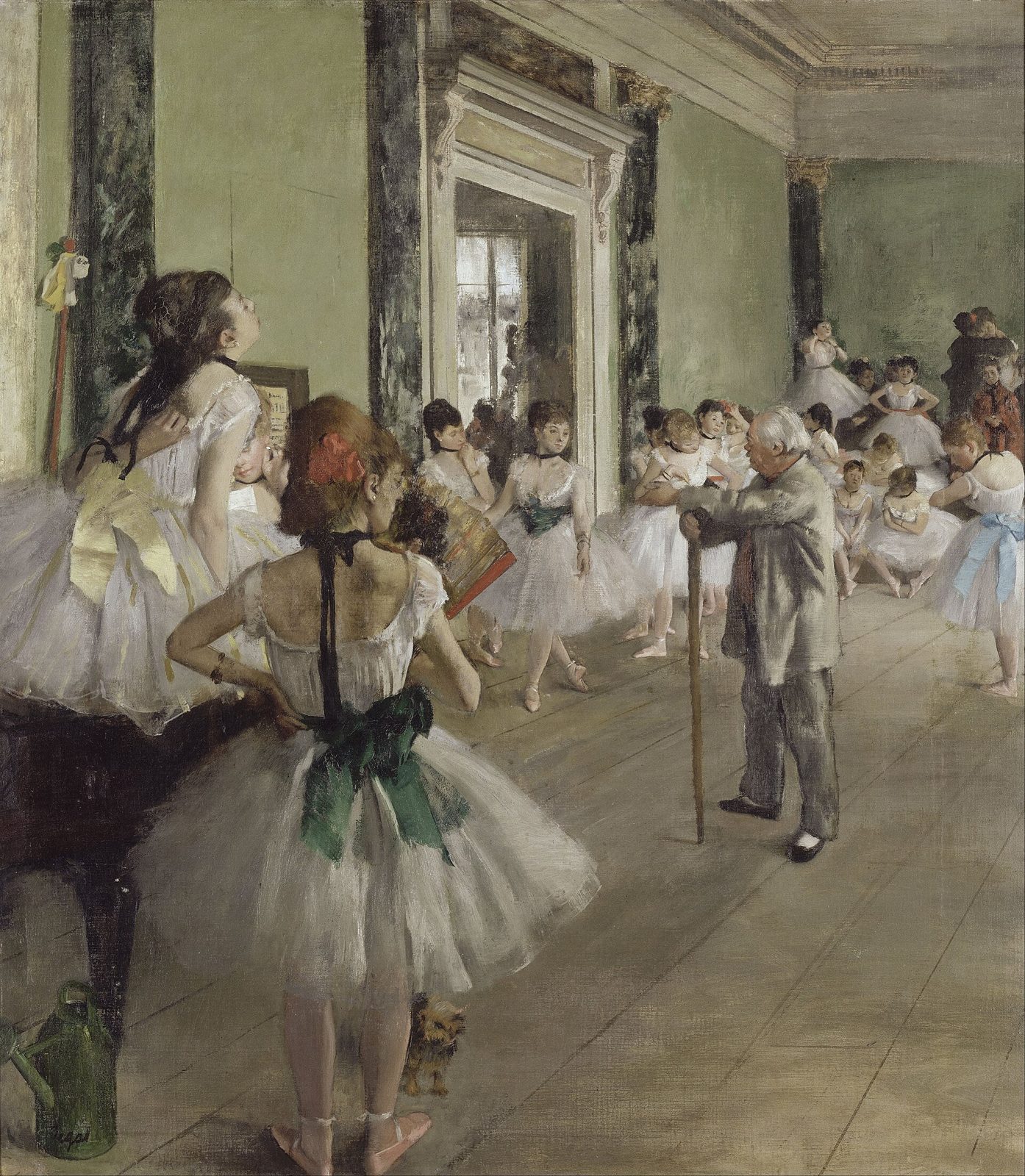
🎧 This work has audio narration — listen in the appTake a moment to really absorb the scene in front of you. Edgar Degas’s "The Ballet Class" captures a fleeting moment in the world of ballet, where the elegance of dance meets the reality of rigorous training. Look closely at the silver-haired teacher, Jules Perrot, at the center. Notice how his critical gaze is fixed on the ballerina in the foreground, her posture a blend of grace and tension. These details matter because they reveal the duality of ballet: the beauty of performance intertwined with the discipline of practice. Degas was fascinated by this contrast, often portraying dancers not just in their moments of glory but in the raw, unfiltered reality of their training. The way the dancers are arranged—some stretching, others chatting—adds a layer of intimacy, inviting you into their world, where every gesture tells a story of hard work and aspiration. Created between 1874 and 1876, this painting reflects a pivotal time in ballet’s evolution at the Paris Opéra, where the status of dancers was shifting. Degas, who frequented the opera, was drawn to the behind-the-scenes life of these performers, capturing their struggles and triumphs with a keen eye. As you stand here, consider what it means to pursue perfection in any art form. What do you think these dancers are feeling at the end of their lesson? Are they exhausted, or are they dreaming of the stage? Let that question linger as you take in the scene.
Edgar Degas, born on July 19, 1834, in Paris, was a pivotal figure in the Impressionist movement, though he preferred to be labeled a realist. Known for his exceptional skill in drawing, Degas focused on capturing movement, particularly in his depictions of dancers, which constitute over half of his oeuvre. His works also include racehorses and portraits that reveal psychological depth and human isolation.
Degas came from a cultured, affluent family; his mother was a Creole from New Orleans, and his father was a banker. After his mother's death, he pursued art against his father's wishes, studying at the École des Beaux-Arts and drawing inspiration from classical masters during his time in Italy. His early ambition to be a history painter shifted as he embraced contemporary subjects, influenced by artists like Édouard Manet.
Despite being a founding member of the Impressionists, Degas's approach diverged from his peers, as he often worked in his studio rather than en plein air. His innovative techniques and themes sparked debate among critics and continue to influence art history today. Degas passed away on September 27, 1917, leaving behind a legacy that challenges traditional boundaries in art.
Commissioned by composer Jean-Baptiste Faure, the painting was first exhibited at the Twelfth Exhibition of Modern French Artists in London in 1876. Degas, a frequent visitor to the opera, was captivated by the dancers' lives, capturing their struggles and aspirations. The painting's provenance includes notable figures like the art dealer Manzi Michel and the Count Isaac Camondo. By 1911, it found a permanent home at the Musée d'Orsay in Paris, where it continues to draw audiences into the world of ballet.
In 'The Ballet Class,' Degas employs a masterful technique that combines oil paint with layered brushwork to create a sense of depth and movement. Notice the way he captures light, particularly on the silver-haired teacher's flannel suit, where the red reflections suggest a play of light that adds warmth to his stern demeanor. The composition is innovative, featuring an oblique wall that draws your eye across the scene, while the dancers are arranged in a loose, dynamic formation that conveys both intimacy and chaos. Degas's choice to depict the dancers in candid moments—some stretching, others chatting—highlights the reality of their training, contrasting with the idealized performances often celebrated in ballet. This blend of observation and imagination gives the painting its unique emotional resonance.
One intriguing detail about 'The Ballet Class' is that Degas originally painted a different male teacher before replacing him with Jules Perrot. This change reflects Degas's meticulous process, as he often adjusted his compositions based on his observations and interactions with his subjects, ensuring that the final work resonated with authenticity.
Degas initially painted a different male teacher before replacing him with Jules Perrot, showcasing his meticulous approach to capturing the essence of his subjects.
Degas had a deep sympathy for dancers, stemming from his understanding of their rigorous training, which he often depicted as exhausting and filled with moments of candid reality.
The painting features intriguing details like 'stage mothers' watching from the back wall, a can of water for dampening the floor, and a little dog, all of which add layers of narrative to the scene.