The Checkered Blouse
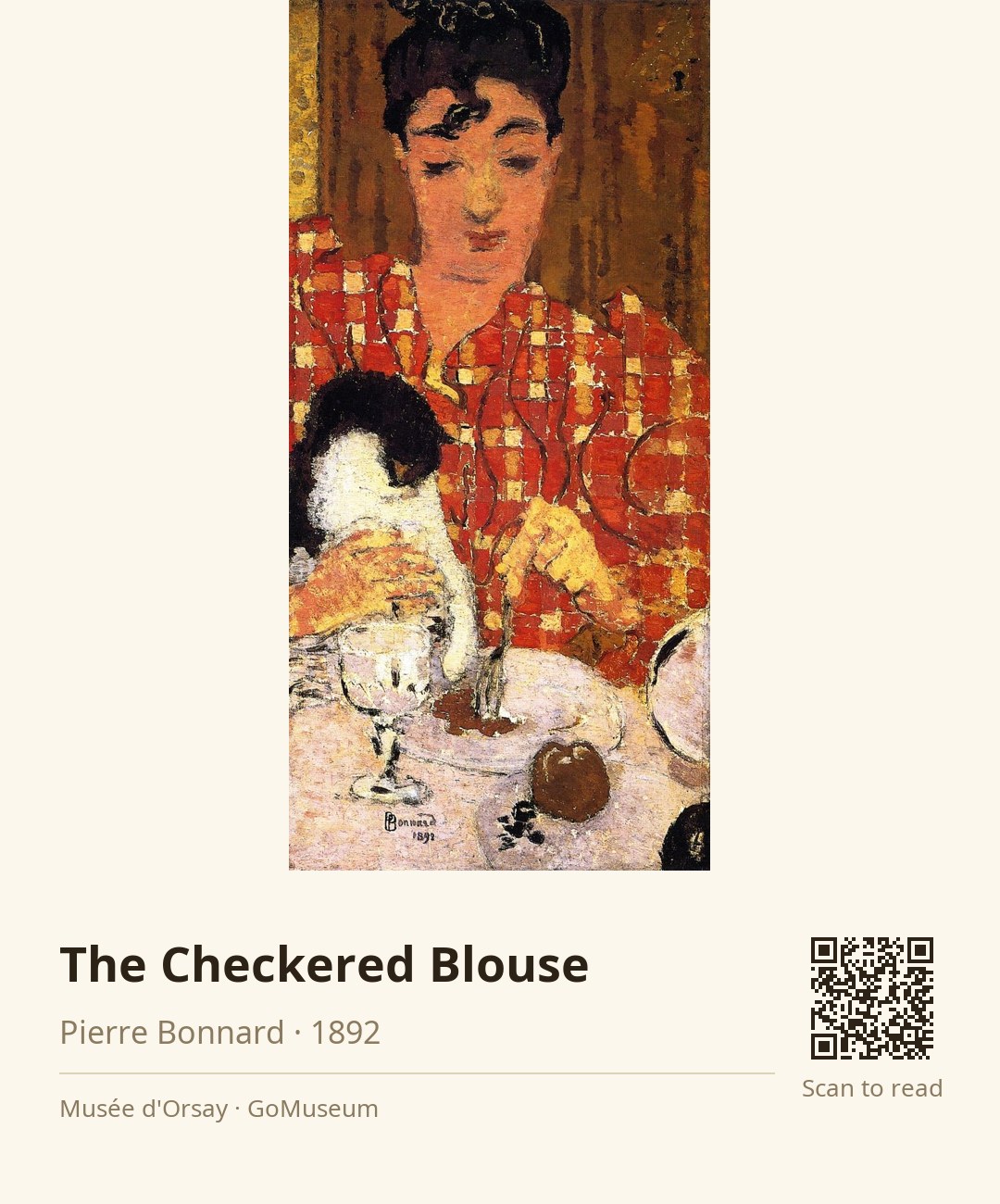
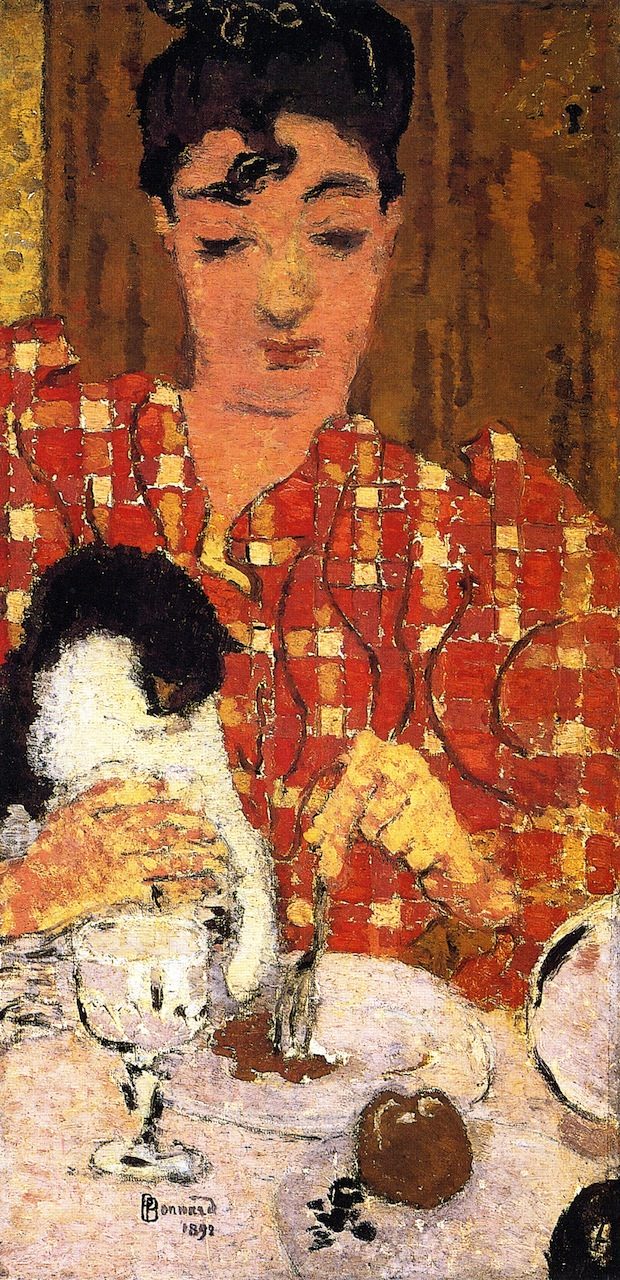
🎧 This work has audio narration — listen in the appThe woman in the red and white checkered blouse captures a moment of domestic tranquility, her dark hair styled elegantly as she cradles a small black and white dog in her left arm. The table before her is adorned with a glass and a piece of fruit, hinting at a simple yet intimate meal, while her right hand holds a fork poised over a plate, suggesting a pause in her dining experience.
This scene reflects Bonnard's fascination with everyday life, where the vibrancy of her clothing contrasts beautifully with the warm, textured brown background. The loose brushwork adds a sense of immediacy, inviting viewers into a snapshot of a serene moment. The checkered pattern of her blouse, a nod to Japanese influences, showcases Bonnard's ability to blend color and form, emphasizing the decorative qualities that define his work.
Created in 1892, "The Checkered Blouse" is a portrait of Andrée Terrasse, the artist's sister-in-law, and exemplifies Bonnard's transition from Impressionism to a more modern approach, where the essence of the subject often takes precedence over strict representation. This painting is part of the rich tapestry of Bonnard's exploration of domesticity and intimacy, themes that would resonate throughout his career.
Pierre Bonnard was a French painter born on October 3, 1867, in Fontenay-aux-Roses. A founding member of the Post-Impressionist group Les Nabis, he was known for his vibrant colors and decorative style. His early influences included Paul Gauguin and Japanese art, which shaped his unique approach to painting. Bonnard's work often prioritized color and composition over subject matter, reflecting his belief in the emotional power of art.
Despite initially pursuing a career in law, Bonnard's passion for art led him to study at the Académie Julian and the École des Beaux-Arts, where he formed lasting friendships with fellow artists. His personal life was marked by a long relationship with Marthe de Méligny, who became his muse and model. Bonnard's paintings often depicted intimate domestic scenes, capturing the essence of everyday life with a sense of joy and nostalgia.
Over his prolific career, Bonnard transitioned from Impressionism to a more modern aesthetic, becoming one of the foremost colorists of the 20th century. His legacy endures as he is celebrated for his innovative use of light and color, positioning him as a significant figure in the evolution of modern art. Bonnard passed away on January 23, 1947, leaving behind a rich body of work that continues to inspire.
In this painting, the woman is seated at a table, her vibrant red and white checkered blouse contrasting against a warm, textured brown background. The loose brushwork gives the piece an expressive quality, with visible texture that enhances the immediacy of the scene. The small black and white dog cradled in her left arm adds a layer of intimacy, while her poised fork suggests a moment frozen in time. The table is adorned with a glass and a piece of fruit, contributing to the domestic atmosphere.
Japanese art significantly influenced Bonnard's style, particularly in his use of bold geometric patterns and color blending, as seen in the checkered pattern of the blouse worn by the woman in this painting.
The major exposition of works by Utamaro and Hiroshige in 1893 at the Durand-Ruel Gallery marked the beginning of Japanese influence on Bonnard's work, leading him to incorporate multiple perspectives and bold patterns.