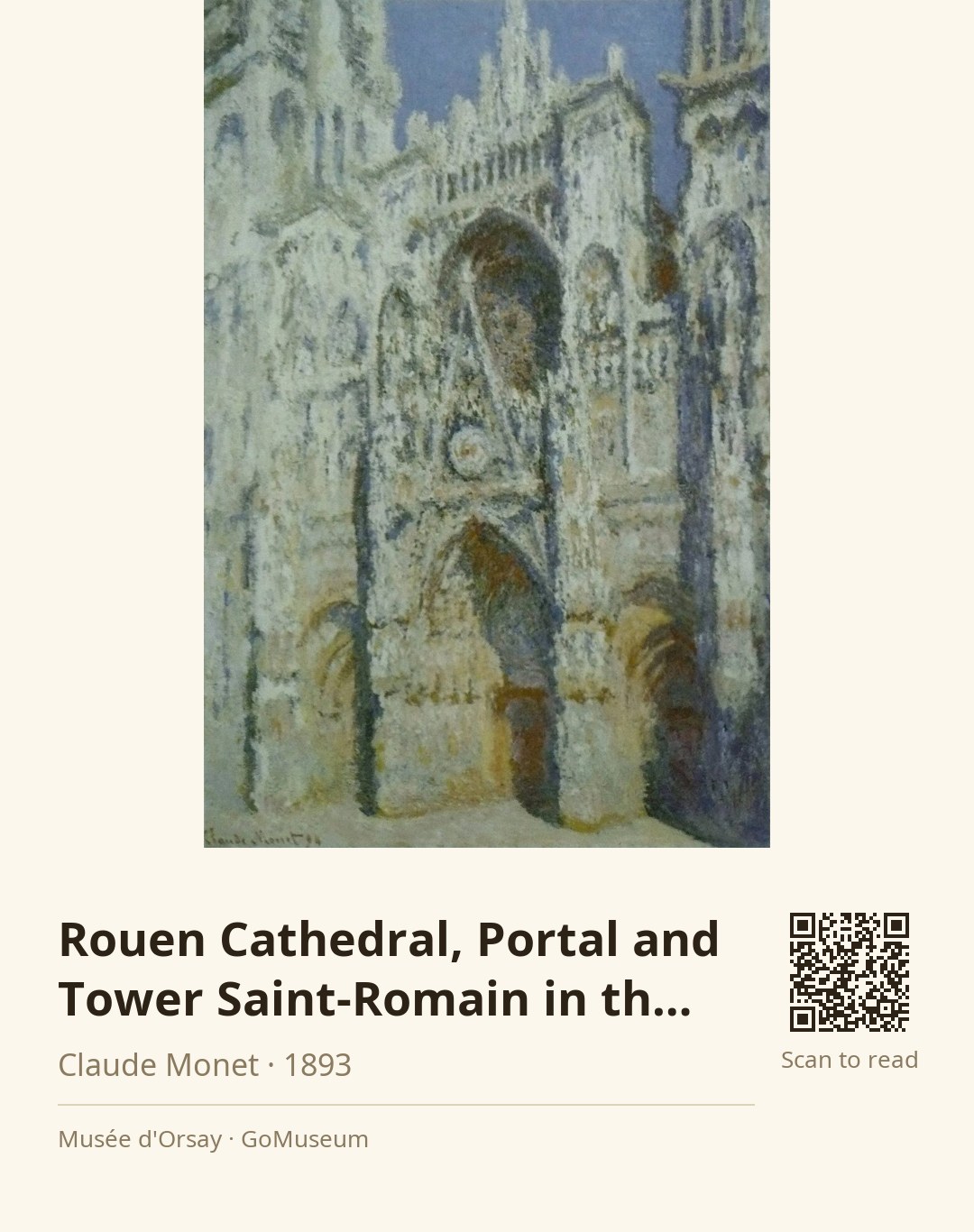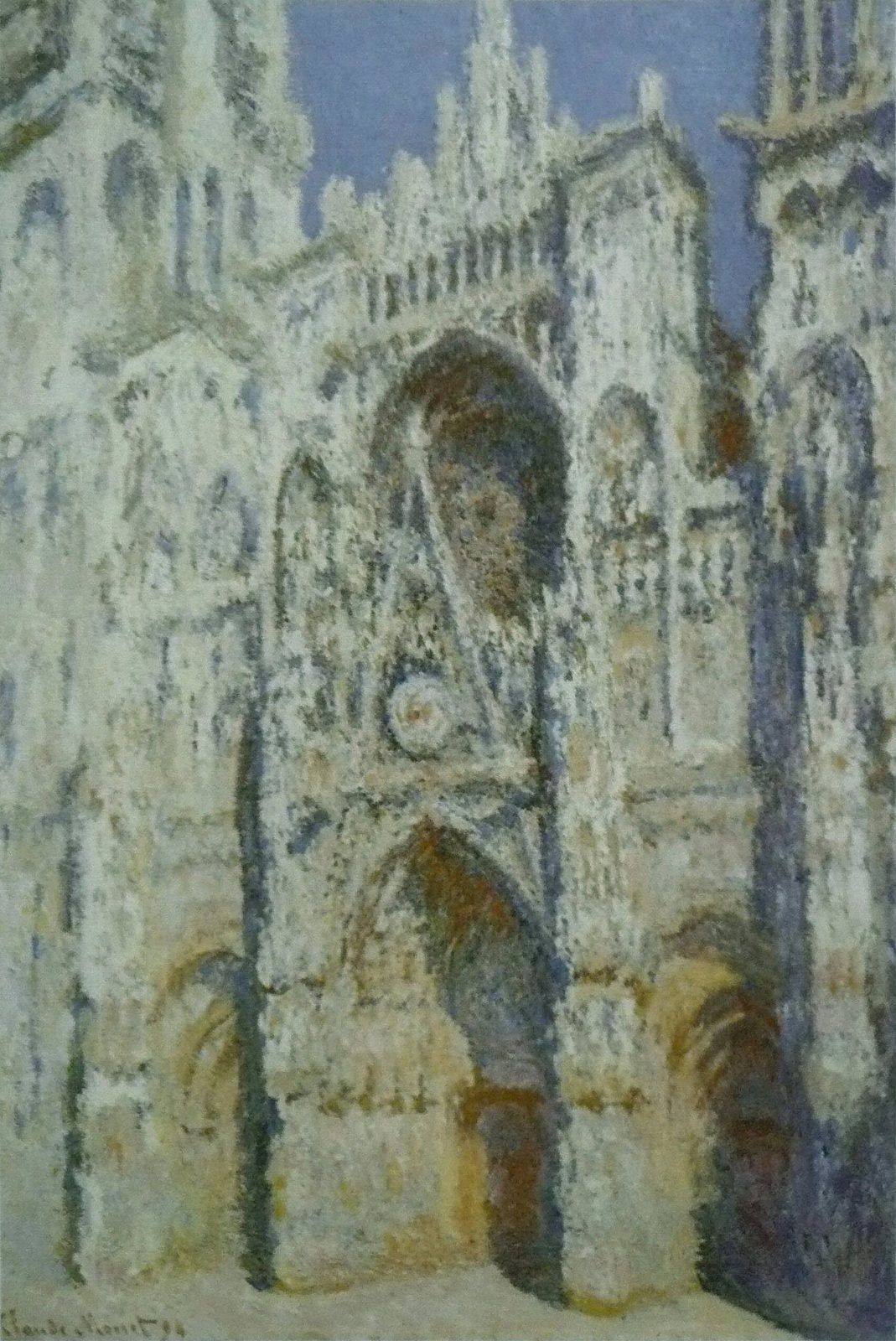
Rouen Cathedral, Portal and Tower Saint-Romain in the Sun
🎧 This work has audio narration — listen in the appThe sun casts a warm glow on the intricate facade of Rouen Cathedral, highlighting the ornate details of the central portal and the towering spire of Saint-Romain. The soft light creates a delicate interplay of muted blues, grays, and creams, punctuated by warm earth tones that breathe life into the stone structure. Monet’s loose brushwork captures the atmospheric effects of sunlight, transforming the cathedral into a shimmering vision of ethereal beauty.
This painting exemplifies Monet's fascination with light and its ability to alter perception, as he sought to convey the fleeting moments of a specific time of day. The Gothic architecture, with its pointed arches and elaborate carvings, stands as a testament to the grandeur of the past, while Monet's impressionistic style allows for a personal interpretation of the scene. His approach emphasizes the transient nature of light, reflecting his broader artistic philosophy of capturing the essence of a moment rather than a detailed representation.
Created in 1893, this work is part of Monet's series on Rouen Cathedral, where he painted the same subject multiple times to explore the changing effects of light and atmosphere throughout the day. Monet's dedication to this series showcases his innovative spirit and his pivotal role in the development of Impressionism.
Oscar-Claude Monet, born on November 14, 1840, in Paris, was a pioneering French painter and a founder of Impressionism, a movement that transformed the art world. Raised in Le Havre, he developed a passion for nature and painting early on, encouraged by his mother, while his father hoped he would pursue a business career. After his mother's death in 1857, Monet moved in with his aunt, who supported his artistic ambitions.
Monet's career began with caricatures, but he soon sought formal training, studying under Eugène Boudin, who introduced him to plein air painting. His breakthrough came in 1866 with "La Femme à la robe verte," which garnered attention at the Salon. The term "Impressionism" originated from his work "Impression, Sunrise," exhibited in 1874, marking a shift away from traditional art.
Throughout his life, Monet focused on capturing the essence of light and color in nature, creating series of paintings that depicted the same scenes under varying conditions, such as his famous haystacks and water lilies. He settled in Giverny in 1883, where he cultivated a beautiful garden that became his muse. Despite personal hardships, including the loss of loved ones and health issues, Monet's relentless dedication to his craft solidified his place in art history as a master of modernism, influencing countless artists and leaving a lasting legacy. He died on December 5, 1926, in Giverny, celebrated as one of the most significant figures in art.
The painting first graced the walls of the Durand-Ruel Gallery in Paris in 1895, where it was met with a mix of admiration and confusion, typical of the Impressionist movement's early reception. Monet's work was often misunderstood, but it gradually gained recognition, leading to its inclusion in prestigious collections. The painting's provenance traces back to Monet's own collection before passing to Isaac Camondo, a notable patron of the arts, highlighting its journey through the hands of art lovers and collectors. This piece remains a testament to Monet's innovative approach to capturing the essence of a moment in time.
In 'Rouen Cathedral, Portal and Tower Saint-Romain in the Sun', Monet employs a technique that emphasizes the fluidity of light and color. The loose brushwork creates a sense of movement, almost as if the cathedral is alive and breathing under the sun's rays. The oil paint is layered thickly in some areas, allowing for texture that enhances the play of light across the intricate stonework. Monet's choice of a muted palette, dominated by soft blues and warm earth tones, evokes a serene atmosphere, inviting viewers to feel the warmth of the sunlight. The composition draws the eye to the central portal, framed by the towering spire, creating a focal point that captures the grandeur of Gothic architecture. This approach not only showcases his mastery of color but also reflects his desire to convey the ephemeral nature of light, transforming a static structure into a dynamic experience.