L'Orchestre de l'Opéra
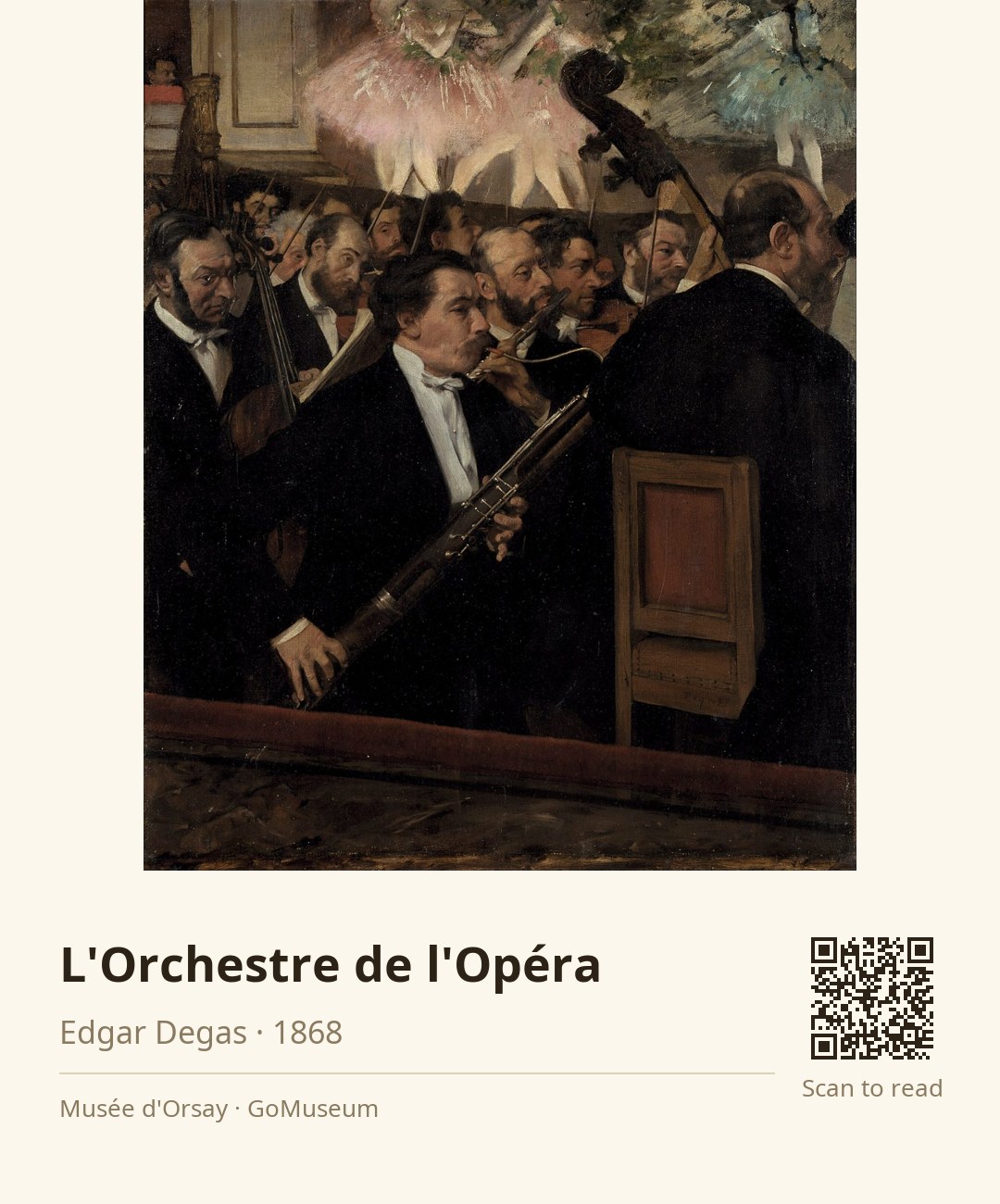
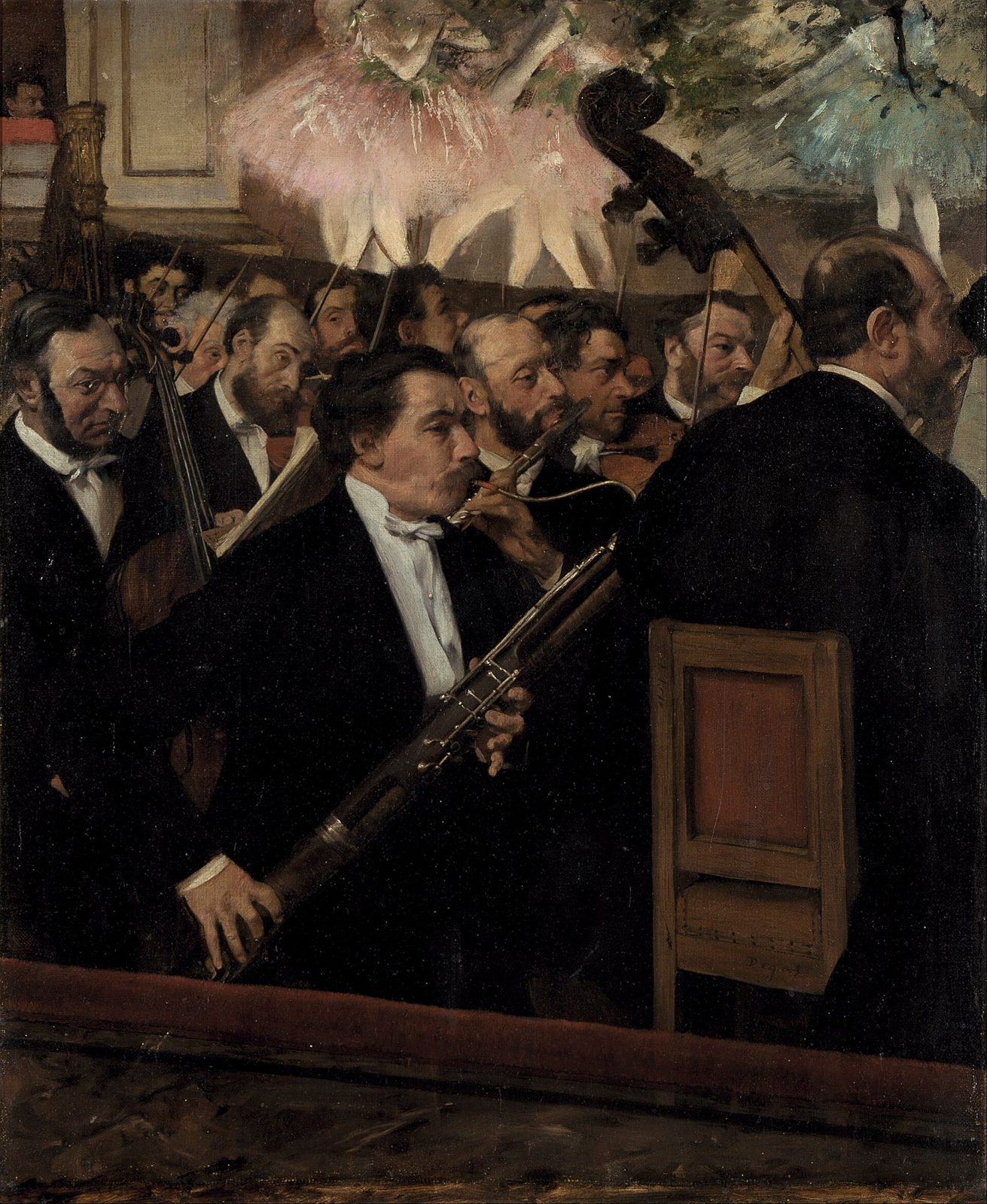
🎧 This work has audio narration — listen in the appTake a moment to really soak in Edgar Degas’ "L'Orchestre de l'Opéra." Look closely at the musicians in the orchestra pit—notice how they seem to blend into their surroundings, yet each one is distinct, almost alive. Focus on the bassoonist, Désiré Dihau, who’s caught mid-performance, his fingers poised over the keys, lost in the music.
By placing Dihau at the forefront, Degas invites us into the intimate world of the orchestra, blurring the lines between portraiture and genre painting. You can almost hear the notes floating through the air, can’t you?
Here, he’s not just depicting a scene; he’s creating a narrative that pulls you into the experience of a night at the opera, a moment shared among friends and fellow artists.
As you stand here, think about the energy in this room—the camaraderie of musicians, the anticipation of the audience, and the fleeting beauty of performance. What do you think Degas was trying to convey about the relationship between the musicians and the dancers above them?
Edgar Degas, born on July 19, 1834, in Paris, was a pivotal figure in the Impressionist movement, though he preferred to be labeled a realist. Known for his exceptional skill in drawing, Degas focused on capturing movement, particularly in his depictions of dancers, which constitute over half of his oeuvre. His works also include racehorses and portraits that reveal psychological depth and human isolation.
Degas came from a cultured, affluent family; his mother was a Creole from New Orleans, and his father was a banker. After his mother's death, he pursued art against his father's wishes, studying at the École des Beaux-Arts and drawing inspiration from classical masters during his time in Italy. His early ambition to be a history painter shifted as he embraced contemporary subjects, influenced by artists like Édouard Manet.
Despite being a founding member of the Impressionists, Degas's approach diverged from his peers, as he often worked in his studio rather than en plein air. His innovative techniques and themes sparked debate among critics and continue to influence art history today. Degas passed away on September 27, 1917, leaving behind a legacy that challenges traditional boundaries in art.
This piece was first exhibited at the Salon des artistes français in Paris in 1870. Interestingly, it was shown without any further retouching, which impressed Degas' family, who had been skeptical about his artistic talents. They remarked that it was thanks to Dihau that Degas had finally completed a true painting. The work captures musicians in the orchestra pit of the Salle Le Peletier, the Paris Opera's home until it burned down in 1873. Degas' choice to depict his friends in this setting blurred the lines between portraiture and genre painting, marking a pivotal moment in his artistic journey.
In 'L'Orchestre de l'Opéra,' Degas employs a dynamic composition that draws the viewer's eye across the canvas. Notice how the bassoonist, Dihau, is positioned prominently in the foreground, his fingers poised mid-performance, while the other musicians recede into the background. This choice creates a sense of depth and perspective, inviting you to feel as if you're part of the audience. The brushwork is both delicate and assertive, capturing the fluidity of movement and the energy of the performance. The color palette is rich yet subdued, with warm tones that evoke the intimate atmosphere of the opera house. Degas' technique of cropping the dancers' legs and tutus at the top adds a layer of intrigue, suggesting a world just beyond the frame, while also emphasizing the musicians' role in the performance. This interplay of light and shadow enhances the emotional resonance of the scene, making it feel alive.
One surprising aspect of 'L'Orchestre de l'Opéra' is that Degas took liberties with the arrangement of the musicians. In reality, the bassoonist would have been positioned at the back of the orchestra, but Degas placed him in the foreground to highlight his friend and create a more engaging composition. This artistic choice reflects Degas' desire to prioritize emotional impact over strict realism, showcasing his innovative approach to painting.
Degas took creative liberties by placing the bassoonist, Désiré Dihau, in the foreground, even though he would have been positioned at the back in reality. This choice not only highlights his friend but also enhances the overall composition, emphasizing emotional impact over strict realism.
In addition to Dihau, the painting features several of Degas' friends, including the tenor Lorenzo Pagans and the painter Alexandre Piot-Normand, showcasing a blend of professional musicians and artists in the orchestra pit.
Degas' family, who had previously doubted his artistic abilities, were impressed by the painting when it was exhibited in Lille, remarking that it was thanks to Dihau that he had finally produced a true work of art.