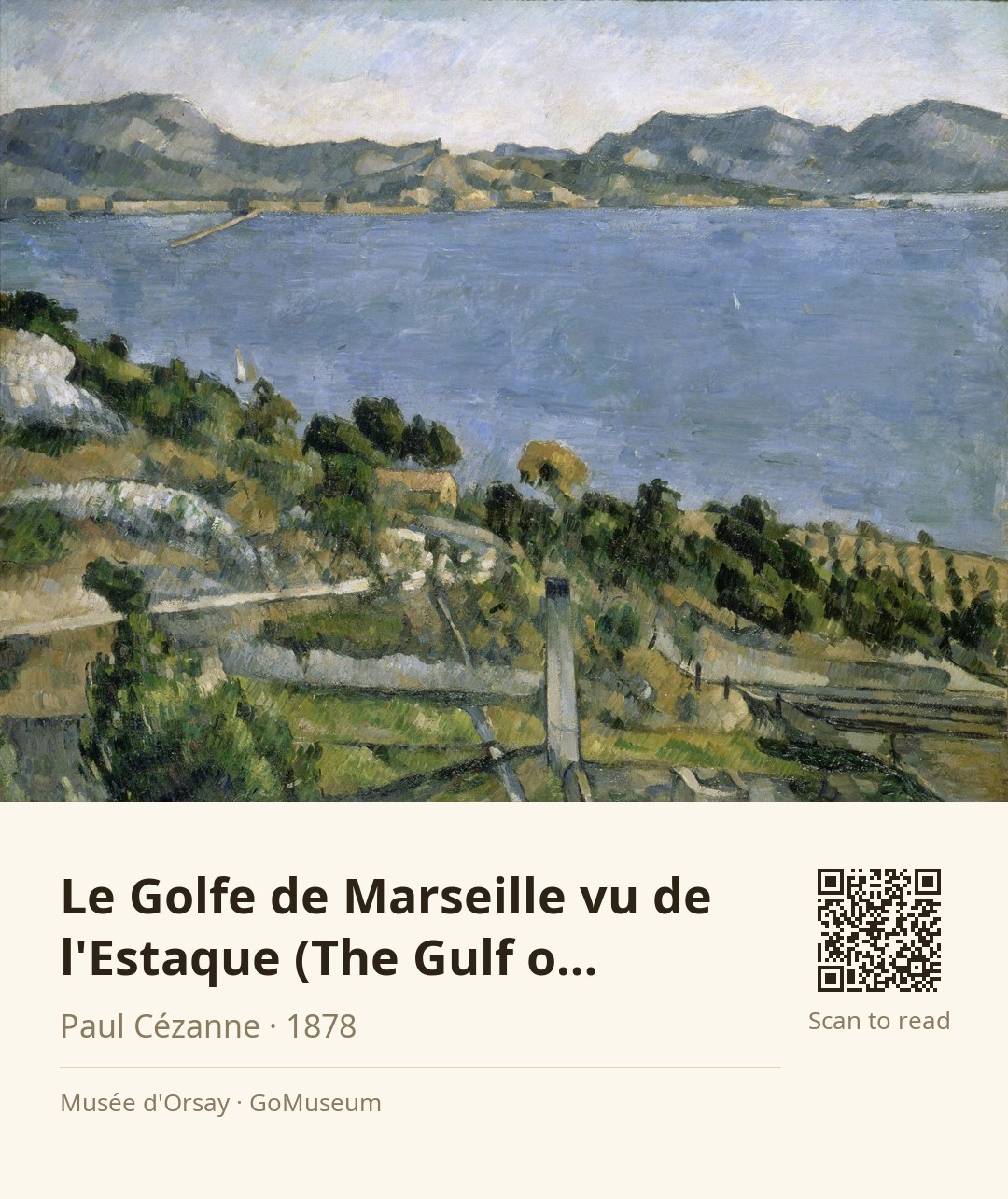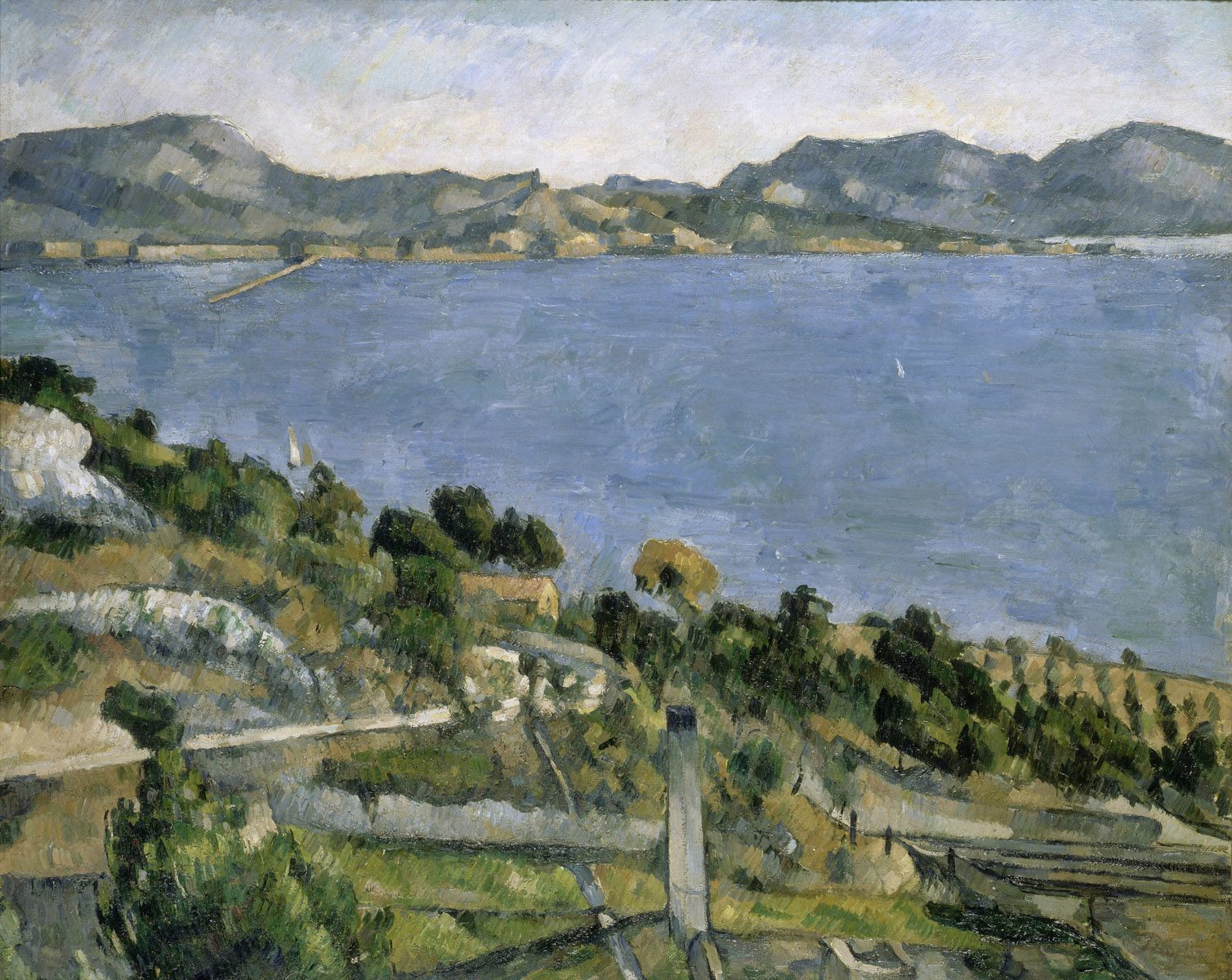
Le Golfe de Marseille vu de l'Estaque (The Gulf of Marseille Seen from L'Estaque)
🎧 This work has audio narration — listen in the appThe small sailboat gliding across the tranquil waters of the Gulf of Marseille is a striking focal point in Paul Cézanne's "Le Golfe de Marseille vu de l'Estaque." Surrounding it, rolling hills and rocky outcrops create a textured foreground, while the muted blues and grays of the distant mountains suggest a serene, sunlit day. The loose brushwork invites a sense of movement, capturing the essence of the Mediterranean landscape.
Cézanne's approach to this scene reflects his innovative exploration of color and form, bridging the gap between Impressionism and the emerging Cubist movement. The harmony between land and water in this composition emphasizes the natural beauty of L'Estaque, a place he frequently painted. His technique, characterized by repetitive brushstrokes and a focus on the underlying structure of the landscape, reveals his deep engagement with the subject matter.
Created in 1878, this painting showcases Cézanne's evolving style during a period when he was still seeking recognition in the art world. It was later acquired by Gustave Caillebotte, a fellow artist and collector who appreciated Cézanne's unique vision.
Paul Cézanne was a French Post-Impressionist painter born on January 19, 1839, in Aix-en-Provence. His innovative approach to color and form bridged the gap between Impressionism and the emerging Cubism of the early 20th century. Initially influenced by Romanticism and Realism, Cézanne developed a unique style that emphasized the underlying structure of objects, using repetitive brushstrokes and planes of color to create depth and complexity in his work.
Despite facing ridicule and misunderstanding from critics during his early career, Cézanne garnered support from fellow artists like Camille Pissarro and the art dealer Ambroise Vollard, who recognized his talent. His first solo exhibition in 1895 marked a turning point, leading to greater appreciation of his contributions to art. Cézanne's legacy is profound; both Henri Matisse and Pablo Picasso acknowledged him as a foundational figure in modern art, dubbing him "the father of us all." He passed away on October 22, 1906, leaving behind a transformative body of work that continues to influence artists today.
Paul Cézanne's "Le Golfe de Marseille vu de l'Estaque" was painted in 1878, during a pivotal time in his artistic journey. This work was created when Cézanne was still striving for recognition, often facing criticism and misunderstanding from the art community. The painting was later acquired by Gustave Caillebotte, a fellow artist and collector who recognized Cézanne's unique vision and potential. Caillebotte's support was crucial, as he was one of the few who appreciated the artist's innovative approach. The painting eventually found its way into various collections, contributing to the growing appreciation of Cézanne's work, particularly in the late 19th century, when his style began to gain traction among avant-garde circles. It is now part of a prestigious collection, showcasing the evolution of landscape painting and Cézanne's influence on future generations of artists.
Cézanne's technique in "Le Golfe de Marseille vu de l'Estaque" is a masterclass in the use of oil paint on canvas. His brushwork is notably loose and textured, which creates a dynamic sense of movement across the tranquil waters and rolling hills. The repetitive brushstrokes build layers of color, giving depth and vibrancy to the landscape. Cézanne's choice of muted blues and grays for the distant mountains not only suggests atmospheric perspective but also evokes a serene mood. The composition is carefully balanced, with the sailboat providing a focal point that draws the viewer's eye across the canvas. This harmony between land and water reflects Cézanne's deep engagement with the natural world, as he sought to capture not just the scene, but the very essence of the Mediterranean landscape.
During his lifetime, many critics did not understand Cézanne's style and often ridiculed his work.
Cézanne's brushwork is characterized by repetitive and exploratory strokes, which contribute to the unique texture and depth of his paintings.