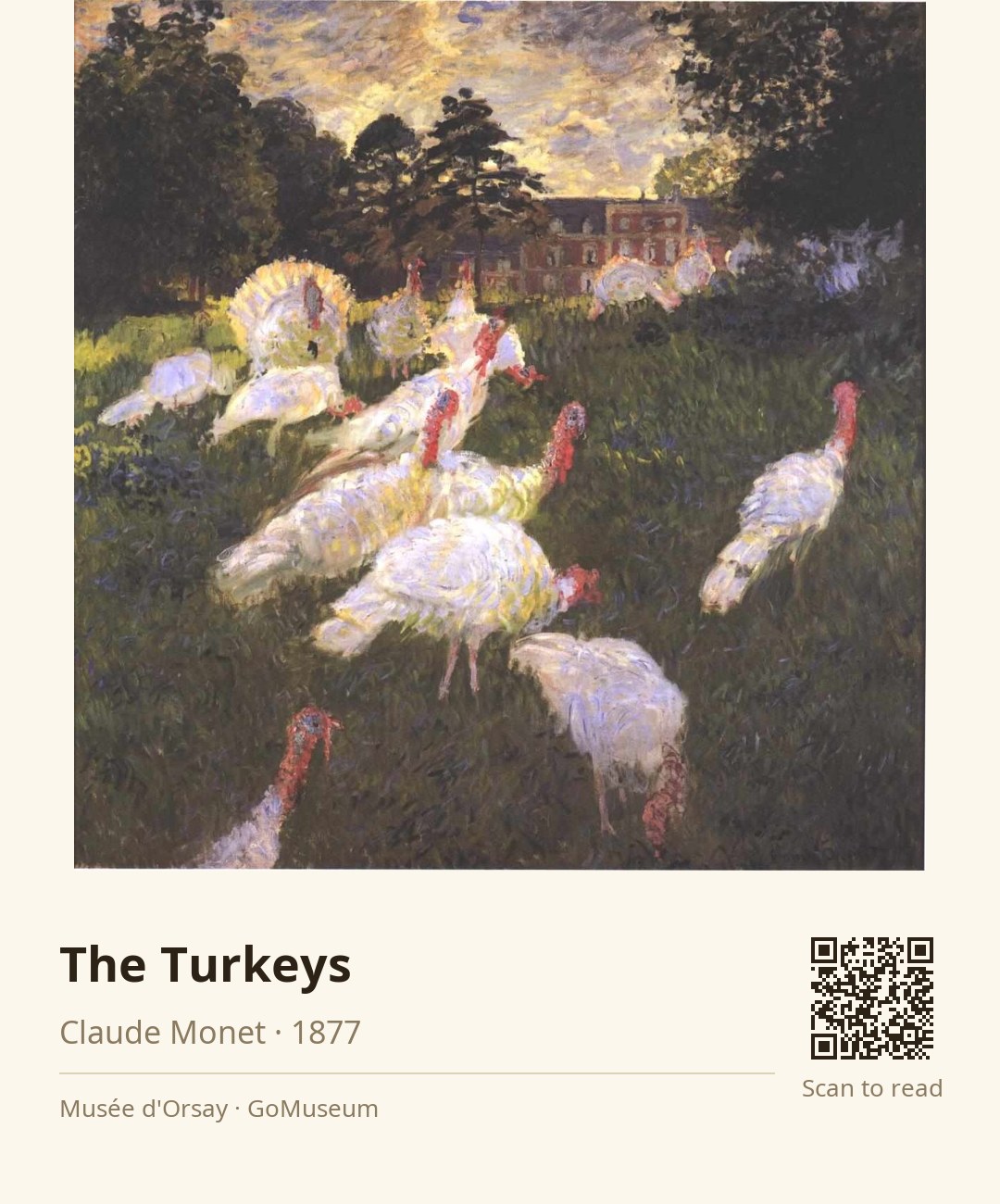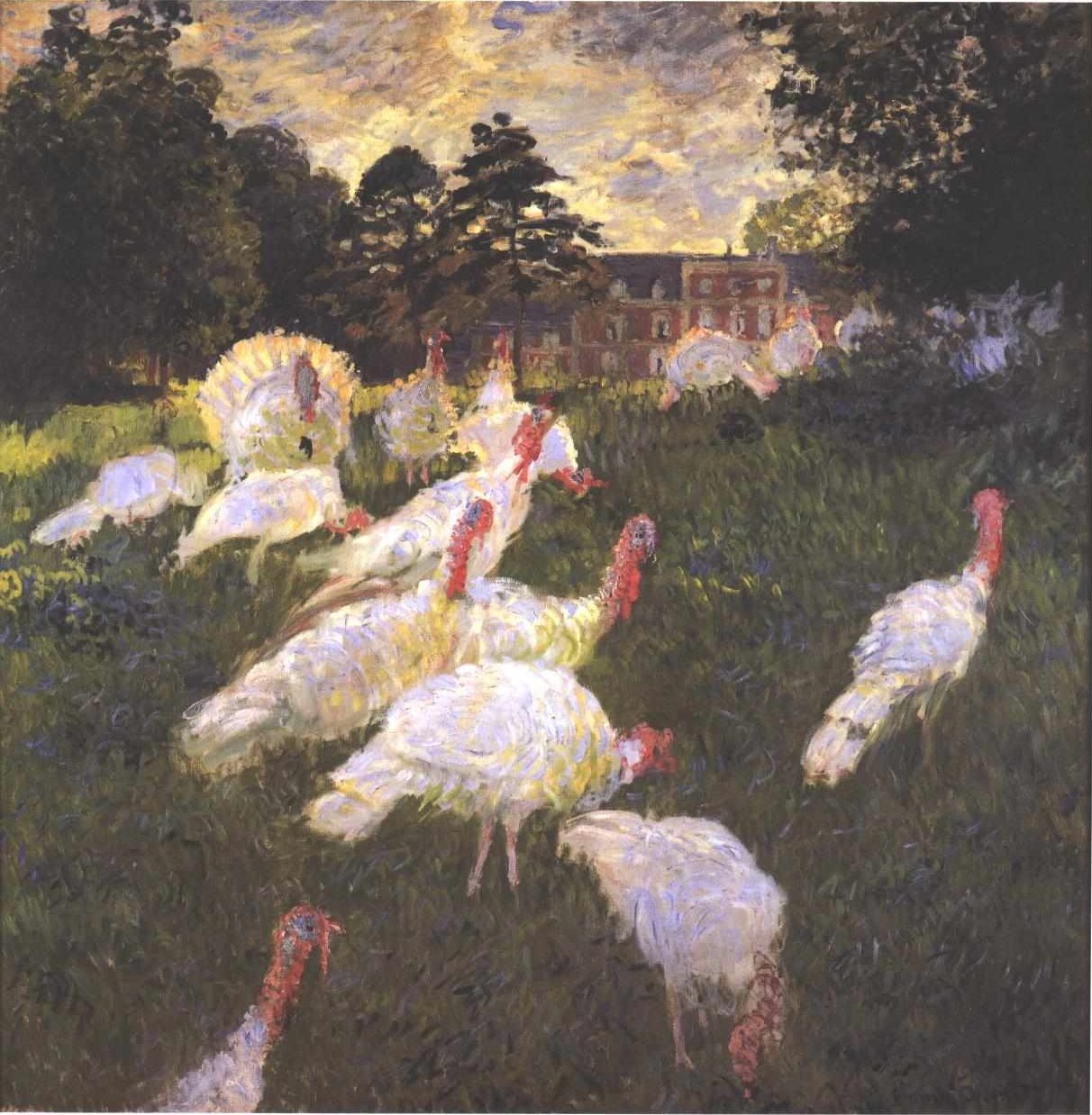
Take a moment to really look at “The Turkeys” by Claude Monet. Notice how the vibrant colors dance across the canvas, especially the rich greens of the grass and the warm browns of the turkeys. One turkey is even partially cropped, its neck extending just beyond the edge, creating a sense of movement and life that pulls you into the scene. These details matter because they reflect Monet's innovative approach to capturing nature. Instead of a static portrayal, he invites you into a lively moment, showcasing the beauty of everyday life in 19th-century France. This painting was part of a series created during a pivotal time in Monet's career, commissioned for the grand salon of a château, where it was meant to bring the outdoors in. Monet painted this in 1877, during a time when he was exploring new techniques and ideas, laying the groundwork for his later masterpieces. As you stand here, consider how this piece captures not just the turkeys, but a fleeting moment in time, a snapshot of nature’s beauty that Monet was so passionate about. What do you think Monet was trying to express about the relationship between humans and nature through these turkeys?
Oscar-Claude Monet, born on November 14, 1840, in Paris, was a pioneering French painter and a founder of Impressionism, a movement that transformed the art world. Raised in Le Havre, he developed a passion for nature and painting early on, encouraged by his mother, while his father hoped he would pursue a business career. After his mother's death in 1857, Monet moved in with his aunt, who supported his artistic ambitions.
Monet's career began with caricatures, but he soon sought formal training, studying under Eugène Boudin, who introduced him to plein air painting. His breakthrough came in 1866 with "La Femme à la robe verte," which garnered attention at the Salon. The term "Impressionism" originated from his work "Impression, Sunrise," exhibited in 1874, marking a shift away from traditional art.
Throughout his life, Monet focused on capturing the essence of light and color in nature, creating series of paintings that depicted the same scenes under varying conditions, such as his famous haystacks and water lilies. He settled in Giverny in 1883, where he cultivated a beautiful garden that became his muse. Despite personal hardships, including the loss of loved ones and health issues, Monet's relentless dedication to his craft solidified his place in art history as a master of modernism, influencing countless artists and leaving a lasting legacy. He died on December 5, 1926, in Giverny, celebrated as one of the most significant figures in art.
In 1877, Claude Monet created 'The Turkeys' as part of a monumental series of four large paintings commissioned by his friend and patron, Ernest Hoschedé. These works were intended to adorn the grand salon of the Château de Rottembourg, a picturesque estate that Hoschedé owned. However, just a year later, Hoschedé faced financial ruin and had to sell his possessions, including these paintings, without ever seeing them displayed in their intended setting. This period was significant for Monet, as it was during his time at Montgeron that he also met Alice, who would later become his second wife. The painting debuted at the Third Impressionist Exhibition in Paris in 1877, where it was part of a bold new movement that challenged traditional artistic conventions.
Take a closer look at Monet's brushwork in 'The Turkeys.' The strokes are lively and spontaneous, almost as if he captured the scene in a single breath. Notice how he layers the paint to create texture, particularly in the grass, where the greens feel almost tactile. The way he captures light is masterful; the sunlight dapples through the trees, creating a play of shadows that adds depth to the composition. The turkeys themselves are rendered with a sense of immediacy, their feathers almost vibrating with life. Monet's choice to crop one turkey at the edge of the canvas draws you into the scene, making you feel as if you're part of this vibrant moment in nature. The overall composition is structured yet dynamic, with the château framing the background, anchoring the lively foreground in a serene context. This balance between movement and stillness is what makes the painting so captivating.
Did you know that "The Turkeys" was part of a grand project for a rotunda at the Château de Rottembourg? Monet was invited by his friend and patron, Ernest Hoschedé, to create a series of four large paintings for this space. However, just a year later, Hoschedé faced bankruptcy and had to sell the paintings before they could ever be displayed in their intended home. Imagine the disappointment—Monet had poured his heart into these works, only for them to be separated from their grand setting almost immediately!
The painting was commissioned to decorate the grand salon of the Château de Rottembourg, intended to bring the beauty of the outdoors into the estate's interior. Unfortunately, due to the financial ruin of Monet's patron, Ernest Hoschedé, the painting was never displayed in its intended setting.
During the time he painted 'The Turkeys,' Monet was living in Montgeron, where he met Alice Hoschedé, who would later become his second wife. This period marked a significant transition in his personal life, as he navigated the complexities of love and loss.
After its completion, 'The Turkeys' was exhibited at the Third Impressionist Exhibition in 1877, but it later changed hands multiple times due to the financial difficulties of its original owner, Ernest Hoschedé, and was sold at auction in 1894.