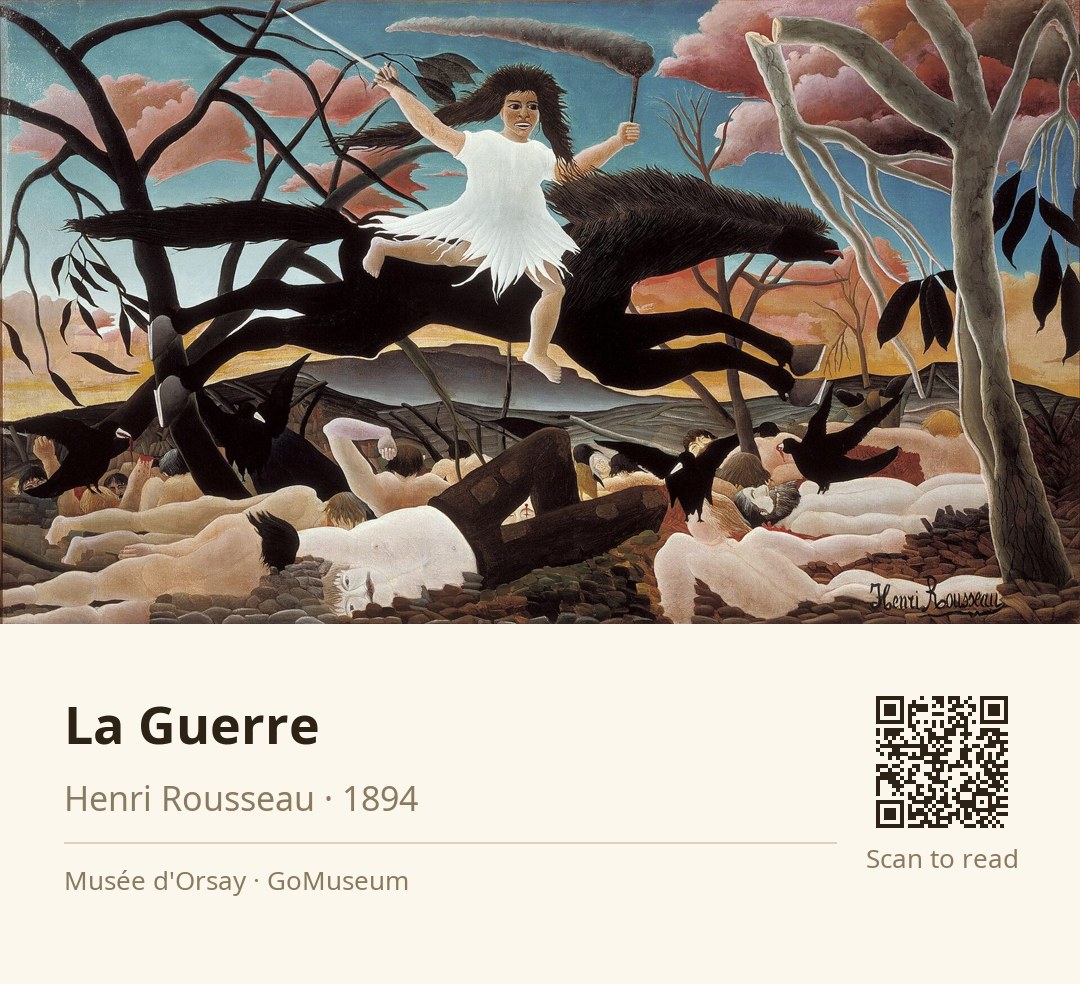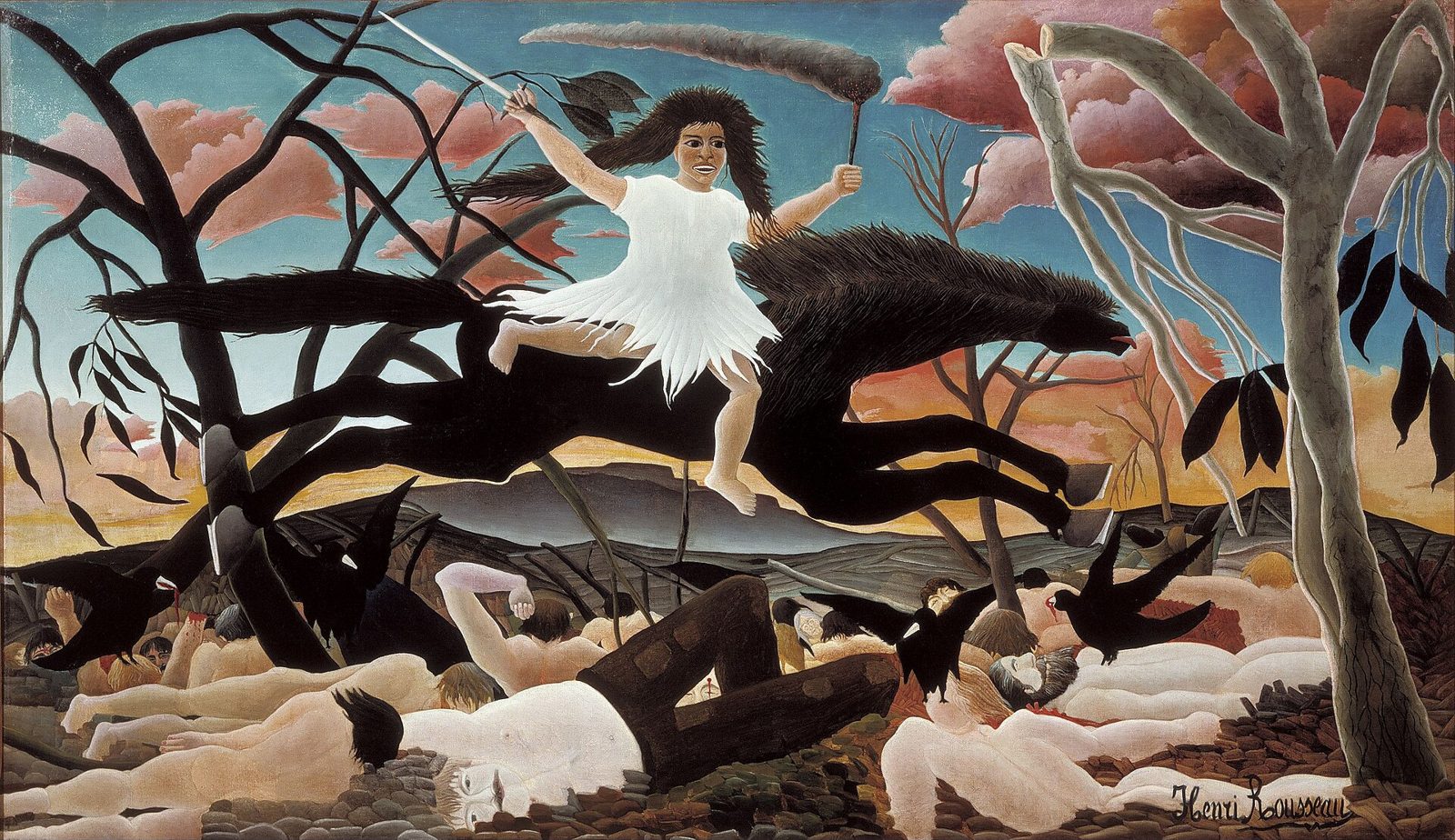
Look closely at Henri Rousseau's "La Guerre." Notice the fierce woman at the center, wielding a sword and a torch, riding a wild, almost monstrous horse. This striking figure embodies the chaos and brutality of war, and her fierce expression suggests a primal force unleashed.
Now, take a moment to observe the stark contrast between her power and the lifeless bodies at the bottom of the canvas, serving as grim reminders of war's consequences. The barren trees and broken branches frame this scene of desolation, while the soft pink clouds above almost mock the violence below. This juxtaposition highlights Rousseau's commentary on the dual nature of war: it is both a spectacle of strength and a source of profound suffering.
Painted in 1894, "La Guerre" emerged in the aftermath of the Franco-Prussian War, a time when Rousseau was deeply affected by the scars of conflict. Despite its initial mixed reception—some found it clumsy while others praised its originality—this painting stands as a testament to Rousseau's unique vision and emotional depth.
As you stand here, consider what this artwork evokes for you. How does it challenge your perception of war? What feelings does it stir within you?
Henri Rousseau, born on May 21, 1844, in Laval, France, was a self-taught painter who became a pivotal figure in the Naïve art movement. Known as "Le Douanier" due to his job as a customs officer, he began painting seriously in his forties after a modest life marked by early hardship and family responsibilities. Despite facing ridicule from critics during his lifetime, Rousseau's unique style, characterized by vivid colors and dreamlike jungle scenes, garnered a devoted following.
His works, inspired by visits to the Natural History Museum and botanical gardens in Paris, often depicted fantastical landscapes, despite his never having traveled outside France. He exhibited regularly at the Salon des indépendants, where his painting "Surprised!" received acclaim from fellow artists, including Félix Vallotton. By the end of his life, Rousseau was celebrated by avant-garde figures like Pablo Picasso, who recognized his genius and honored him with a banquet in 1908.
Rousseau's influence on modern art is profound, impacting generations of artists, including the Surrealists and the Fauves. His legacy endures as a testament to the power of imagination and the beauty of simplicity in art. He passed away on September 2, 1910, in Paris, leaving behind a body of work that continues to inspire and captivate audiences worldwide.
Henri Rousseau's 'La Guerre' was painted in 1894, during a time when the scars of the Franco-Prussian War and the Paris Commune still lingered in the collective memory of France. This painting was exhibited at the Salon des Indépendants the same year, where it sparked a mix of reactions. Some critics dismissed it as clumsy, while others, like the young painter Louis Roy, praised its originality and Rousseau's unique artistic voice. Roy noted that the work was unlike anything seen before, highlighting Rousseau's personal style. The painting has since been part of various exhibitions, including notable ones at the Musée d'Orsay and the Grand Palais, and has been preserved there since 1986.
As you gaze at 'La Guerre,' notice the bold brushwork that captures the chaotic energy of the scene. Rousseau employs a pyramid composition, with the fierce woman and her monstrous horse dominating the upper part of the canvas, while the lifeless bodies lie at the base, creating a stark visual hierarchy. The colors are striking; the soft pink clouds above contrast sharply with the dark, brutal imagery below. This juxtaposition enhances the emotional weight of the painting. Rousseau's technique, often described as naïve, brings a raw, almost childlike quality to the work, yet it is meticulously crafted, revealing his deep understanding of light and shadow. The restless brushwork adds to the sense of turmoil, making the viewer feel the tension inherent in the theme of war.
Painted in 1894, it reflects Rousseau's unique vision and emotional response to the chaos surrounding him, particularly the lingering shadows of the Franco-Prussian War. This painting, with its raw and unrefined style, influenced a generation of avant-garde artists who sought to break free from traditional artistic constraints. Critics initially mocked Rousseau's technique, yet his commitment to personal expression resonated deeply with figures like Picasso and the Fauves, who would later celebrate his originality. Remember this: Rousseau's work not only challenged the norms of his era but also laid the groundwork for future artistic movements, proving that true art comes from the heart, not just the hand.
One surprising tidbit about 'La Guerre' is that when it was first exhibited at the Salon des Indépendants in 1894, it received a mixed reception. Some critics mocked its awkwardness, while others praised its unique style. Young artist Louis Roy even noted that Rousseau's work was refreshingly original, stating it didn't evoke any previously seen ideas. This blend of ridicule and admiration highlights the polarizing nature of Rousseau's art during his lifetime, setting the stage for his later recognition as a self-taught genius.
While many critics dismissed Rousseau's style as clumsy, some, like the young painter Louis Roy, recognized his originality and personal artistic voice, which later influenced the avant-garde movements.