Gabrielle à la rose
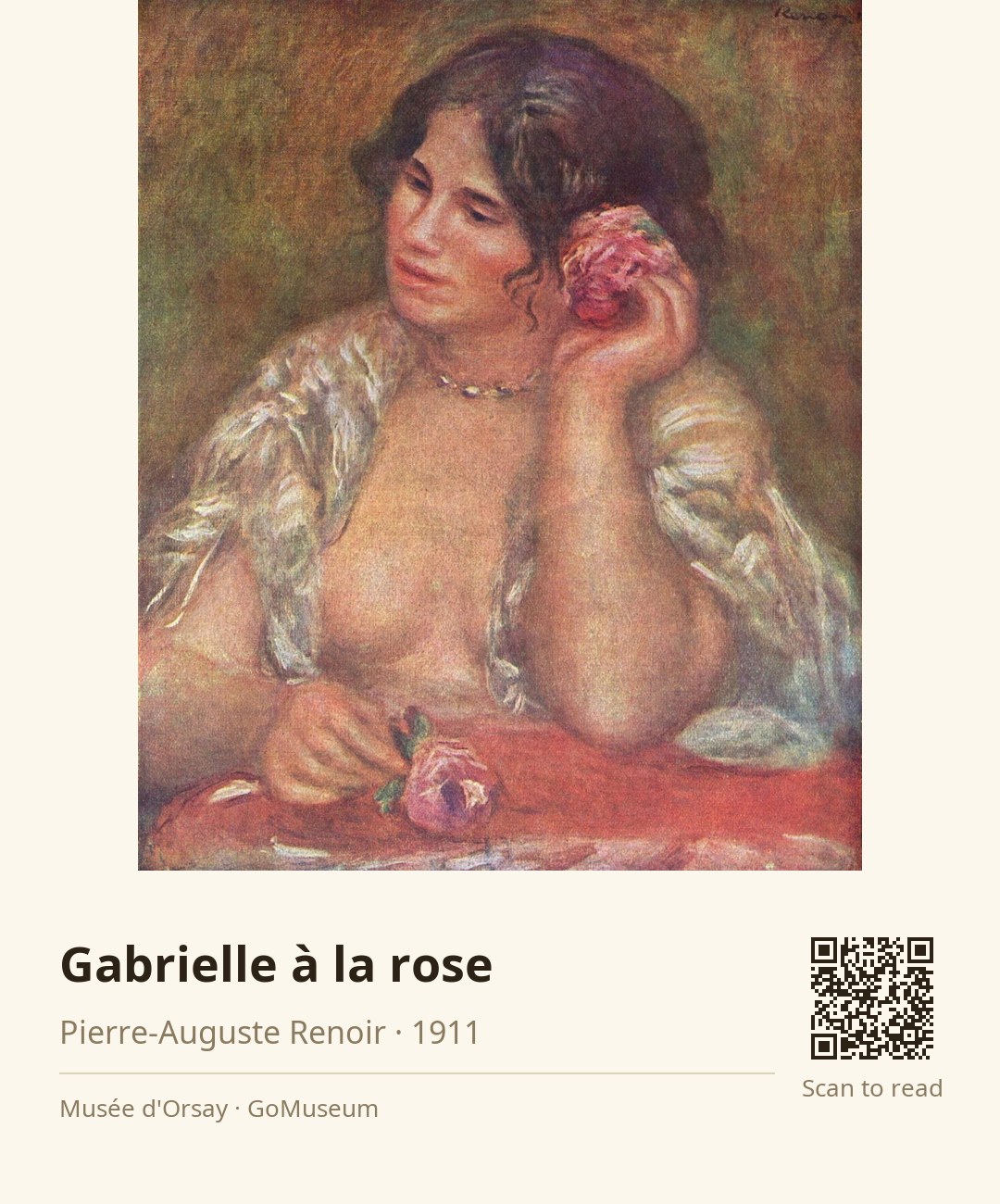
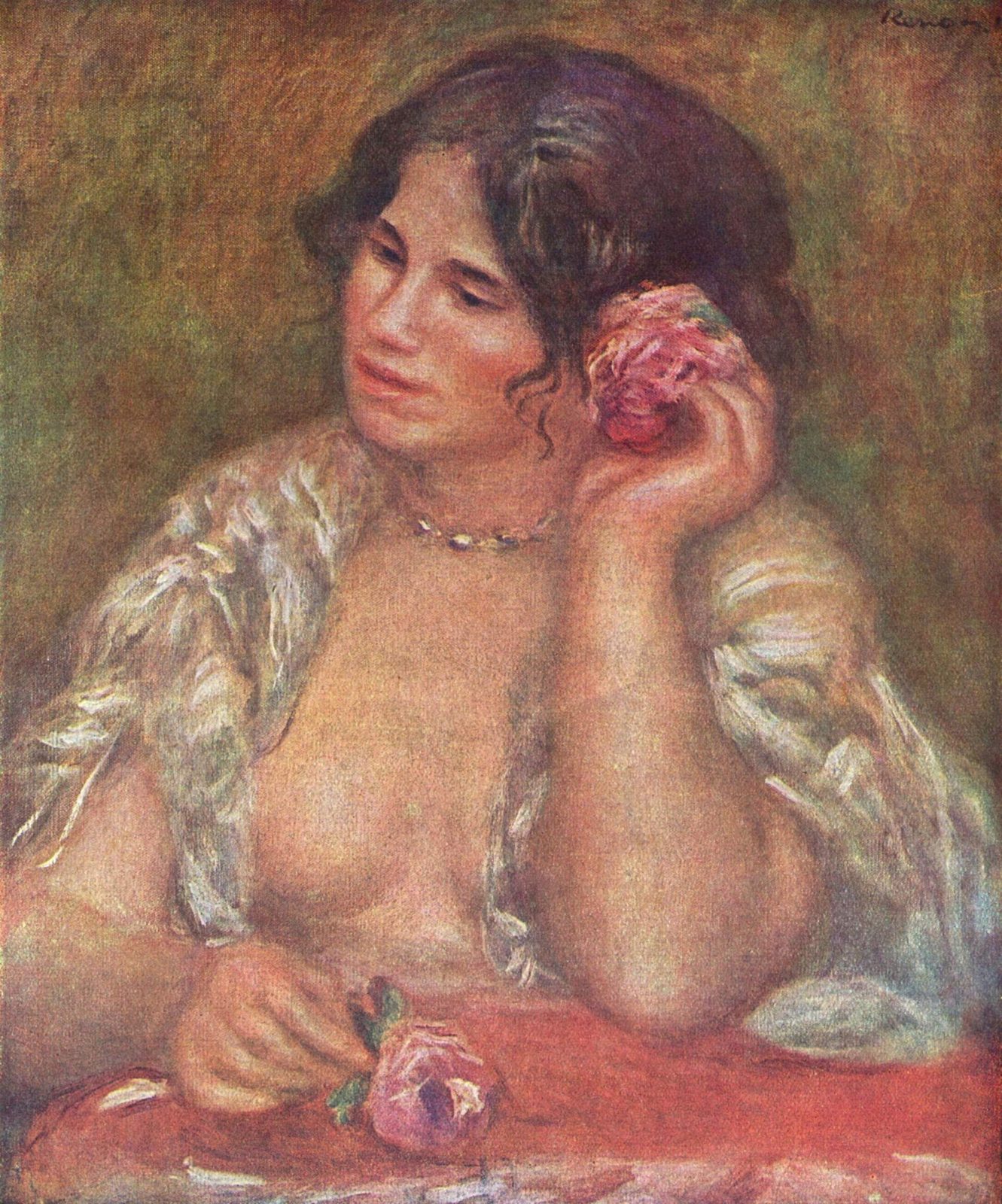
🎧 This work has audio narration — listen in the appTake a moment to really look at "Gabrielle à la rose." Notice how Gabrielle Renard, Renoir's beloved model, is enveloped in soft, flowing fabric that almost seems to blend into the background. Her blouse, sheer and billowy, hints at a sensuality that’s both playful and intimate. And that rose tucked behind her ear? It’s not just a flower; it symbolizes her youth and vitality, a nod to the fleeting beauty of life.
These details matter because they reveal Renoir's deep appreciation for the female form and the way he captures the essence of his subjects. This painting, created in 1911, marks a significant evolution in his style, moving away from the precise lines of his earlier works to a more textured, almost tactile approach. Renoir himself said he loved "touching" a painting, and you can feel that love in the rich, thick brushstrokes here.
As you stand before this work, remember that Renoir painted Gabrielle many times, each time exploring different facets of her beauty. This particular piece showcases his late-career mastery, often overlooked in favor of his earlier Impressionist works.
So, what do you think Renoir was trying to convey about beauty and youth in this moment? Let that question linger as you take in the warmth and richness of this stunning painting.
Pierre-Auguste Renoir, born on February 25, 1841, in Limoges, France, emerged as a pivotal figure in the Impressionist movement. His early life in a modest family led him to Paris, where he honed his artistic skills amidst the masterpieces of the Louvre. Initially apprenticed in a porcelain factory, Renoir's passion for painting flourished, particularly after studying under Charles Gleyre, where he befriended fellow artists like Monet and Sisley.
Renoir's work celebrated feminine beauty and vibrant social scenes, exemplified in iconic pieces like "Dance at Le Moulin de la Galette." Despite facing criticism early on, he gained recognition, especially after participating in the first Impressionist exhibition in 1874. His style evolved over the years, transitioning towards realism influenced by classical masters like Raphael.
Throughout his life, Renoir balanced personal struggles, including health issues, with a prolific output, reportedly creating around four thousand works. He became a beloved figure in art history, known for his warm palette and expressive brushwork. Renoir passed away on December 3, 1919, leaving a legacy that continues to inspire artists and art lovers alike.
The painting 'Gabrielle à la rose' was created by Pierre-Auguste Renoir in 1911, a time when he was deeply immersed in exploring the beauty of his favorite model, Gabrielle Renard. The painting was exhibited at the Grand Palais in Paris in 1985, where it was recognized as a significant work from Renoir's later career. The reception of this painting has evolved over time, often overshadowed by his earlier Impressionist works, yet it stands as a testament to his late-career mastery and the intimate connection he had with his subjects.
As you gaze at 'Gabrielle à la rose,' take note of Renoir's bold brushwork, which feels almost tactile. The thick, buttery strokes create a sense of movement and life, as if Gabrielle might step out of the canvas at any moment. The way he handles light is particularly striking; it dances across the sheer fabric of her blouse, enhancing her sensuality. The composition is carefully structured, with Gabrielle positioned centrally, drawing your eye to her relaxed pose and the vibrant roses that symbolize her youth. The rich reds and soft whites create a warm atmosphere, inviting you to linger in this moment of beauty. Renoir's choice to blend the background with Gabrielle's form blurs the lines between subject and setting, immersing you in the intimate world he created.
Its lush palette and emotive brushwork inspired contemporaries like Henri Matisse, who frequently visited Renoir to learn from his techniques. This painting not only showcases Renoir's evolution as an artist but also highlights the enduring legacy of his approach to femininity and beauty in art, paving the way for future explorations of these themes.
Interestingly, while many artists of the time opted for mass-produced frames, Renoir had a preference for handcrafted frames. For 'Gabrielle à la rose,' he commissioned an ornate Louis XV style frame, intricately carved from hardwood, which adds an extra layer of elegance to the painting. This choice reflects his commitment to artistry not just in the canvas but in the presentation of his work as well.
Renoir commissioned an ornate Louis XV style frame carved from hardwood for 'Gabrielle à la rose,' reflecting his commitment to artistry not just on the canvas but also in how his work was presented.
Gabrielle was one of Renoir's favorite models, and he painted her many times, each time exploring different aspects of her beauty, which allowed him to evolve his style and deepen his understanding of feminine form.
The painting's lush palette and emotive brushwork inspired contemporaries like Henri Matisse, who frequently visited Renoir to learn from his techniques, showcasing its influence on the next generation of artists.