Fritillaries in a Copper Vase
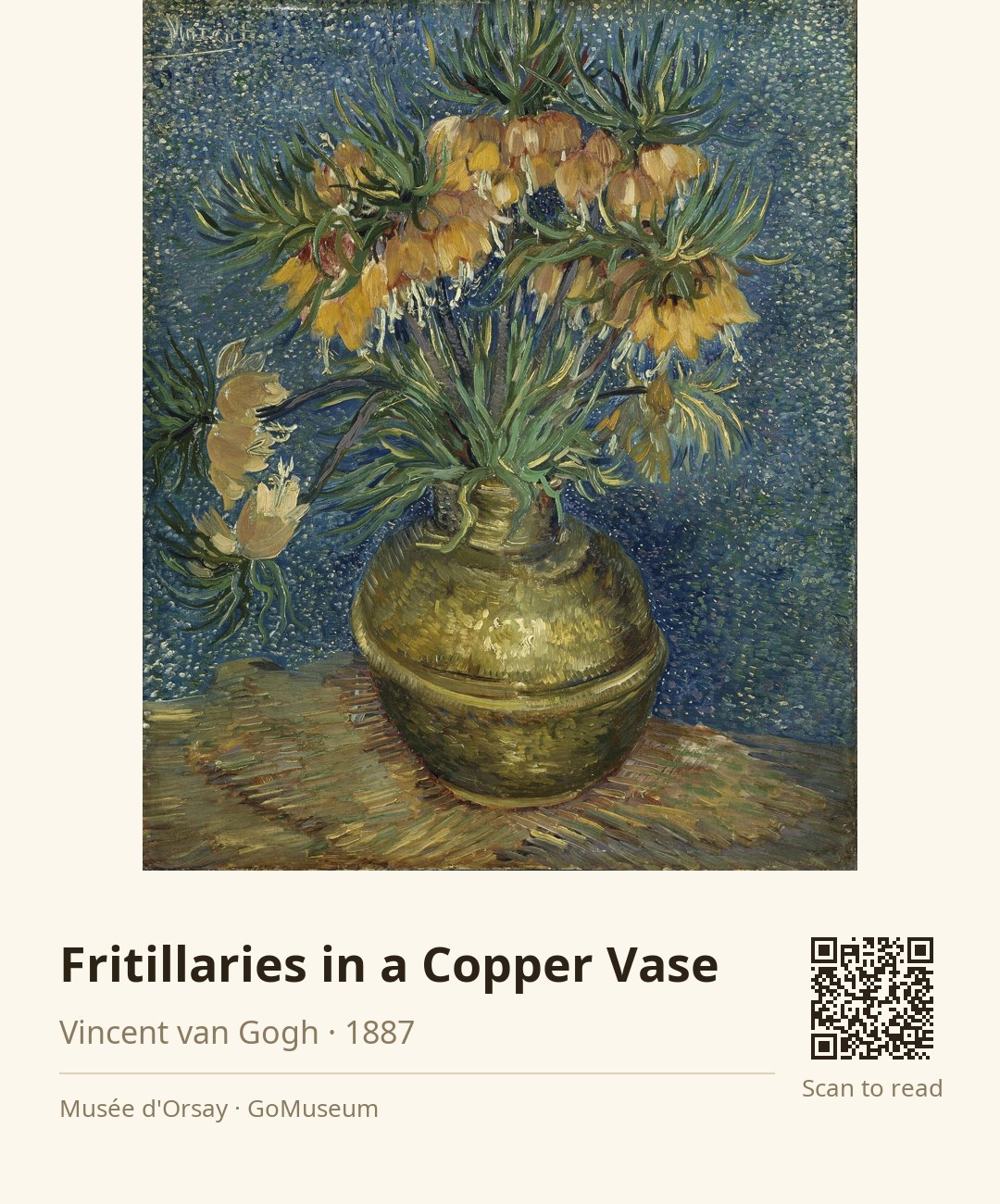
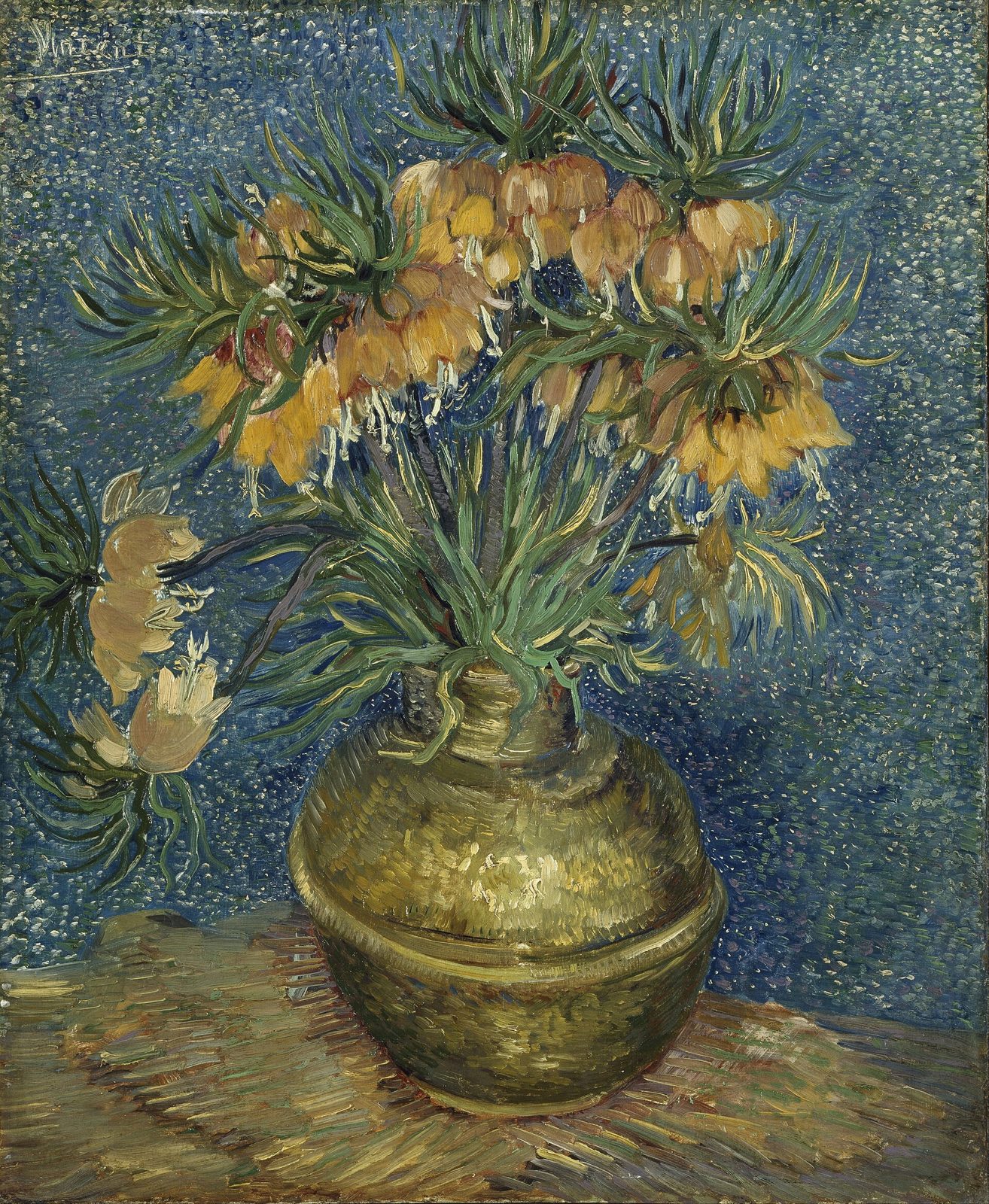
🎧 This work has audio narration — listen in the appTake a moment to really look at "Fritillaries in a Copper Vase." Notice how the vibrant orange of the fritillaries almost seems to glow against the cool blues and greens of the background. This contrast isn’t just for show; it’s Van Gogh’s way of capturing the energy of springtime, a celebration of life bursting forth after winter’s chill.
Now, focus on the texture of the paint. You can see the thick, expressive brushstrokes that create a sense of movement and depth. This isn’t just a still life; it’s a dynamic interplay of color and light, a technique that Van Gogh honed during his time in Paris, influenced by the Impressionists around him. The way the copper vase reflects the flowers adds a layer of complexity, inviting you to explore the relationship between the objects.
Painted in 1887, this piece marks a pivotal moment in Van Gogh’s artistic journey. He was experimenting with color and technique, laying the groundwork for the masterpieces that would follow. It’s almost as if he’s saying, “Look at how color can transform a simple bouquet into something extraordinary.”
As you stand here, think about what this painting evokes for you. What feelings does it stir? How does it change your perception of flowers and still life? Let this vibrant celebration of color linger in your mind as you move on.
Vincent van Gogh was a Dutch Post-Impressionist painter born on March 30, 1853, in Zundert. He is renowned for his vibrant use of color and expressive brushwork, which laid the groundwork for modern art. Despite creating around 2,100 artworks in just over a decade, including 860 oil paintings, he struggled with mental illness and poverty throughout his life. His early career as an art dealer was marked by disillusionment, leading him to pursue painting in 1881.
Van Gogh's intense passion for art was evident in his correspondence with his brother Theo, who provided emotional and financial support. His works evolved significantly after moving to Paris in 1886, where he mingled with avant-garde artists. His time in Arles in 1888 marked a peak in his creativity, producing iconic series like sunflowers and wheat fields.
Tragically, van Gogh's life ended in suicide at 37, after years of battling his demons. Initially unrecognized, he gained fame posthumously, becoming a symbol of the tortured artist. His legacy influenced movements like Fauvism and Expressionism, securing his place as one of the most significant figures in art history.
Vincent van Gogh painted 'Fritillaries in a Copper Vase' in 1887 during a transformative period in his life while living in Paris. This piece was created amidst his growing fascination with color and light, influenced by the Impressionists he encountered. The painting was part of a collection owned by notable figures like Eugène Murer and Isaac Camondo, reflecting its significance in the art world even during Van Gogh's lifetime. Although it didn't receive widespread acclaim initially, it has since been recognized as a pivotal work that showcases Van Gogh's evolving style. Today, it resides in the Musée d'Orsay, a testament to its enduring legacy.
As you gaze at 'Fritillaries in a Copper Vase,' pay attention to the way Van Gogh manipulates paint to create texture and depth. The thick, impasto brushstrokes give the flowers a sense of vitality, almost as if they are swaying in a gentle breeze. Notice how the background employs a pointillist technique, contrasting with the more expressive strokes of the flowers and vase. This interplay of styles not only draws your eye to the vibrant fritillaries but also enhances their luminosity against the cooler tones of the backdrop. The copper vase, with its reflective surface, captures and refracts the colors of the flowers, creating a dynamic visual dialogue that invites you to explore the relationship between the objects.
Painted in 1887, this work showcases Van Gogh's early experimentation with color and technique, influenced by the Impressionists around him. It’s a vibrant testament to his evolving style, blending Pointillism and Impressionism, which would later inspire movements like Fauvism and Expressionism. The bold use of complementary colors—like the striking oranges of the fritillaries against the cool blues of the background—was revolutionary, pushing the boundaries of color theory in art.
Interestingly, Van Gogh signed only about 130 of his 900 works, and 'Fritillaries in a Copper Vase' is one of them. He chose to simply sign 'Vincent,' a decision that reflected his desire to be recognized as an individual rather than just a member of the Van Gogh family, which had a more conservative reputation.
By signing his works simply as 'Vincent', he aimed to establish his individuality apart from his family's more conservative reputation, reflecting his desire for personal recognition in the art world.
The imperial fritillaries bloom in spring, suggesting that Van Gogh painted this work during that season while living in Paris, a period marked by his exploration of color and light.
In this painting, Van Gogh combined Pointillism in the background with expressive brushstrokes for the flowers and vase, showcasing his willingness to experiment with different styles in a single work.