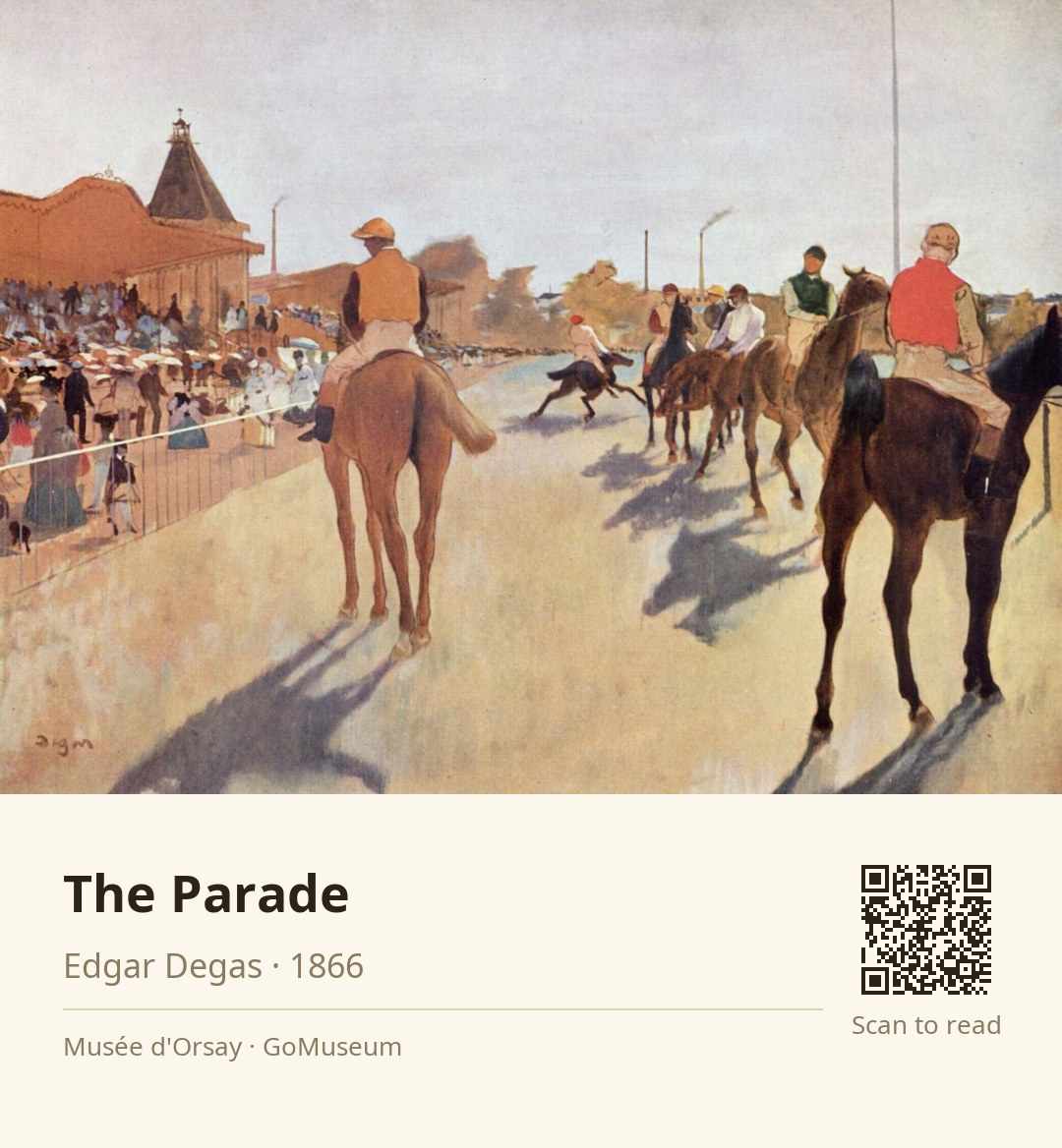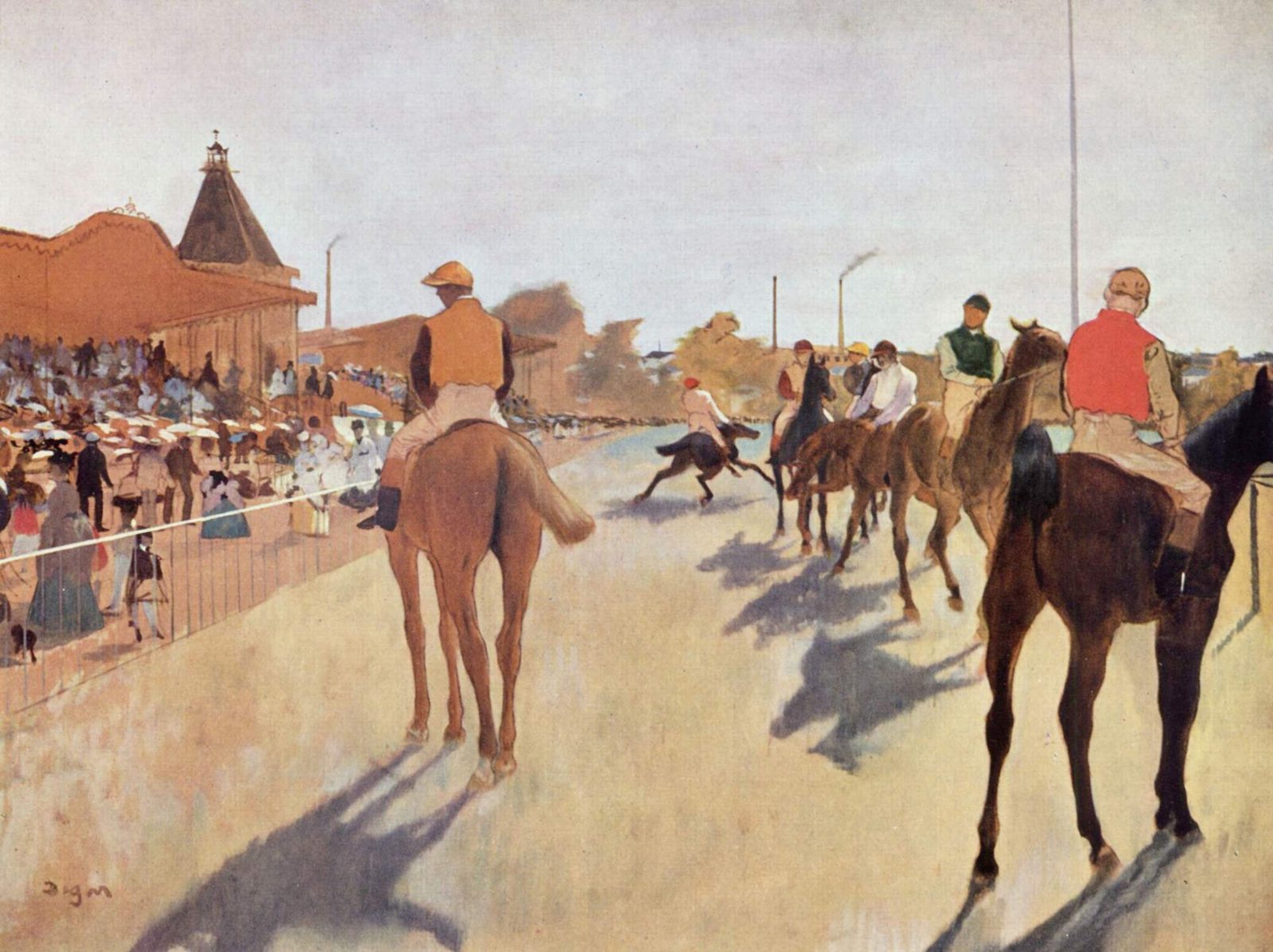
Take a moment to really look at "The Parade" by Edgar Degas. Notice how the horses are poised, their muscles taut with anticipation, while the jockeys seem almost suspended in time. The way Degas captures the tension just before the race begins is electric, isn’t it?
Now, focus on the diagonal composition and the play of light and shadow. The horses cast long shadows that stretch across the canvas, leading your eye toward the distant riders. This clever use of perspective not only draws you in but also heightens the sense of excitement and expectation. It’s as if you can feel the energy in the air, the crowd holding its breath for the race to start.
Degas painted this scene in 1866, a time when he was shifting from classical themes to capturing modern life, especially the world of horse racing. Unlike many artists of his time, he wasn’t interested in the race itself but in the moments leading up to it, which he portrays with a unique blend of realism and impressionism.
As you stand here, think about how Degas, often associated with dancers, found beauty and drama in the world of racing. What do you think he saw in these moments that made them worth capturing? Let that question linger as you absorb the energy of this remarkable piece.
Edgar Degas, born on July 19, 1834, in Paris, was a pivotal figure in the Impressionist movement, though he preferred to be labeled a realist. Known for his exceptional skill in drawing, Degas focused on capturing movement, particularly in his depictions of dancers, which constitute over half of his oeuvre. His works also include racehorses and portraits that reveal psychological depth and human isolation.
Degas came from a cultured, affluent family; his mother was a Creole from New Orleans, and his father was a banker. After his mother's death, he pursued art against his father's wishes, studying at the École des Beaux-Arts and drawing inspiration from classical masters during his time in Italy. His early ambition to be a history painter shifted as he embraced contemporary subjects, influenced by artists like Édouard Manet.
Despite being a founding member of the Impressionists, Degas's approach diverged from his peers, as he often worked in his studio rather than en plein air. His innovative techniques and themes sparked debate among critics and continue to influence art history today. Degas passed away on September 27, 1917, leaving behind a legacy that challenges traditional boundaries in art.
Edgar Degas painted 'The Parade' between 1866 and 1868, marking a pivotal moment in his artistic journey as he transitioned from classical themes to the vibrant world of modern life. This piece, also known as 'Chevaux de course devant les tribunes', was one of his first dedicated to horse racing, a subject that would recur throughout his career. The painting was initially part of Degas's personal collection until 1873, when it was sold to Jean-Baptiste Faure, a passionate supporter of the Impressionists. By 1893, it found its way to the renowned art dealer Paul Durand-Ruel, who championed many Impressionist artists. The painting later belonged to the distinguished banker and collector Isaac de Camondo until his death in 1911. Afterward, it was accepted by the French state as a bequest to the national museums, eventually landing in the Musée d'Orsay, where it remains today. Its journey reflects the shifting tides of art appreciation in the late 19th century, as Degas's work gained recognition and respect.
Take a moment to appreciate the way Degas constructs 'The Parade'. Notice the dynamic diagonal composition that draws your eye across the canvas, creating a sense of movement and anticipation. The horses, with their taut muscles, are rendered with a brushwork that feels almost restless, capturing the energy of the moment just before the race. The play of light and shadow is masterfully handled; the long shadows cast by the horses stretch dramatically, enhancing the depth and perspective of the scene. Degas's choice of colors is equally striking, with a palette that balances the earthy tones of the horses against the vibrant hues of the jockeys' silks. This careful orchestration of elements not only captures the excitement of the impending race but also invites you to feel the tension in the air, making you a part of this electrifying moment.
Painted in 1866, it reflects his shift from classical themes to the vibrant world of contemporary life, particularly the excitement of horse racing. Unlike traditional depictions focused on the race itself, Degas captures the charged atmosphere just before the start, emphasizing tension and anticipation. Degas's unique blend of realism and modernity invites viewers to see the beauty in fleeting moments, forever changing how we appreciate the ordinary in art.
Interestingly, Degas was not just a painter; he was also a skilled draftsman and sculptor, and he often experimented with different mediums. Degas's choice to depict the moments before the race, rather than the race itself, reflects his unique approach to capturing the essence of modern life, focusing on the anticipation and the atmosphere rather than the action.
Degas focused on the moments leading up to the race, emphasizing the anticipation and atmosphere rather than the race itself, which was a departure from the typical action-oriented depictions by other artists.
Born to a Creole family with roots in New Orleans, Degas's diverse cultural background may have contributed to his fascination with movement and performance, evident in both his depictions of dancers and racehorses.
Around this period, Degas transitioned from classical themes to capturing modern life, marking a pivotal shift in his career that allowed him to explore contemporary subjects like horse racing.