Dance in the City
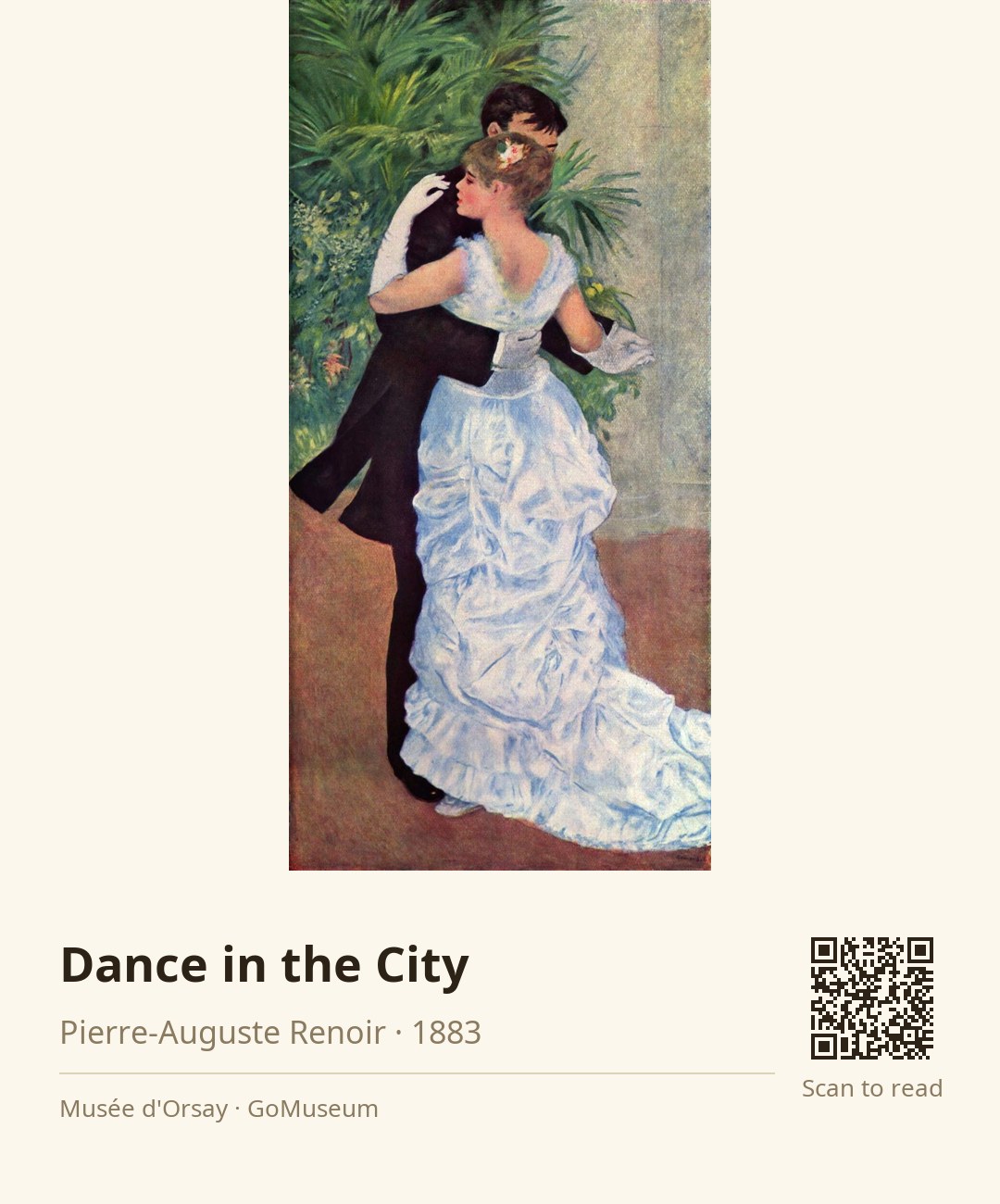
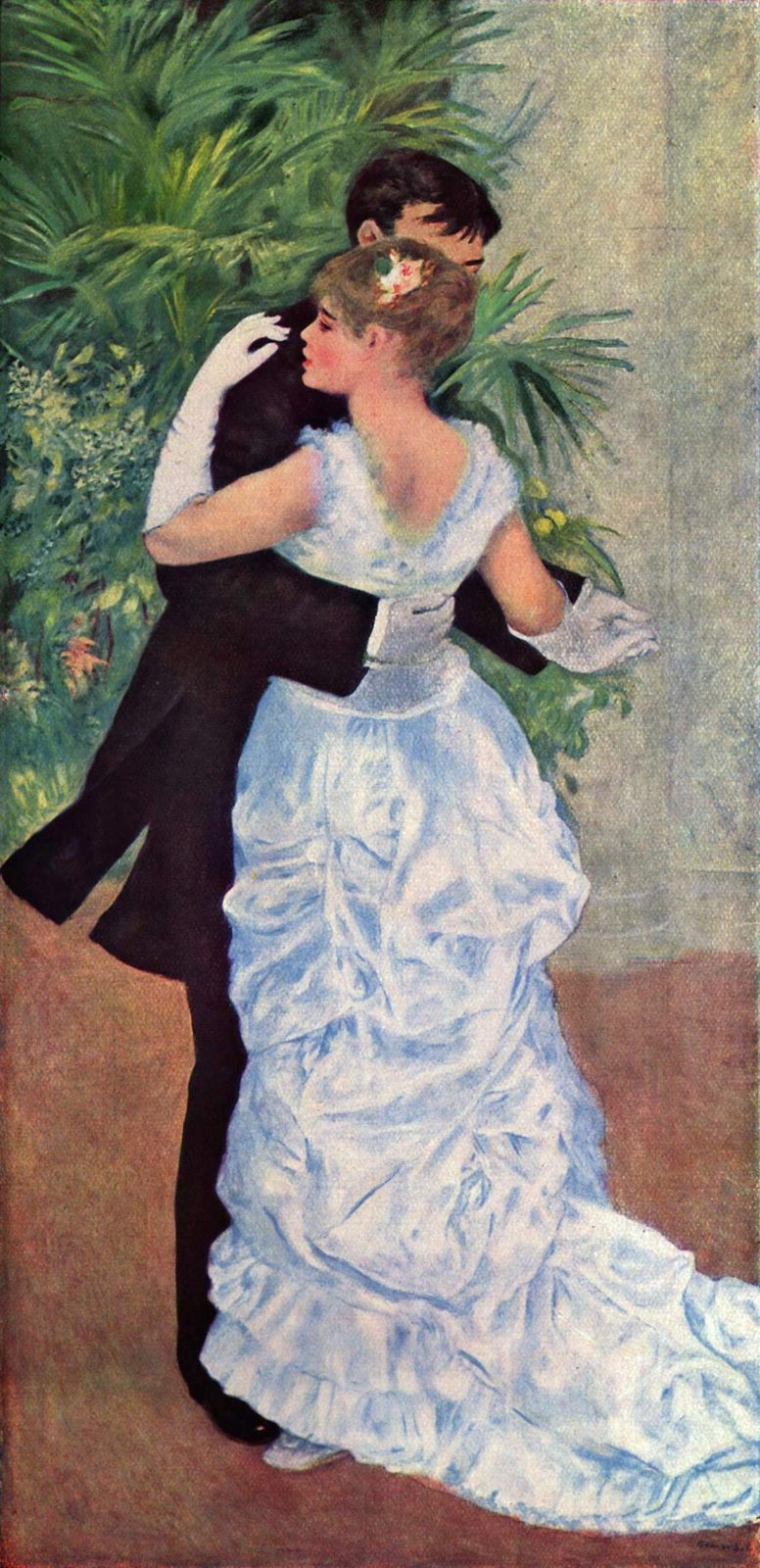
🎧 This work has audio narration — listen in the appTake a moment to really soak in the elegance of "Dance in the City." Look closely at the couple in the center; notice how the woman's gown flows, capturing the essence of Parisian fashion in the 1880s. The way her arm is gracefully wrapped around her partner's neck speaks volumes about the intimacy of their dance—a waltz, the only dance of the time that allowed couples to draw so close. These details matter because they reveal Renoir's fascination with the social dynamics of his era. The painting isn't just about dance; it's a snapshot of urban life, where elegance and formality coalesce in a salon setting. The contrast between the couple's refined posture and the lively atmosphere of the city captures a moment of joy amidst the hustle and bustle of Paris. Created in 1883, this piece was part of a series commissioned by art dealer Paul Durand-Ruel, showcasing different aspects of dance. Renoir's choice of models—Suzanne Valadon and Paul Auguste Lhôte—adds a personal touch, as Valadon would later become a celebrated artist herself. As you stand here, think about the stories that unfold in such a moment. What do you imagine the couple is feeling as they dance?
Pierre-Auguste Renoir, born on February 25, 1841, in Limoges, France, emerged as a pivotal figure in the Impressionist movement. His early life in a modest family led him to Paris, where he honed his artistic skills amidst the masterpieces of the Louvre. Initially apprenticed in a porcelain factory, Renoir's passion for painting flourished, particularly after studying under Charles Gleyre, where he befriended fellow artists like Monet and Sisley.
Renoir's work celebrated feminine beauty and vibrant social scenes, exemplified in iconic pieces like "Dance at Le Moulin de la Galette." Despite facing criticism early on, he gained recognition, especially after participating in the first Impressionist exhibition in 1874. His style evolved over the years, transitioning towards realism influenced by classical masters like Raphael.
Throughout his life, Renoir balanced personal struggles, including health issues, with a prolific output, reportedly creating around four thousand works. He became a beloved figure in art history, known for his warm palette and expressive brushwork. Renoir passed away on December 3, 1919, leaving a legacy that continues to inspire artists and art lovers alike.
In 1883, Pierre-Auguste Renoir created 'Dance in the City' as part of a series commissioned by the influential art dealer Paul Durand-Ruel. This series aimed to capture the vibrancy of dance in urban settings, and Renoir's work was displayed prominently at exhibitions, including its debut at the 1883 Paris exhibition where it was listed as number 26. The painting was well-received, showcasing Renoir's growing reputation as a leading figure in the Impressionist movement. By 1886, it was already in the hands of Durand-Ruel, indicating its immediate value. Over the years, the painting changed hands, eventually being accepted by the state in 1978 as part of a payment for inheritance taxes, and it found its home at the Musée d'Orsay, where it remains today, a testament to its enduring appeal and significance in art history.
Renoir's technique in 'Dance in the City' is a masterclass in capturing movement and emotion. The brushwork is lively and fluid, almost as if the paint itself dances across the canvas. Notice how the colors blend seamlessly, creating a warm, inviting atmosphere that draws you into the scene. The use of light is particularly striking; it bathes the couple in a soft glow, enhancing their intimacy. The composition is carefully structured, with the couple at the center, their bodies forming a diagonal line that guides your eye through the painting. The scale is life-sized, making the viewer feel as though they could step right into the salon and join the dance. This immersive quality is a hallmark of Renoir's work, inviting you to experience the joy and elegance of the moment.
One intriguing aspect of 'Dance in the City' is the personal connection between the artist and his models. The woman depicted, Suzanne Valadon, would later become a renowned artist herself, breaking barriers in a male-dominated field. At the time of posing for Renoir, she was pregnant with her son, Maurice Utrillo, who would also go on to become a notable painter. This intertwining of lives adds a layer of depth to the painting, making it not just a representation of a moment in time but also a snapshot of the artistic community of the era.
Renoir's brushwork in this painting is particularly notable for its fluidity, which captures the essence of movement and emotion, making the viewer feel as if they could step into the scene. The warm color palette and soft lighting also enhance the intimate atmosphere of the dance.