Fin d'arabesque
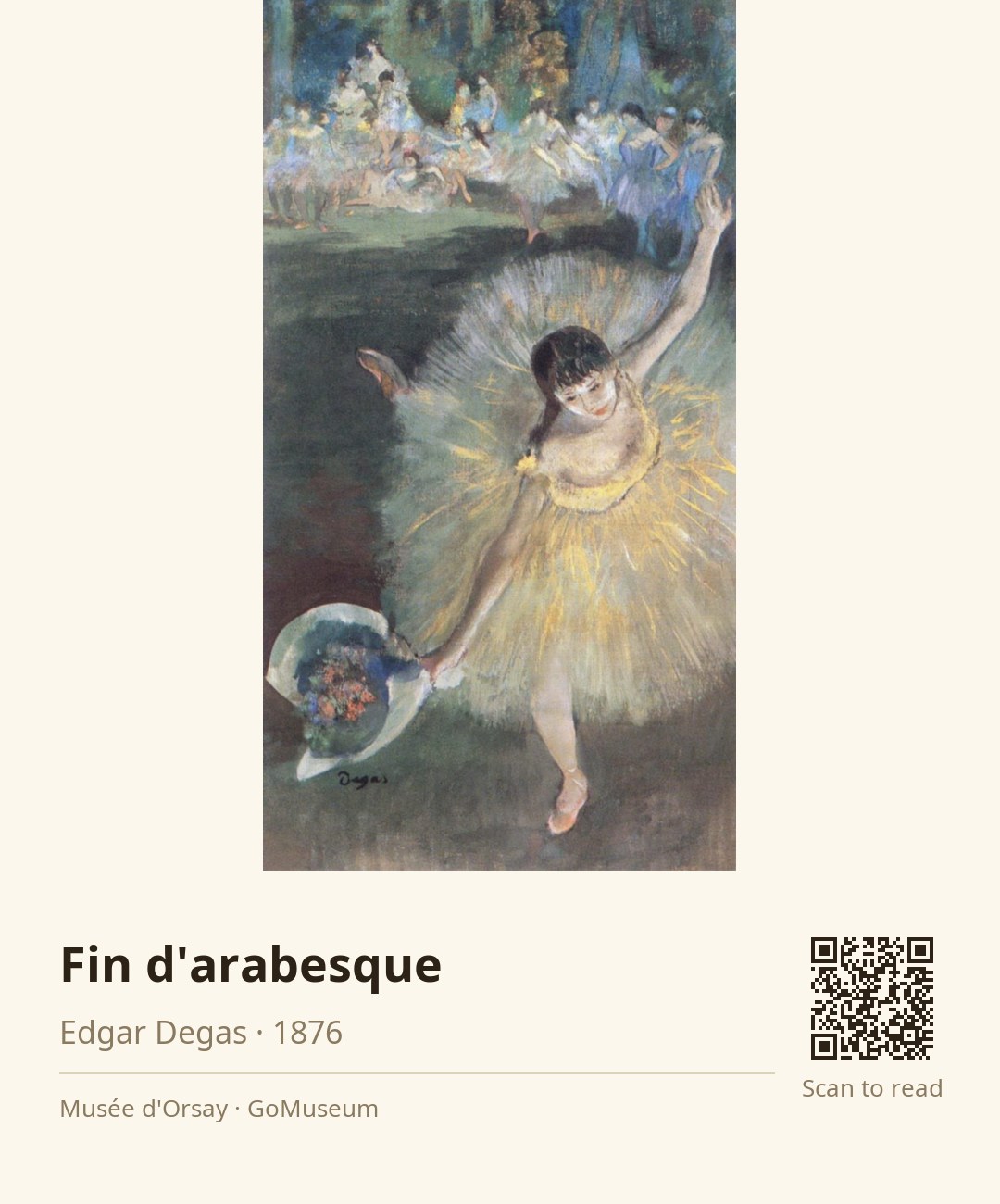
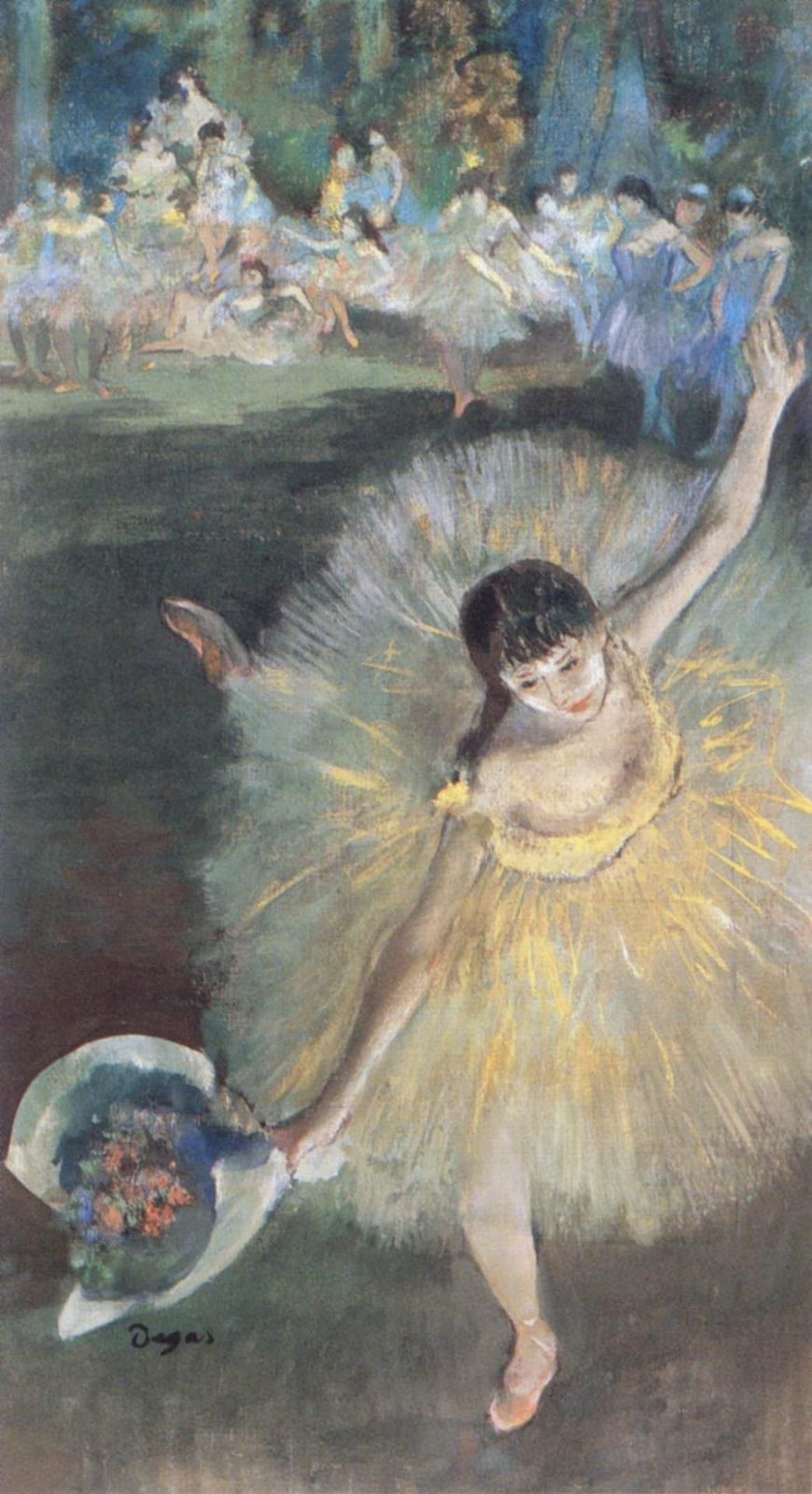
🎧 This work has audio narration — listen in the appAs you stand before Edgar Degas's "Fin d'arabesque," let your eyes linger on the ballerina in her vibrant yellow tutu. Notice how her delicate hand cradles a bouquet of flowers, a striking contrast to the graceful pose of her raised leg. This moment captures not just a dance, but a fleeting expression of beauty and balance.
What’s fascinating here is the way Degas freezes this precise moment in time, allowing us to appreciate the elegance of the arabesque—a pose that embodies both strength and fragility. The soft pastels and oil blend seamlessly, creating a dreamlike quality that pulls you into the world of ballet, where every movement tells a story.
Degas painted this piece in 1876, during a period when he was deeply immersed in the world of dance, a subject that would dominate much of his work. His unique perspective as an artist allowed him to capture the essence of movement, making us feel the energy and grace of the dancers.
So as you take in this artwork, think about the dedication and artistry that went into capturing such a moment. What emotions does this scene evoke for you? Can you imagine the music that might accompany this dancer’s performance?
Edgar Degas, born on July 19, 1834, in Paris, was a pivotal figure in the Impressionist movement, though he preferred to be labeled a realist. Known for his exceptional skill in drawing, Degas focused on capturing movement, particularly in his depictions of dancers, which constitute over half of his oeuvre. His works also include racehorses and portraits that reveal psychological depth and human isolation.
Degas came from a cultured, affluent family; his mother was a Creole from New Orleans, and his father was a banker. After his mother's death, he pursued art against his father's wishes, studying at the École des Beaux-Arts and drawing inspiration from classical masters during his time in Italy. His early ambition to be a history painter shifted as he embraced contemporary subjects, influenced by artists like Édouard Manet.
Despite being a founding member of the Impressionists, Degas's approach diverged from his peers, as he often worked in his studio rather than en plein air. His innovative techniques and themes sparked debate among critics and continue to influence art history today. Degas passed away on September 27, 1917, leaving behind a legacy that challenges traditional boundaries in art.
Edgar Degas's "Fin d'arabesque" was painted in 1876, a pivotal year when he was deeply engaged with the world of ballet. After its completion, the work was eventually bequeathed to the French state by Camondo in 1911, ensuring its preservation for future generations. Today, it resides in the Musée d'Orsay, where it continues to captivate audiences. This painting, like many of his works, reflects his unique perspective on modern life, particularly the ephemeral beauty of dance.
As you gaze at "Fin d'arabesque," take a moment to appreciate the masterful technique Degas employs. The combination of pastel and oil creates a rich texture that brings the ballerina to life, her yellow tutu almost glowing against the softer hues of the background. Notice how the brushwork feels both fluid and dynamic, capturing the very essence of movement. The composition is vertically oriented, drawing your eye upward along the dancer's extended leg, while her delicate hand cradles the bouquet, creating a balance between strength and grace. The play of light across her form enhances the sense of depth, while the subtle variations in color evoke the fleeting nature of the moment. Degas's choice to depict this arabesque, a pose that embodies both elegance and tension, invites you to feel the dancer's struggle and poise.
Did you know that Degas, despite being a key figure in the Impressionist movement, actually preferred to be called a realist? He was known for his meticulous draftsmanship and often worked in the studio rather than outdoors, which was quite different from his contemporaries. This painting, 'Fin d'arabesque,' showcases his unique approach to capturing movement and grace, particularly in ballet, which fascinated him throughout his career. His dedication to the subject of dance is evident, as more than half of his works feature dancers, making him a true chronicler of this art form.
Degas's use of pastel alongside oil paint creates a distinctive texture that makes the ballerina's yellow tutu appear almost luminous, enhancing the visual impact of the garment against the softer background.
Coming from a moderately wealthy family with a Creole mother from New Orleans, Degas had access to art and culture from a young age, which likely nurtured his artistic ambitions and connections to influential figures in the art world.
Initially, Degas aspired to be a history painter, a goal shaped by his rigorous academic training and admiration for classical art, before he shifted his focus to contemporary subjects like ballet.