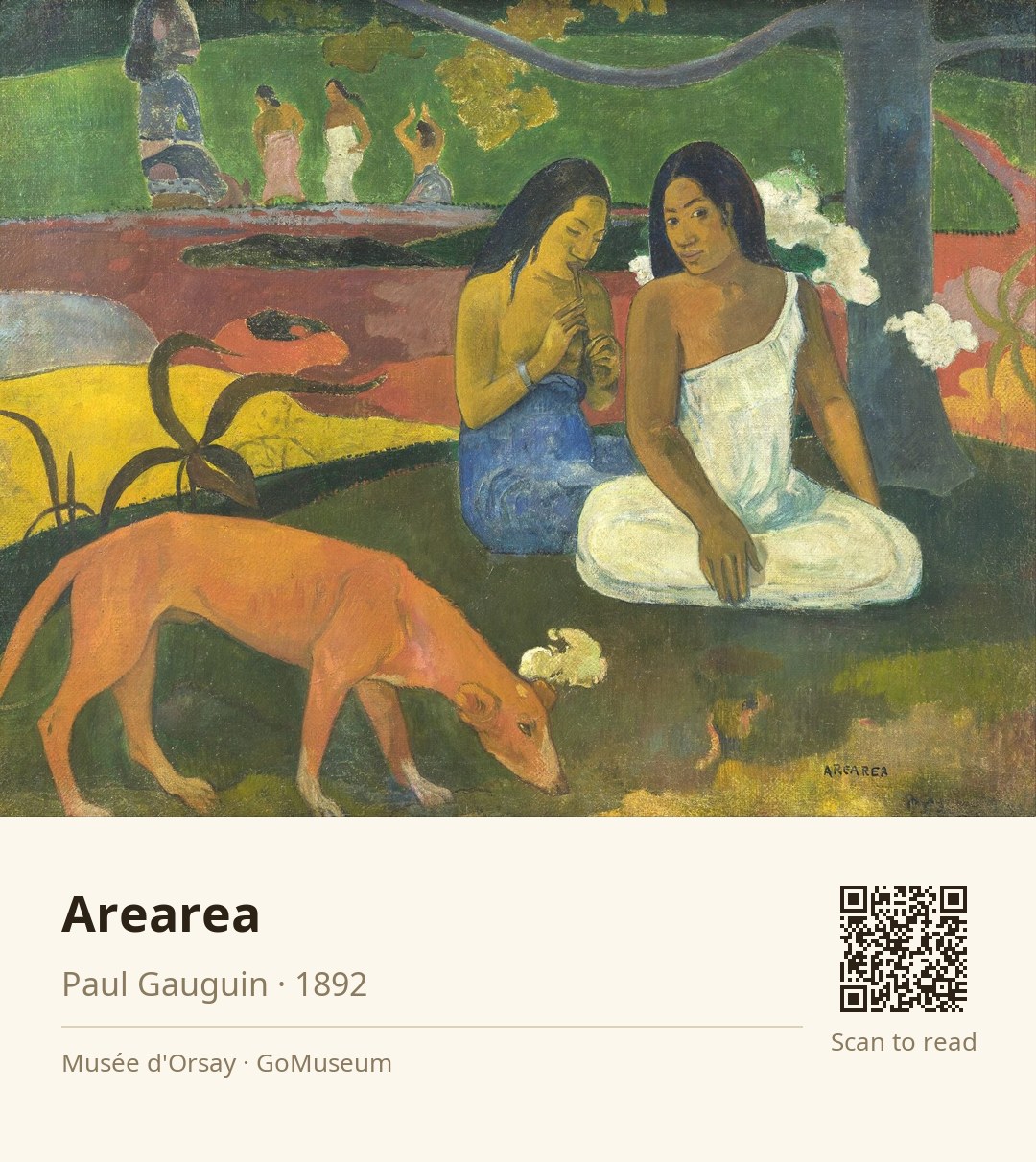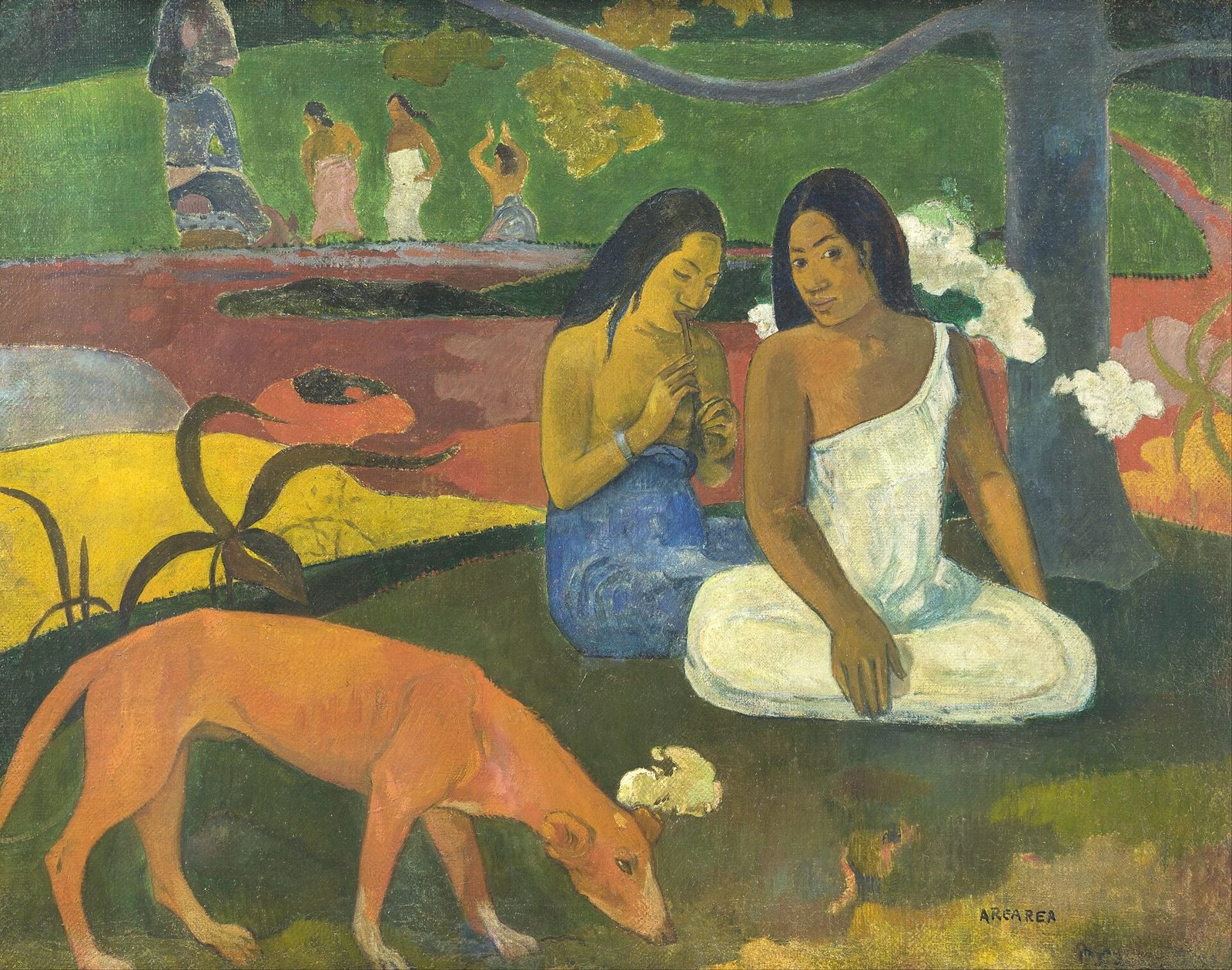
Take a moment to really soak in the vibrant colors and the playful spirit of Gauguin's "Arearea." Notice how the two women at the forefront are nestled under that lush tree, one playing a lively tune on a traditional instrument while the other sits gracefully in a lotus position. Look closely at the expressions on their faces; they radiate a sense of joy and connection to their surroundings.
These details matter because they capture Gauguin’s fascination with Tahitian life, blending dream and reality in a way that invites you into their world. The presence of the dog, possibly Gauguin's own companion from Tahiti, adds a layer of intimacy and warmth, suggesting a shared moment of leisure and community.
Created in 1892 during his time in Tahiti, "Arearea" reflects Gauguin's desire to escape the constraints of European society and immerse himself in a culture that he found more authentic and vibrant. This painting was part of a series that showcased his evolving style, moving away from Impressionism towards a more symbolic approach.
As you stand here, think about the joy and simplicity captured in this scene. What stories do you think these women might share with each other? What does this moment of happiness mean to you?
Eugène Henri Paul Gauguin was a French artist born on June 7, 1848, in Paris. His early life in Peru, where he experienced a privileged childhood, deeply influenced his artistic vision. Initially a stockbroker, Gauguin turned to painting full-time after a financial crisis in 1882. He was largely self-taught, drawing inspiration from his connections with artists like Camille Pissarro, who introduced him to Impressionism.
Gauguin's work evolved into a distinct style characterized by bold colors and symbolic themes, diverging from traditional Impressionism. His time in Brittany and later in Tahiti marked significant phases in his career, where he sought to capture the essence of native life and spirituality. Despite struggling with health and financial issues in his later years, his art gained recognition posthumously, largely due to the efforts of art dealer Ambroise Vollard.
Today, Gauguin is celebrated as a key figure in Post-Impressionism and a precursor to modern art, influencing artists like Picasso and Matisse. His exploration of color and form continues to resonate, securing his place in art history as a visionary who sought to transcend the confines of Western civilization.
Gauguin's "Arearea" was created in 1892 during his transformative journey in Tahiti, where he sought to escape the confines of European society. This painting was part of a series that he exhibited in Paris in 1893, but the reception was far from warm; critics were more likely to mock than to praise. Gauguin himself considered this piece one of his finest, even repurchasing it in 1895 after its initial sale. The painting was eventually bequeathed to the French state in 1961 and now resides in the Musée d'Orsay, a testament to its enduring significance.
Take a closer look at the brushwork in "Arearea"; it’s almost like Gauguin is dancing with the paint. The vibrant colors are layered with a thick application of oil, giving the scene a palpable texture that feels alive. Notice how the light filters through the lush foliage, casting playful shadows that enhance the sense of depth. The composition is carefully structured, with the two women positioned in a triangular formation that draws your eye across the canvas. This arrangement creates a sense of harmony and balance, while the bold colors evoke the warmth of Tahitian sunlight. Gauguin's choice to simplify forms and use flat areas of color reflects his shift towards a more symbolic style, inviting you to feel rather than just see.
Interestingly, the presence of dogs in Gauguin's paintings, including in "Arearea," has sparked much speculation. This adds a layer of personal narrative to the work, hinting at Gauguin's own longing for connection in a foreign land.
Initially, 'Arearea' was not well-received by critics, but Gauguin later repurchased it in 1895, indicating that he came to view it as one of his finest works.
Gauguin's use of thick oil paint creates a textured surface that enhances the vibrancy of the colors, making the scene feel almost alive and inviting viewers to engage with the painting on a sensory level.