Vue du canal Saint-Martin
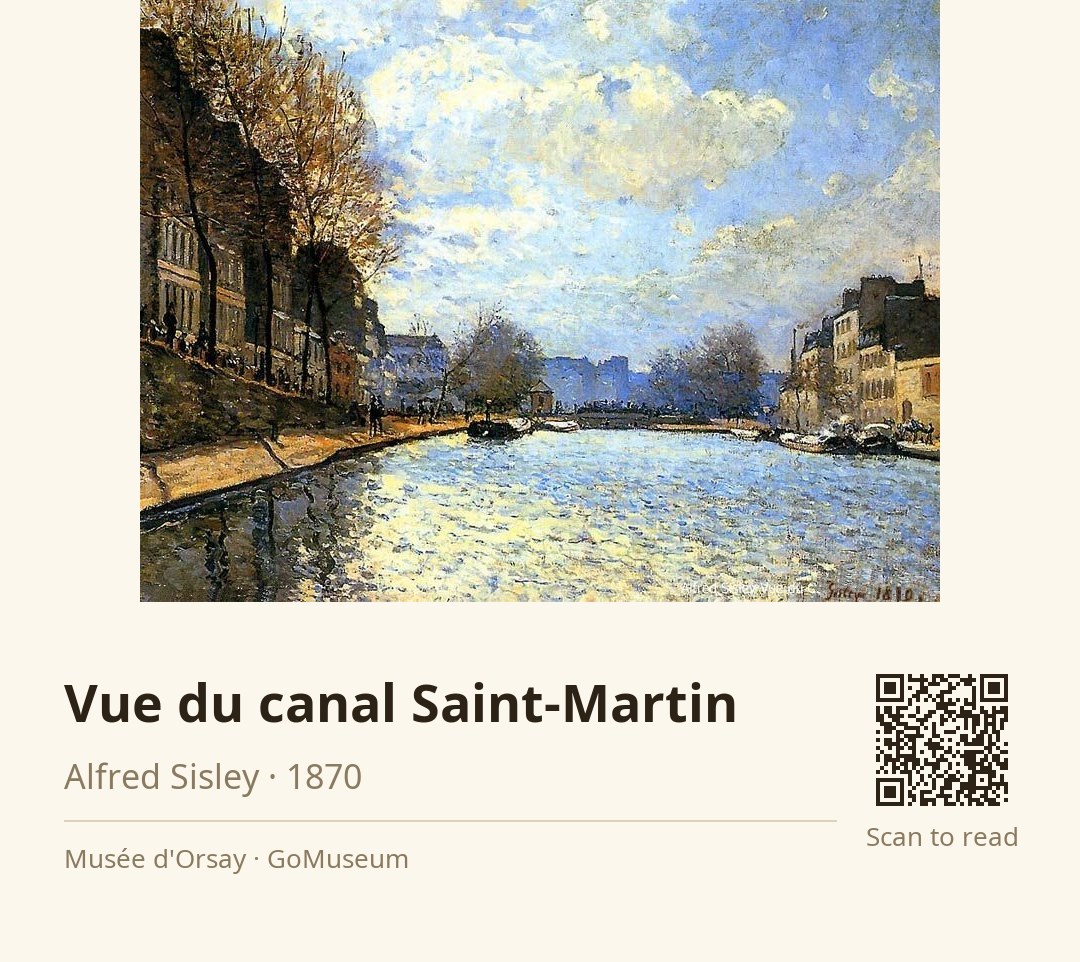
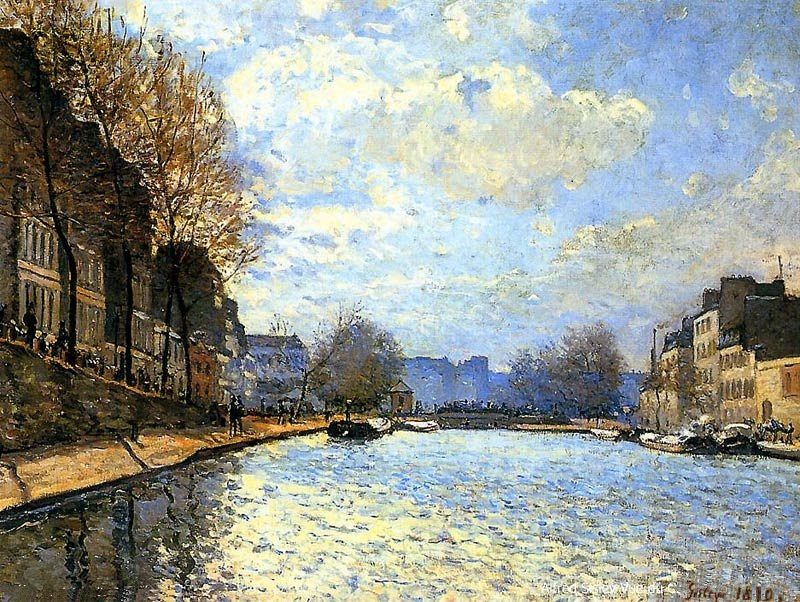
🎧 This work has audio narration — listen in the appTake a moment to really soak in the scene before you in Alfred Sisley’s "Vue du canal Saint-Martin." Notice how the soft blues and grays of the water reflect the sky, creating a tranquil mirror that draws your eye deeper into the painting. Look closely at the boats gently moored along the quay; their stillness contrasts with the bustling life of the city that surrounds them.
These details matter because they capture a moment of calm amidst the industrial pulse of Paris in the late 19th century. Sisley, unlike many of his contemporaries, chose to focus on the less picturesque, more working-class areas of the city. This canal, a vital artery for commerce, symbolizes the intersection of nature and industry, a theme that resonates with the rapid changes happening in urban life at the time.
Painted in 1870, this work was part of Sisley’s exploration of Parisian landscapes, showcasing his dedication to capturing the essence of the city as it transformed. While many artists were drawn to the grand boulevards and opulent architecture, Sisley found beauty in the everyday, the overlooked corners of the city.
As you stand here, think about how this painting invites you to reflect on the balance between nature and urban life. What stories do you think the canal could tell if it could speak?
Alfred Sisley was a British-born Impressionist landscape painter, born in Paris on October 30, 1839, to affluent expatriate parents. His dedication to painting outdoors, or en plein air, marked him as one of the most consistent figures within the Impressionist movement. Sisley’s work primarily focused on landscapes, with notable series depicting the River Thames, the floods at Marly-le-Roi, and the Gothic church at Moret-sur-Loing. Despite his talent, he struggled for recognition and financial stability throughout his life, often relying on the support of patrons and friends.
Sisley's artistic journey began in earnest after returning to Paris from London, where he had been sent to pursue a business career. Instead, he found his calling in art, studying at the École des Beaux-Arts and forming close friendships with fellow artists like Monet and Renoir. His personal life was marked by hardship, particularly after the Franco-Prussian War disrupted his family's financial support. He married Eugénie Lescouezec, and together they faced many challenges, including the loss of a child and Sisley’s ongoing financial instability.
Although Sisley’s work was largely overlooked during his lifetime, it has since gained significant appreciation, solidifying his place in art history as a key contributor to Impressionism and French landscape painting. His delicate depictions of nature continue to resonate, showcasing the beauty of the world around him. Sisley passed away on January 29, 1899, in Moret-sur-Loing, leaving behind a legacy that would flourish posthumously.
Alfred Sisley's 'Vue du canal Saint-Martin' was painted in 1870 and first exhibited at the Salon des artistes français in Paris that same year. Despite the significance of the work, it was largely overlooked by critics at the time, a common fate for many Impressionist pieces. Paul Gachet for 170 francs before 1883, who recognized its value when many did not. This journey from obscurity to a cherished piece in a major museum reflects the changing tides of art appreciation over the decades.
As you gaze at 'Vue du canal Saint-Martin,' pay attention to Sisley's masterful brushwork. The soft, fluid strokes create a sense of movement in the water, while the dappled light plays across the surface, capturing the fleeting effects of sunlight. Sisley’s palette is dominated by tranquil blues and grays, which evoke a serene atmosphere, contrasting sharply with the industrial backdrop of Paris. Notice how he structures the composition: the canal leads your eye into the distance, drawing you deeper into the scene. The placement of the moored boats along the quay adds a sense of stillness, inviting you to pause and reflect on the harmony between nature and urban life. This careful balance of elements showcases Sisley’s dedication to capturing the essence of his surroundings.
Interestingly, Sisley was born to British parents in Paris and spent much of his life in France, yet he never became a French citizen despite multiple attempts. His British nationality remained a point of contention throughout his life, and he faced financial struggles that contrasted sharply with the posthumous acclaim his work would eventually receive.
At the Salon des artistes français in 1870, 'Vue du canal Saint-Martin' was largely overlooked by critics, a fate common for many Impressionist works at the time, which often struggled for recognition.
After being acquired by art dealers, it was purchased by Dr. Paul Gachet for 170 francs before 1883, and later passed to his son, who donated it to the Louvre in 1951.