Village de Voisins
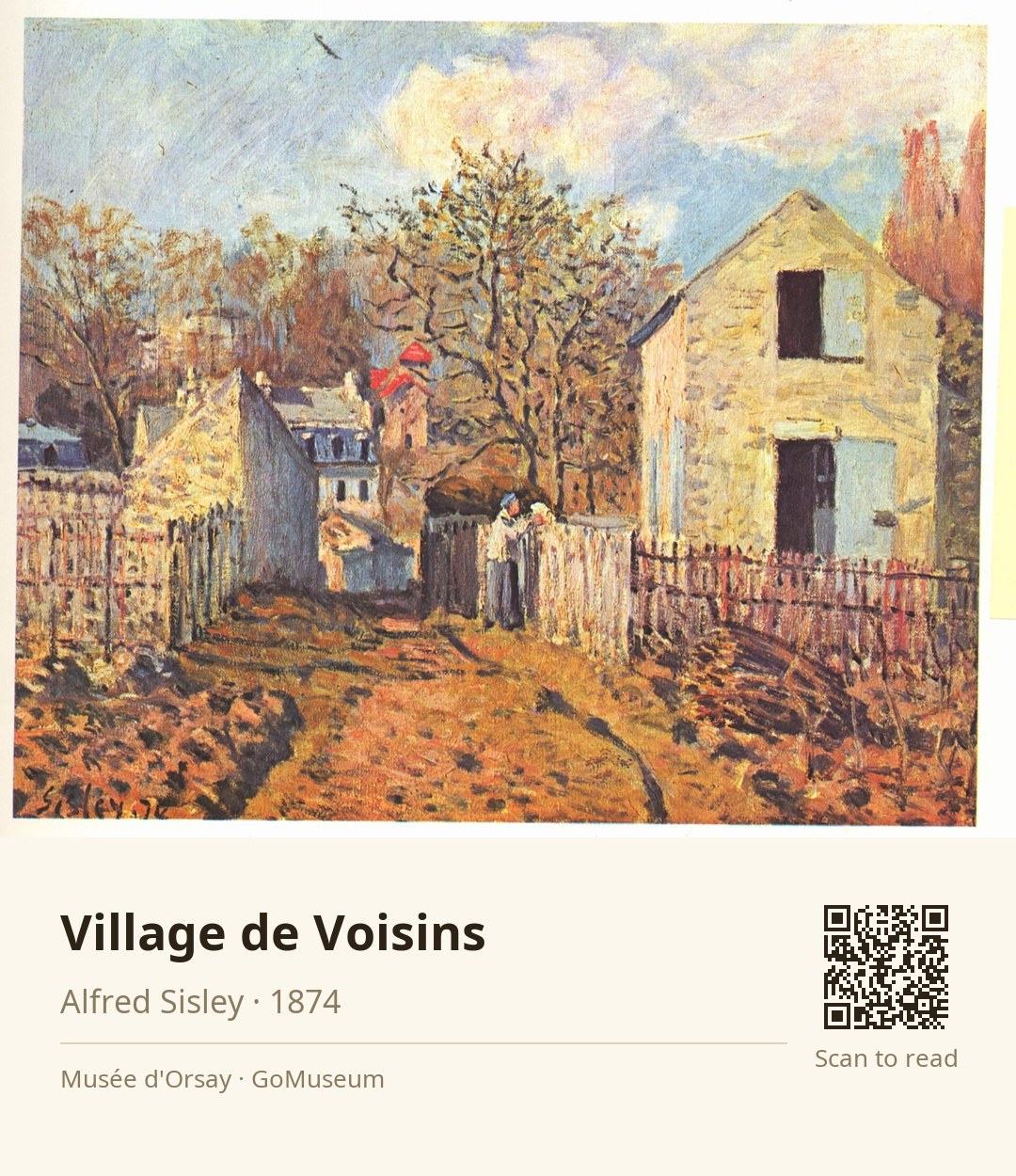
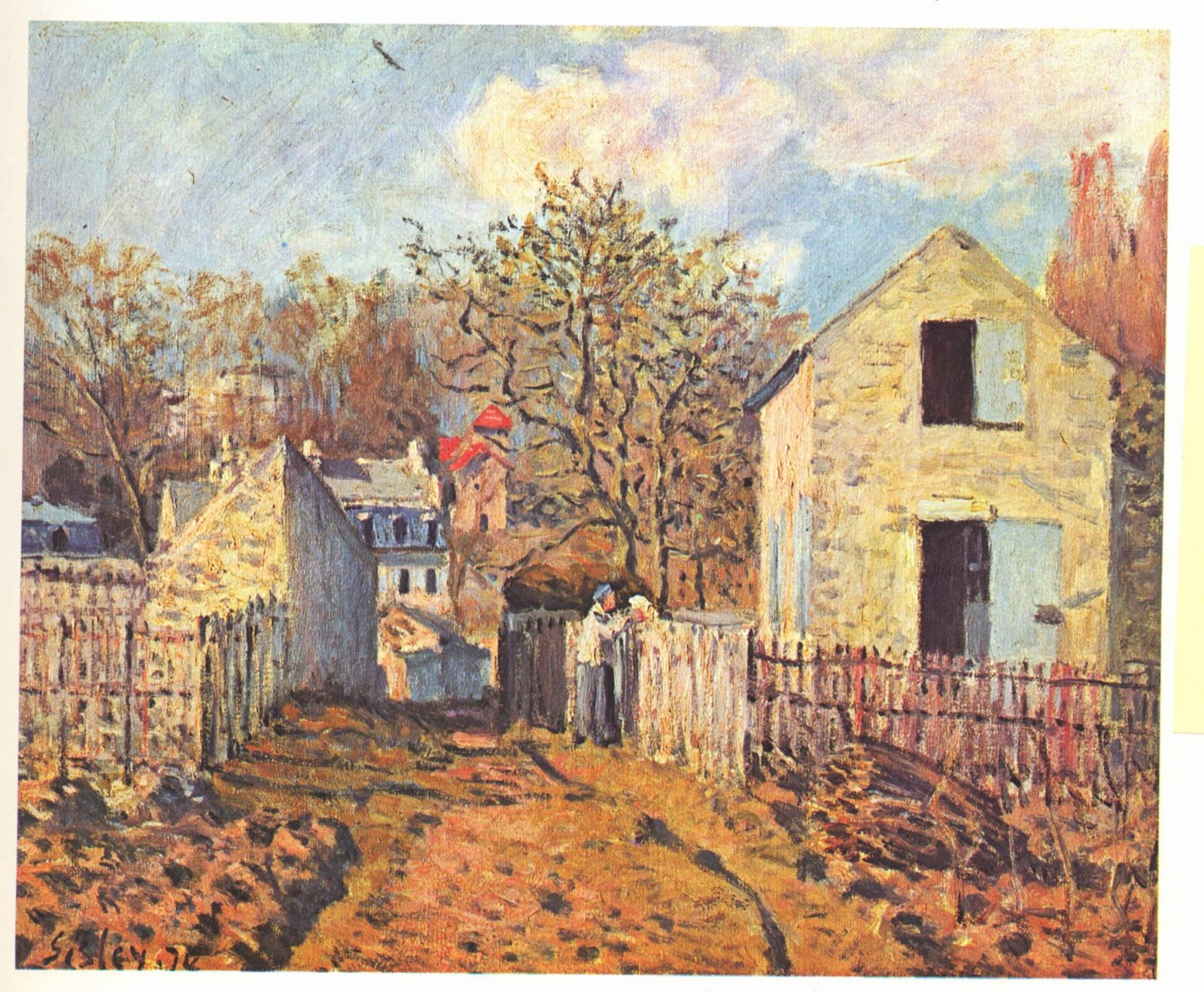
🎧 This work has audio narration — listen in the appTake a moment to really absorb the scene in front of you. Alfred Sisley’s "Village de Voisins" captures a tranquil moment in a small French village, and it’s almost like stepping into a peaceful daydream. Notice how the path meanders through the lush greenery, flanked by wooden fences, leading your eye towards the cozy homes nestled among the trees.
Now, focus on the woman chatting over the fence. Her presence adds a touch of life and intimacy to the landscape, inviting you to imagine the stories shared between neighbors.
Created in 1874, this piece showcases Sisley’s mastery of light and color, hallmarks of the Impressionist movement he was part of. He lived in Louveciennes during this time, and you can feel his connection to the landscape, as he painted en plein air, capturing the fleeting moments of nature.
As you stand here, think about the simplicity of this scene and how it resonates with our own lives today. What stories might unfold in your own neighborhood?
Alfred Sisley was a British-born Impressionist landscape painter, born in Paris on October 30, 1839, to affluent expatriate parents. His dedication to painting outdoors, or en plein air, marked him as one of the most consistent figures within the Impressionist movement. Sisley’s work primarily focused on landscapes, with notable series depicting the River Thames, the floods at Marly-le-Roi, and the Gothic church at Moret-sur-Loing. Despite his talent, he struggled for recognition and financial stability throughout his life, often relying on the support of patrons and friends.
Sisley's artistic journey began in earnest after returning to Paris from London, where he had been sent to pursue a business career. Instead, he found his calling in art, studying at the École des Beaux-Arts and forming close friendships with fellow artists like Monet and Renoir. His personal life was marked by hardship, particularly after the Franco-Prussian War disrupted his family's financial support. He married Eugénie Lescouezec, and together they faced many challenges, including the loss of a child and Sisley’s ongoing financial instability.
Although Sisley’s work was largely overlooked during his lifetime, it has since gained significant appreciation, solidifying his place in art history as a key contributor to Impressionism and French landscape painting. His delicate depictions of nature continue to resonate, showcasing the beauty of the world around him. Sisley passed away on January 29, 1899, in Moret-sur-Loing, leaving behind a legacy that would flourish posthumously.
Alfred Sisley's 'Village de Voisins' was created in 1874 during a period when he was deeply immersed in the Impressionist movement. The work was first exhibited at the gallery of Georges Petit in Paris in 1897, where it garnered attention, but it wasn't until after Sisley's death that his work gained significant recognition. The painting eventually became part of the collection of Count Isaac de Camondo, who bequeathed it to the French state in 1911. Today, it resides in the Musée d'Orsay, a testament to Sisley’s enduring legacy in the art world.
As you gaze at 'Village de Voisins', take a moment to appreciate Sisley's unique brushwork. His technique involves quick, loose strokes that create a sense of movement and spontaneity, capturing the essence of the scene rather than focusing on minute details. The vibrant greens and soft blues are layered with a lightness that evokes the gentle play of sunlight filtering through the trees. Notice how the composition draws your eye along the winding path, leading you through the lush landscape to the cozy homes. The arrangement of elements—like the woman chatting over the fence—adds a narrative quality, inviting you to step into the moment. Sisley’s choice to paint en plein air allows for a dynamic interplay of light and shadow, making the scene feel alive and ever-changing.
Painted in 1874, it reflects the tranquil beauty of the French countryside, a theme that resonated with many artists and collectors of his time. Sisley's approach to plein air painting influenced a generation of landscape artists, encouraging them to explore the interplay of light and color in nature. His work, often overshadowed by more famous contemporaries, has gained recognition for its subtlety and emotional depth, reminding us that beauty can be found in the everyday scenes of rural life.
One intriguing aspect of 'Village de Voisins' is that it was painted during a time when Sisley faced significant financial struggles. Despite his talent, he often relied on the support of patrons to sustain his artistic career.
The painting was created during a period of financial hardship for Sisley, as he had to rely on the support of patrons after his father's business failed due to the Franco-Prussian War.