 Image: Maarten from Netherlands
John the Baptist
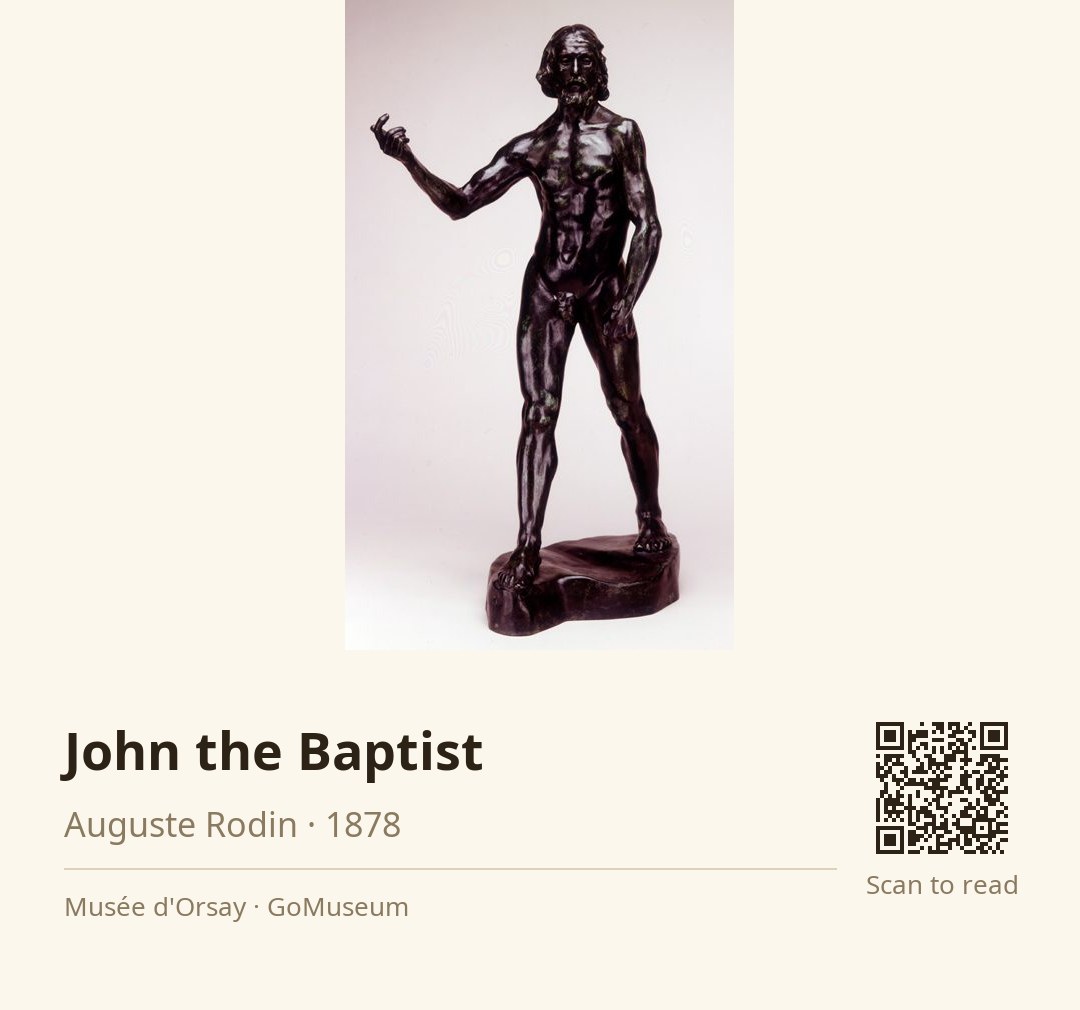
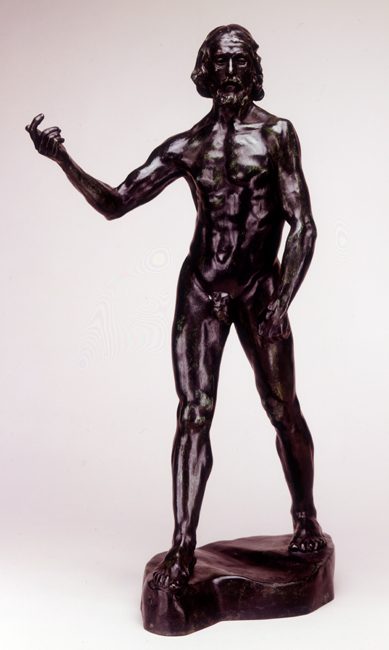
🎧 This work has audio narration — listen in the appTake a moment to really look at Rodin's "John the Baptist." Notice how the figure stands tall and powerful, with his torso twisted slightly as if caught in a moment of passionate preaching. The way his finger points upward is not just a gesture; it’s a declaration, a call to something greater. This detail is crucial because it captures the essence of John the Baptist as a visionary and a precursor to Christ. Rodin was inspired by a real-life Italian peasant, whose raw, natural strength he saw as embodying the spirit of this biblical figure. By stripping John of his traditional garments, Rodin emphasizes his connection to nature and asceticism, inviting us to see him as a man of the earth, yet deeply spiritual. Created in 1878, this sculpture marked a turning point for Rodin, showcasing his revolutionary approach to form and emotion. It was a bold statement against the rigid conventions of his time, proving that sculpture could convey not just beauty, but also the complexities of human experience. As you stand here, consider what it means to be a voice for the unheard. What message would you want to share if you were in John’s place?
François Auguste René Rodin, born on November 12, 1840, in Paris, is celebrated as a pioneer of modern sculpture. His artistic journey began in a working-class family, where he developed a passion for drawing at an early age. Despite facing rejections from prestigious art schools, Rodin honed his skills through self-education and apprenticeships, notably under the influential sculptor Antoine-Louis Barye.
Rodin's work is characterized by a remarkable ability to capture the human form with naturalism and emotional depth, diverging from the decorative and formulaic styles of his contemporaries. His iconic pieces, such as The Thinker and The Kiss, reflect a profound exploration of human experience, blending elements of romanticism and impressionism. His innovative approach often sparked controversy, yet he remained steadfast in his vision.
Throughout his life, Rodin formed significant relationships, notably with sculptor Camille Claudel, who was both his student and muse. He eventually married his lifelong partner, Rose Beuret, shortly before their deaths. By the turn of the 20th century, Rodin had achieved international acclaim, becoming a sought-after artist among the elite. Although his popularity waned after his death in 1917, his legacy endured, solidifying his status as one of the most influential sculptors in art history.
Notice the way the surface is textured, almost alive, with a sense of movement captured in the folds of the figure's muscles. This gives the sculpture a raw, organic feel, as if it could breathe. The details, from the powerful stance to the expressive hands, showcase Rodin's ability to model the human form with a sense of realism that was revolutionary for his time.
Rodin began crafting 'John the Baptist' in 1877, following the controversy surrounding his earlier work, 'The Age of Bronze.' This sculpture was a response to critics who accused him of merely copying from life. To prove his originality, he created this larger-than-life figure, showcasing his unique style. The plaster version debuted at the Salon of 1880, where it garnered attention and praise. In 1881, the bronze cast was acquired by the French state, solidifying Rodin's reputation. Over the years, several smaller versions were cast, and today, you can find them in prestigious collections around the world, including the Musée d'Orsay and the Tate.
Created in 1878, it not only showcased Rodin's mastery of form and emotion but also challenged the conventions of his time. By portraying the biblical figure in a raw, unadorned state, Rodin stripped away the traditional attributes associated with saints, emphasizing the humanity and physicality of his subject. This approach influenced generations of artists, paving the way for modern sculpture to embrace more expressive and naturalistic forms. Rodin's innovative techniques, like fragmentation and assembly, broke free from the rigid academic styles of the past, allowing for a new language in sculpture that celebrated individual character and emotional depth. Remember, this work is not just a representation of a saint; it's a bold declaration of the artist's vision and a catalyst for change in the art world.
When he first saw this man, he was struck by his raw, powerful presence, which he felt embodied the spirit of John the Baptist. Rodin's admiration for this peasant's physicality led him to model the sculpture in a way that captures both strength and spirituality, a blend that was quite revolutionary for the time.
Rodin employed a revolutionary approach to modeling, focusing on capturing the raw, organic feel of the human body, which allowed him to create intricate textures that convey a sense of movement and life.