 Image: Phyrexian · Honza Soukup from Czech Republic · Honza Soukup from Czech Republic · InSapphoWeTrust from Los Angeles, California, USA · Ibex73
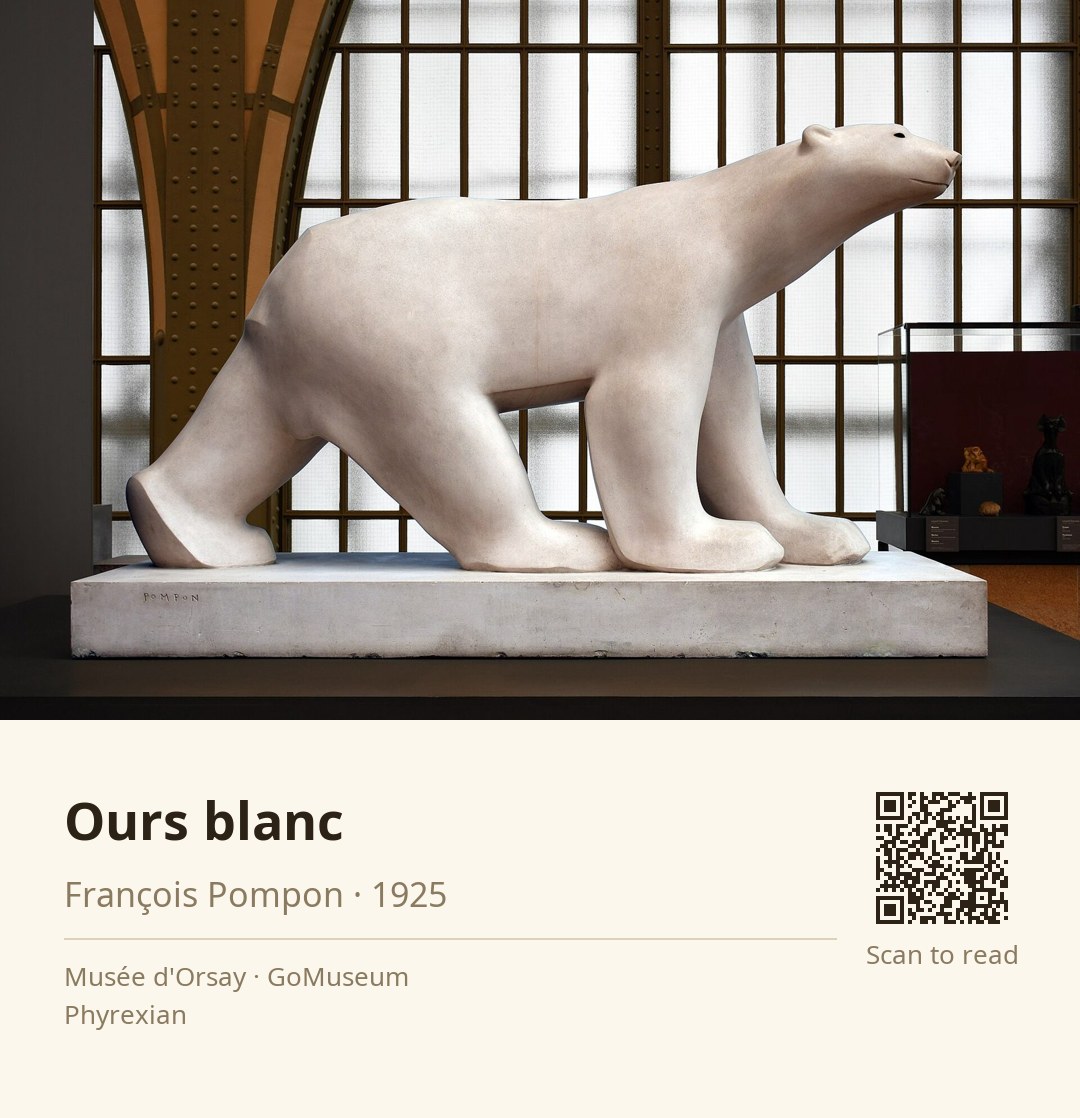
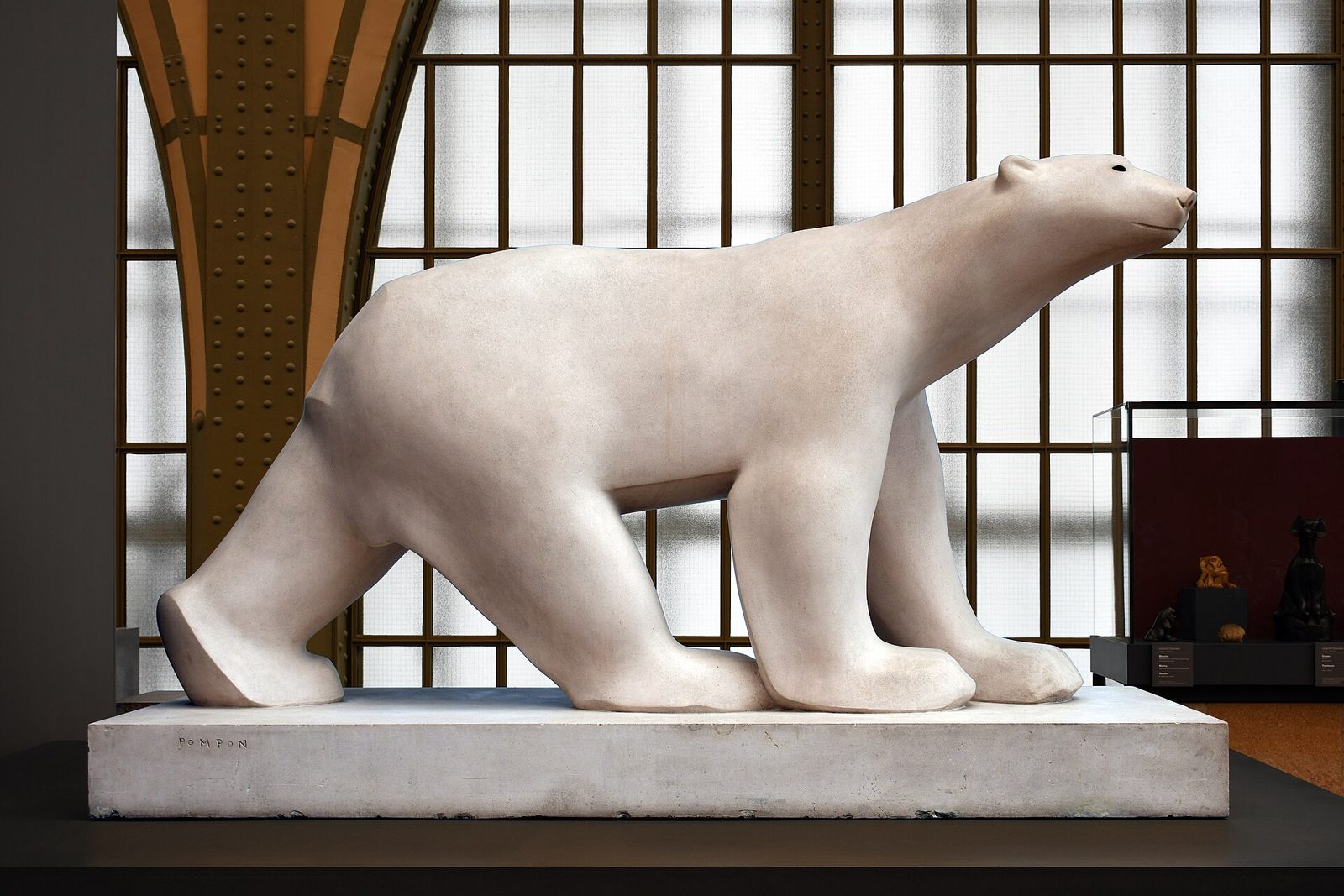
Take a moment to really look at "Ours blanc," the striking white bear by François Pompon. Notice how its smooth, flowing lines create a sense of grace and movement, almost as if it’s about to stride right off the pedestal. The way the light catches the polished stone gives it a lifelike quality, making you feel the bear's presence in the room. These details matter because they reflect Pompon's innovative approach to sculpture, where he simplified forms and emphasized elegance over realism. This was a bold move in the 1920s, a time when many artists were still focused on intricate details. Pompon’s style marks a shift towards modernism, influencing generations of sculptors who followed. Pompon, who spent decades honing his craft, didn’t find fame until he was 67, showcasing the perseverance of an artist dedicated to his vision. "Ours blanc" was his breakthrough piece at the Salon d'Automne in 1922, finally earning him the recognition he deserved. As you stand here, think about the journey this bear represents—not just for Pompon, but for all artists who strive for their moment in the spotlight. What does this bear inspire in you?
François Pompon was a French sculptor born on May 9, 1855, in Saulieu, Burgundy. He began his artistic journey as an apprentice marble carver, later studying at the École nationale supérieure des arts décoratifs. His career took off in Paris, where he worked under renowned sculptors, including Auguste Rodin. Despite his early promise, Pompon's innovative style, characterized by simplified forms and polished surfaces, went largely unrecognized until he was 67. His breakthrough came at the 1922 Salon d'Automne with "Ours blanc," a work that marked his transition into modern stylized animalier sculpture. This acclaim allowed him to create significant pieces like "Grand Cerf" and "Taureau." Pompon's legacy as a pioneer of modern sculpture influenced artists such as Constantin Brâncuși. He passed away on May 6, 1933, leaving behind a rich collection of works and a posthumous recognition that finally honored his contributions to art.
As you admire 'Ours blanc,' take a closer look at the stone itself. Pompon chose a white stone that’s been polished to a smooth finish, which not only enhances its elegance but also allows light to dance across its surface. Notice how the contours of the bear are simplified, almost abstracted, yet they still convey a sense of life and movement. This technique of polishing and streamlining forms was revolutionary, steering away from the intricate detailing that dominated earlier sculptures. It’s this very craftsmanship that invites you to feel the bear’s presence, as if it’s ready to leap into action.
François Pompon's 'Ours blanc,' or 'White Bear,' made its debut at the Salon d'Automne in 1922, marking a pivotal moment in the artist's career. This was no ordinary exhibition; it was where Pompon finally received the recognition he had long sought, at the age of 67. The acclaim was immediate and profound, as his work stood out for its modernist approach, a stark contrast to the realistic styles that dominated the 19th century. Following this success, Pompon enjoyed newfound independence, allowing him to create significant works like 'Grand Cerf' and 'Taureau.' The sculpture itself, carved from stone, measures an impressive 163 cm in height and 251 cm in length, embodying the essence of the polar bear in a stylized form. Today, the final exemplar of 'Ours blanc' resides in the Musée d'Orsay, a testament to Pompon's lasting impact on the world of sculpture.
When it debuted in 1922, it broke away from the overly detailed realism that dominated the 19th century, ushering in a new era of modernism. Pompon's simplified forms and polished surfaces influenced a generation of artists, including the renowned Constantin Brâncuși. This shift towards abstraction in animal sculpture opened doors for future explorations in minimalism and stylization, making Pompon a pivotal figure in art history.
Did you know that Pompon's career took a surprising turn during World War I? With many of his contemporaries away at war, he found himself without work and had to take on odd jobs just to make ends meet. This period of hardship only fueled his determination to create, leading to the groundbreaking work that would eventually bring him fame. It's a testament to his resilience and passion for art, even in the face of adversity.
Pompon was notably influenced by Japonisme and ancient Egyptian art, which inspired his simplification of forms and polished surfaces. His exposure to these styles helped him develop a modern approach to animal sculpture that set him apart from his contemporaries.
Pompon's early work as an assistant to renowned sculptors like Auguste Rodin provided him with invaluable skills and insights into the art world. These experiences not only honed his craftsmanship but also allowed him to network with influential figures, ultimately paving the way for his later recognition.
After Pompon's passing, many of his works were cast in bronze by various foundries, leading to the production of numerous fakes, some of poor quality. His legacy was further solidified by the establishment of the Musée François Pompon in his hometown, which showcases his contributions to modern sculpture.