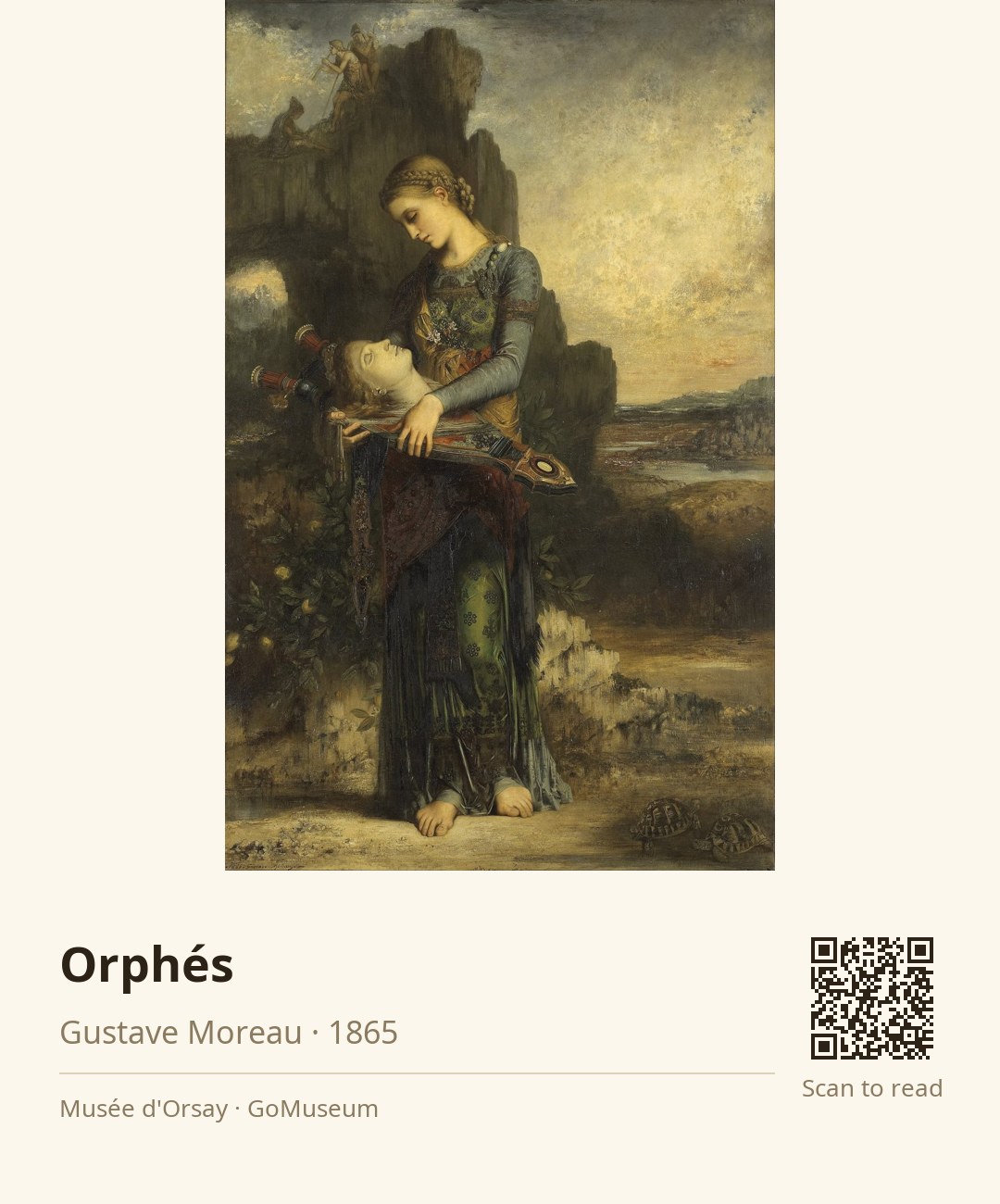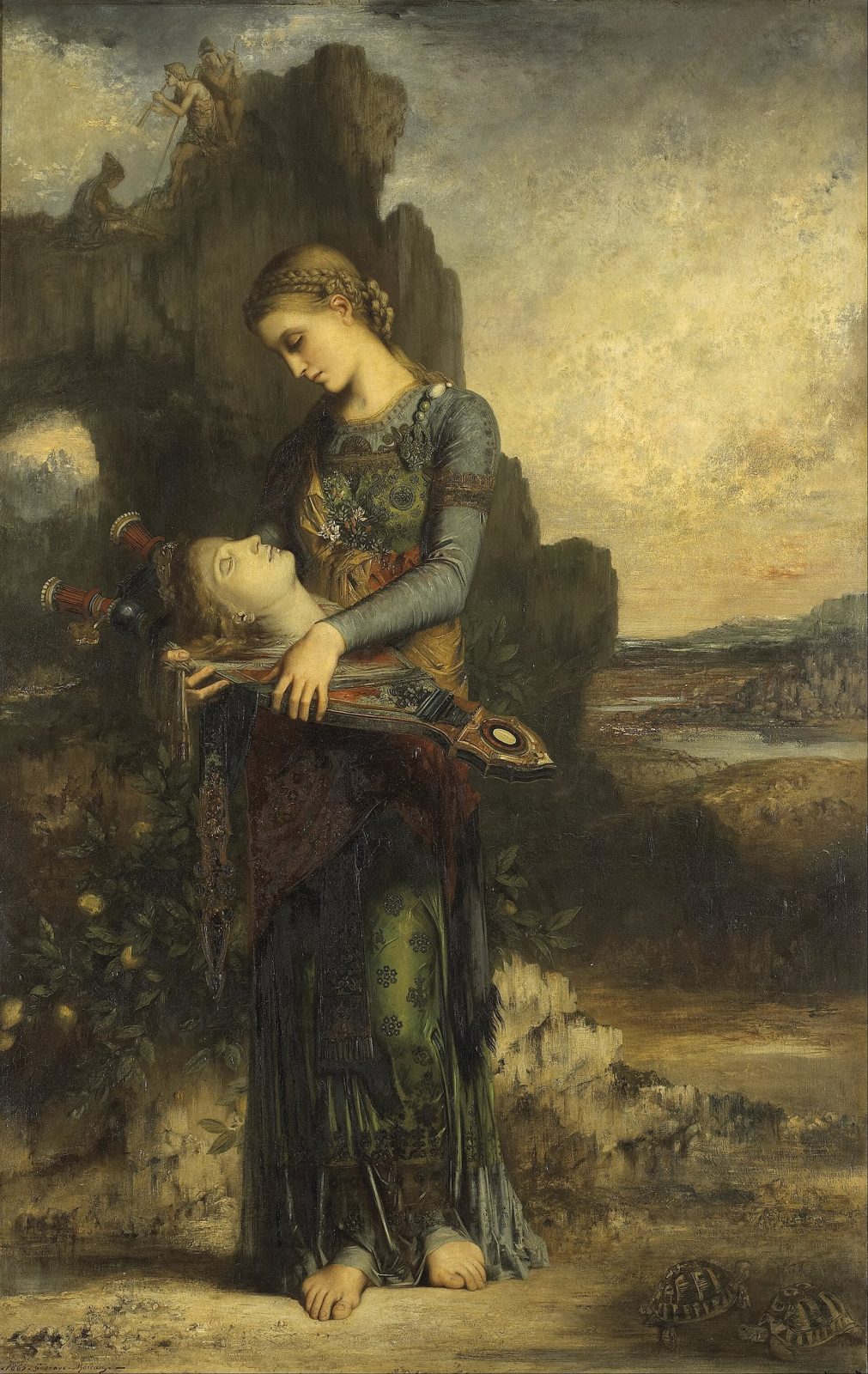
Take a moment to really look at "Orphés" by Gustave Moreau. Notice how the young Thracian girl cradles Orpheus's head, her expression a blend of melancholy and reverence. The way her gaze mirrors the serene yet haunting visage of Orpheus creates an eerie connection between life and death, doesn’t it?
This detail is crucial because it encapsulates the essence of Moreau's vision — he transforms a tragic myth into a moment of quiet reflection. Instead of focusing on the horror of Orpheus's demise, Moreau invites us into a dreamlike space where beauty and sorrow coexist. The head resting on the lyre suggests a unity between music and memory, hinting at the enduring power of art even in the face of loss.
Created in 1865, this painting was one of Moreau's early successes, marking his departure from conventional representations of mythological subjects. Unlike his contemporaries, who favored realism, Moreau's work paved the way for the Symbolist movement, where emotion and imagination reign supreme.
As you stand here, think about the duality of Orpheus — a figure celebrated for his artistry yet doomed by it. How does this resonate with your own experiences of beauty and loss?
Gustave Moreau, born on April 6, 1826, in Paris, was a pivotal figure in the Symbolist movement, celebrated for his intricate and mystical interpretations of biblical and mythological themes. His early education, influenced by his architect father and musician mother, fostered a deep appreciation for the arts. Moreau's artistic journey began at the École des Beaux-Arts, where he was mentored by François-Édouard Picot and later inspired by Théodore Chassériau.
His breakthrough came with the 1864 exhibition of "Oedipus and the Sphinx," which established his reputation. Moreau's work is characterized by rich detail and a unique blend of allegory and symbolism, earning him acclaim as the quintessential Symbolist painter. Despite his success, he became increasingly reclusive, rejecting numerous prestigious offers and exhibiting infrequently.
Moreau's legacy includes over 15,000 works, and he was instrumental in shaping the Symbolist aesthetic. His influence waned in the early 20th century but saw a resurgence in the 1960s, solidifying his status as a master of the movement. He passed away on April 18, 1898, leaving behind a vast collection of art that now resides in the Musée Gustave Moreau, a testament to his enduring impact on the art world.
Gustave Moreau's 'Orphés' was created in 1865 and quickly became a significant piece in his oeuvre, marking his early success as an artist. Commissioned by Moreau himself, it was first exhibited at the Salon des Artistes français in Paris in 1866, where it was assigned the number 1404. The following year, it was showcased at the Exposition universelle in Paris, further solidifying its prominence. In 1879, it made its way to the Exposition internationale des Beaux-Arts in Munich, where it was listed as number 116. The painting remained in Moreau's collection throughout his life, and after his passing, it was bequeathed to the state, eventually finding its home in the Musée d'Orsay. The reception of 'Orphés' was pivotal, as it helped establish Moreau's reputation in artistic circles that were beginning to appreciate a departure from realism towards a more symbolic and imaginative representation of mythological themes.
As you gaze upon 'Orphés', take a moment to appreciate Moreau's masterful brushwork. The way he layers oil paint creates a rich texture that draws you into the scene. Notice the soft, almost ethereal quality of the light — it bathes the figures in a warm glow, enhancing the dreamlike atmosphere. The composition is carefully structured; the young Thracian girl and Orpheus's head are positioned in a way that their gazes almost meet, creating a poignant connection. Moreau employs a complex interplay of colors, with deep blues and warm earth tones that evoke both melancholy and reverence. The intricate details, from the delicate folds of the girl's garment to the ornate lyre, showcase his meticulous attention to ornamentation. This technique not only highlights the emotional weight of the scene but also immerses the viewer in a world where beauty and sorrow coexist harmoniously.
One fascinating tidbit about 'Orphés' is that it was one of Gustave Moreau's early successes, helping him gain recognition in official art circles. This painting, created in 1865, marked a pivotal moment in his career, setting the stage for his later works that would define the Symbolist movement. Interestingly, while many artists of his time were turning away from traditional academic styles, Moreau embraced and reinvented them, making his approach to mythological subjects both fresh and enchanting.
Moreau's use of layering oil paint creates a rich texture that enhances the ethereal quality of the light in the painting, drawing viewers into its dreamlike atmosphere.