 Image: Didier Descouens
Marguerite de Conflans
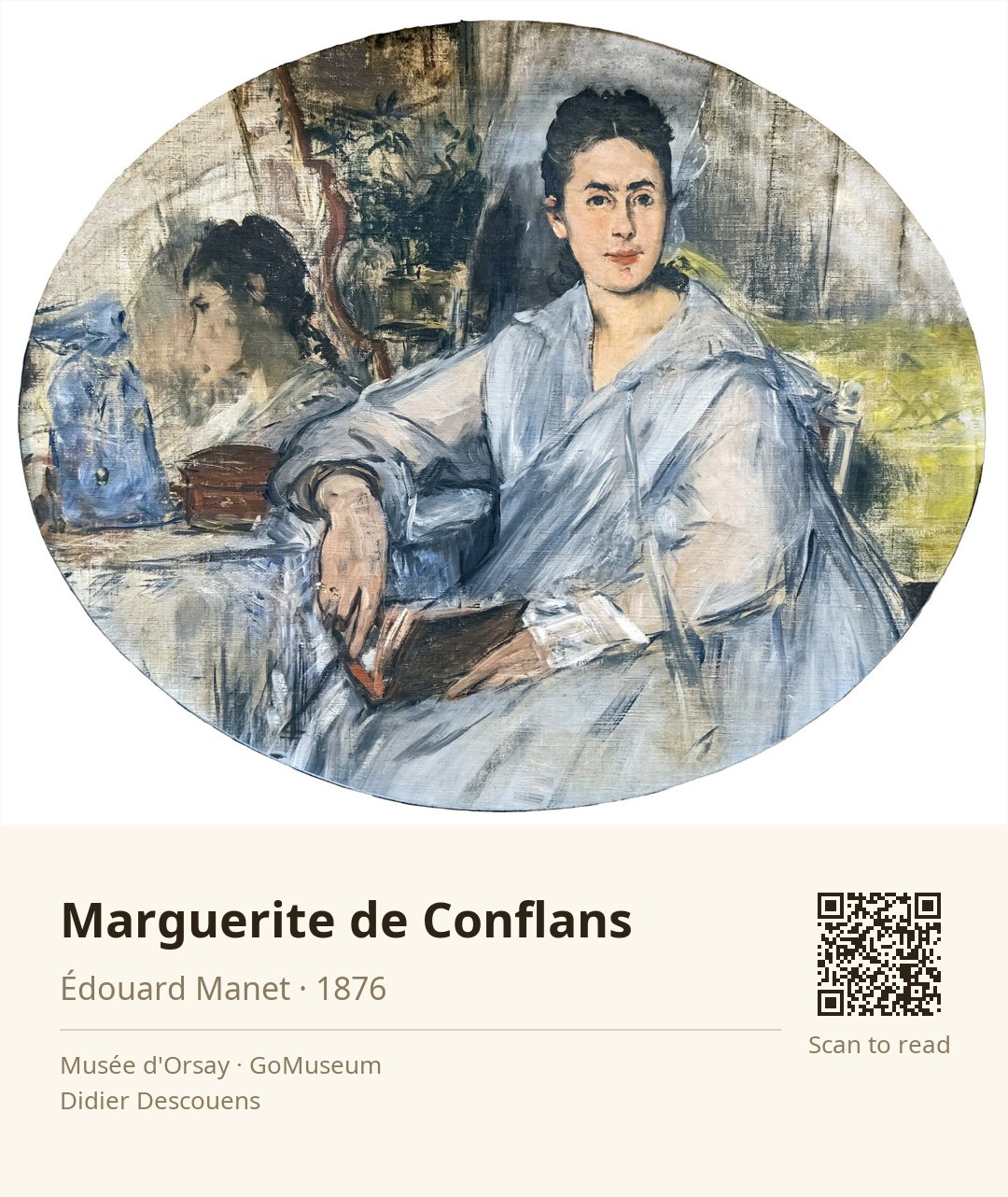
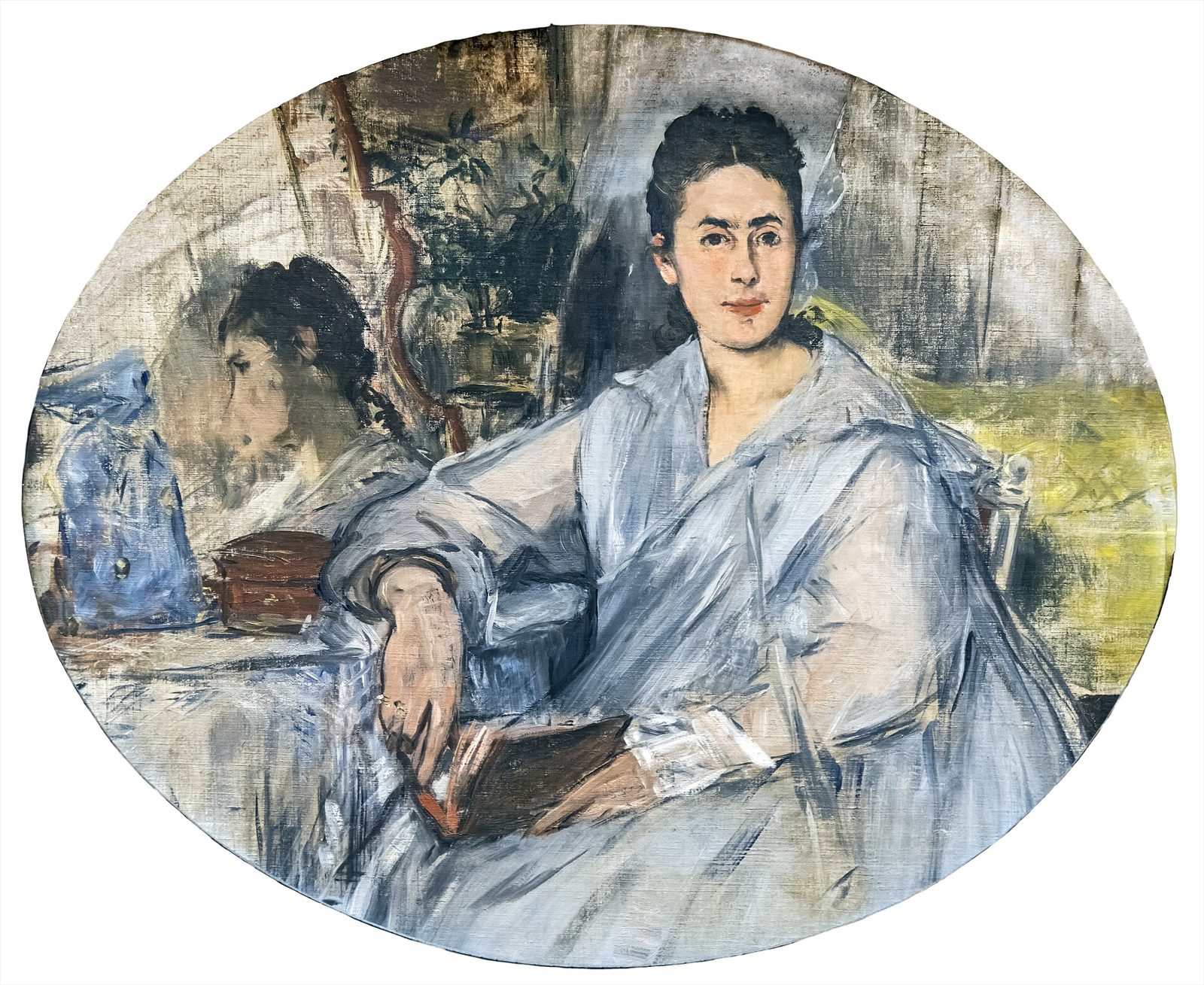
🎧 This work has audio narration — listen in the appTake a moment to really look at Marguerite de Conflans. Notice how Manet captures her in this intimate moment, seated casually, yet there’s a certain elegance in her pose. Look closely at the way her white muslin robe contrasts against the soft, muted background, almost blending into the light.
These details matter because they reveal Manet’s innovative approach to portraiture. Instead of a stiff, formal representation, he invites us into a private space, suggesting a relaxed familiarity. The mirror behind her adds depth, reflecting not just her image but also the complexity of her character—she’s not just a subject; she’s a person with a story, perhaps lost in thought or simply enjoying the moment.
Painted in 1876, this work is one of five portraits of Marguerite, showcasing Manet's fascination with her unique beauty and personality. He often met her at social gatherings hosted by his wife, where he would ask her to pose repeatedly, capturing her essence in a way that feels both personal and universal.
As you stand here, think about what it means to see someone in such a natural state. What do you think Manet wanted us to feel about Marguerite? What stories might she hold within this frame?
Édouard Manet, born on January 23, 1832, in Paris, emerged as a pivotal figure in 19th-century art, bridging Realism and Impressionism. From an affluent family, he initially faced pressure to pursue a naval career but instead dedicated himself to painting, influenced by his uncle and the Old Masters. His early works, including "The Luncheon on the Grass" and "Olympia," sparked controversy and challenged traditional artistic norms, marking him as a revolutionary force.
Manet's style, characterized by loose brushwork and a focus on contemporary life, diverged from the meticulous techniques of his predecessors. He often depicted modern Parisian scenes, capturing the essence of leisure and social dynamics. Despite initial rejection from the art establishment, he gained recognition among progressive artists and became a mentor to the Impressionists.
Throughout his life, Manet formed connections with influential figures like Baudelaire and Zola, who defended him against critics. His later works, such as "A Bar at the Folies-Bergère," showcased his evolving style and mastery of color. Manet's contributions to art history are profound; he is celebrated not only for his innovative techniques but also for elevating still life and modern subjects to the forefront of artistic expression. He passed away on April 30, 1883, leaving behind a legacy that continues to inspire artists today.
Édouard Manet's 'Marguerite de Conflans' was painted in 1876 and is one of five portraits of Marguerite, a woman he was captivated by. The earliest of these portraits dates back to 1873. Manet often encountered Marguerite at social gatherings hosted by his wife, where she would come with her mother. This particular painting was first owned by Mademoiselle d'Angély, Marguerite's daughter, who bequeathed it to the Louvre in 1941. It officially entered the museum's collection in 1945 and was later transferred to the Musée d'Orsay when it opened in 1986. Interestingly, that same year, it was exchanged for another painting, 'The Death of a Sister of Charity' by Isidore Pils, now housed in the Musée des Augustins in Toulouse, where 'Marguerite de Conflans' is currently displayed. The painting underwent restoration in 2005, revealing insights into its material structure, including the fact that the wooden frame is not original.
As you gaze at 'Marguerite de Conflans', notice the brushwork—it's both lively and deliberate, creating a sense of intimacy. Manet's use of color is striking; the soft, muted background contrasts beautifully with Marguerite's white muslin robe, making her figure pop. The oval shape of the canvas draws your eye inward, while the mirror cleverly reflects her image, adding layers to her character. This technique, reminiscent of Ingres, is quite rare for Manet, who typically avoided such motifs. The painting's scale is intimate, inviting you into a private moment, as if you’re peeking into her world. The loose application of paint gives the work a sense of immediacy, almost as if it was completed in one sitting, capturing Marguerite's essence in a fleeting moment.
This painting, created in 1876, showcases Manet's departure from traditional techniques, embracing a looser brushwork and a more intimate portrayal of his subjects. By depicting Marguerite in a relaxed, personal setting, he invites viewers into her world, breaking away from the formalities of earlier portraiture. This approach not only influenced his contemporaries but also set the stage for future artists to explore more personal and candid representations.
One intriguing detail about 'Marguerite de Conflans' is that during its restoration in 2005, it was discovered that the edges of the canvas were worn, yet the canvas itself remained surprisingly supple. This suggests that despite its age, the painting has retained its integrity, allowing us to appreciate Manet's technique and the vibrant colors he employed.
The oval shape of 'Marguerite de Conflans' is quite distinctive and can create a sense of intimacy, drawing the viewer's eye inward and making the scene feel more personal and inviting.
Initially owned by Marguerite's daughter, Mademoiselle d'Angély, the painting's bequest to the Louvre in 1941 adds a layer of familial connection and historical importance, linking the artwork directly to the subject's lineage.