Réunion de famille
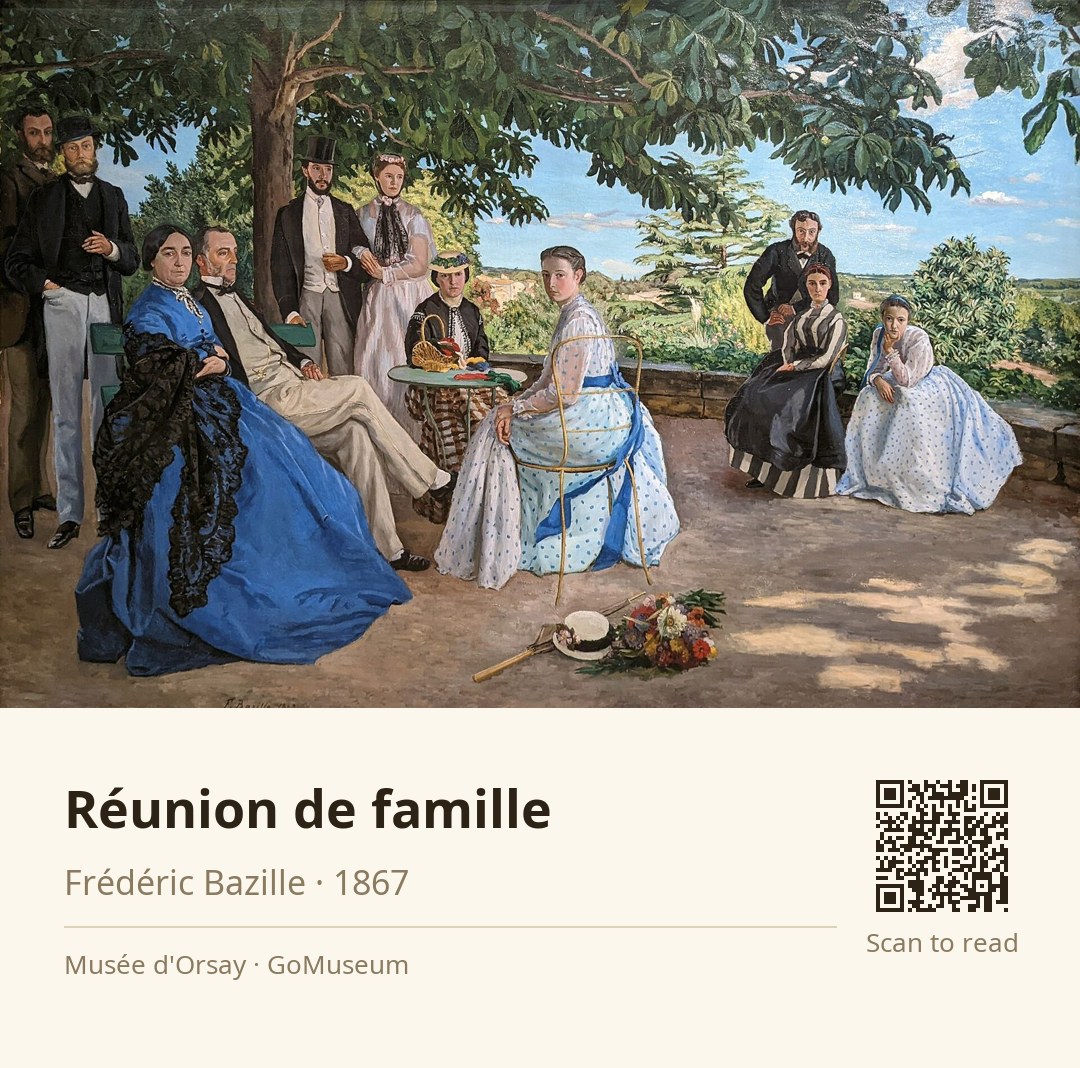
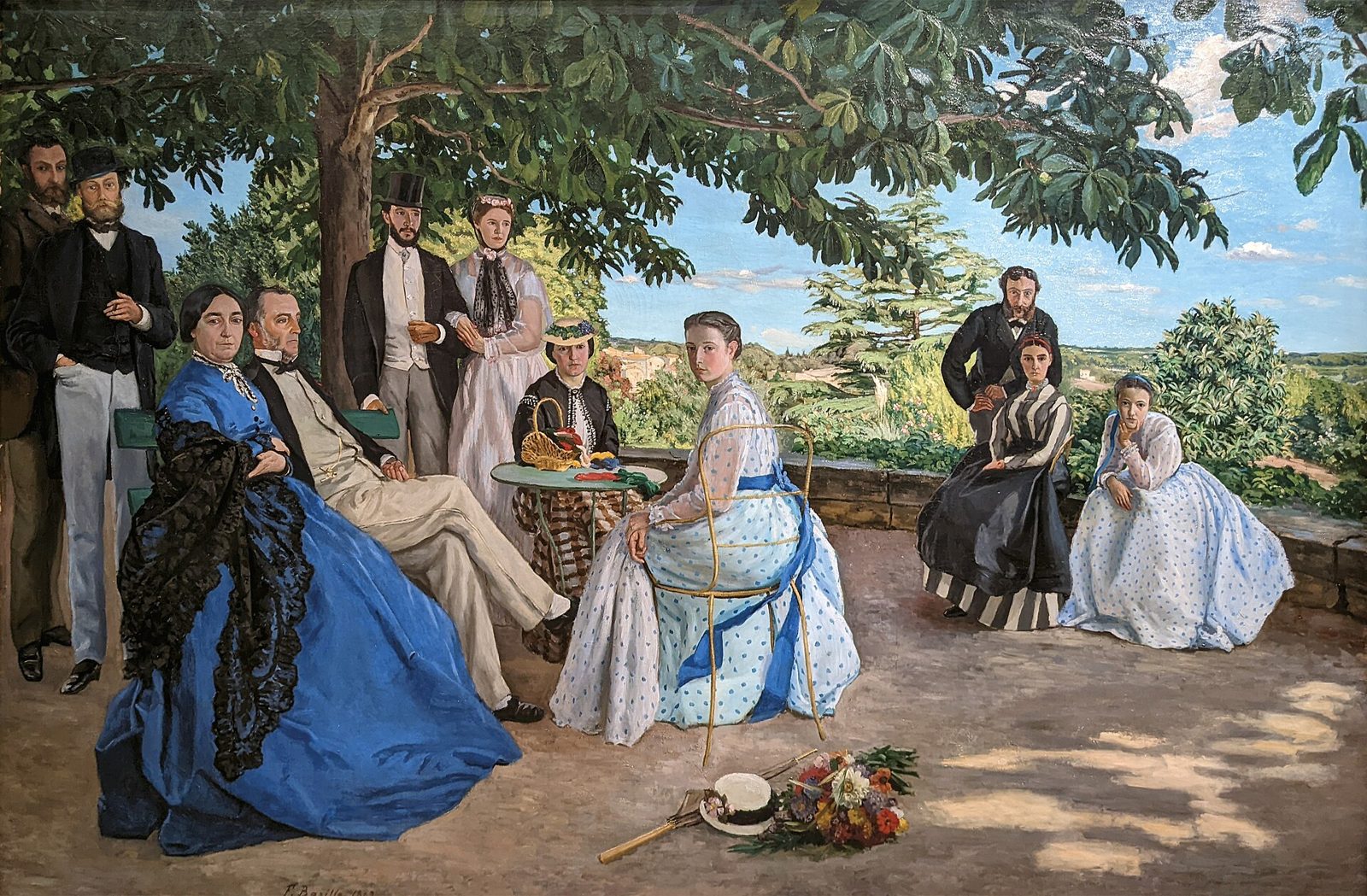
🎧 This work has audio narration — listen in the appTake a moment to really soak in the scene of "Réunion de famille." Look closely at the figures gathered under that sprawling chestnut tree. Notice how eight of the eleven people are looking directly at you, yet there’s a palpable distance between them, almost like a staged family portrait. This stillness contrasts sharply with the vibrant Southern French light that Bazille captures so beautifully, illuminating their fashionable dresses and the lush greenery around them.
Well, Bazille's choice to depict his family in this way reflects the complexities of their relationships. His father, seated in profile, seems to embody a certain patriarchal authority, while the rest of the family appears almost frozen in time, each person a distinct character yet disconnected from one another. This tension hints at Bazille’s own struggles with familial expectations, especially since he chose art over medicine, a decision that likely strained his relationship with his father.
Painted in 1867, this piece is not just a family gathering; it’s a snapshot of 19th-century bourgeois life, capturing the essence of a moment that Bazille later felt compelled to refine after its exhibition. It’s a reminder of how art can serve as both a personal expression and a reflection of societal norms.
As you stand here, think about the stories behind those gazes. What do you imagine they were feeling in that moment?
Jean Frédéric Bazille was a French Impressionist painter born on December 6, 1841, in Montpellier. Coming from a wealthy Protestant family, he initially pursued medicine to satisfy his parents but soon shifted his focus to art after being inspired by Eugène Delacroix. Moving to Paris in 1862, he became part of the burgeoning Impressionist movement, befriending artists like Claude Monet and Pierre-Auguste Renoir. Bazille's works, characterized by their vibrant figures set against natural landscapes, include notable pieces such as "Family Reunion" and "The Pink Dress."
Despite his promising career, Bazille's life was tragically cut short when he died at the age of 28 during the Franco-Prussian War. His commitment to his friends and the arts was evident as he generously supported fellow artists. Although his work was largely forgotten after his death, a revival began in the 20th century, recognizing his contributions to Impressionism. Today, Bazille is celebrated for his unique perspective and remains an important figure in art history, embodying the spirit of youthful creativity and camaraderie among the Impressionists.
Frédéric Bazille painted 'Réunion de famille' in 1867, inspired by a family gathering at his home in Méric, near Montpellier. The painting was exhibited at the Salon des artistes français in Paris in 1868, where it received attention for its portrayal of natural light and the detailed depiction of the figures. Émile Zola, a rising literary star at the time, was commissioned to review the work, praising Bazille's sensitivity in capturing the essence of the moment. Despite its acceptance, Bazille felt compelled to refine the piece after its exhibition, indicating his ongoing struggle for artistic validation. The painting was later acquired by the state museums from Bazille's family in 1905, marking its journey from a personal family portrait to a significant piece in the Musée d'Orsay's collection.
As you gaze at 'Réunion de famille,' notice how Bazille's brushwork creates a vivid interplay of light and shadow, particularly under the sprawling chestnut tree. The way he captures the Southern French sunlight adds a warmth that contrasts with the stillness of the figures. Each character is painted with meticulous attention to detail, from the fashionable dresses of the women to the subtle expressions on their faces. The composition is structured almost like a stage, with Bazille himself positioned behind his seated parents, reinforcing the familial hierarchy. The scale of the painting, being the largest of his works, enhances the sense of intimacy while also emphasizing the disconnect among the figures, as they gaze outward yet remain isolated in their own worlds.
One surprising detail about 'Réunion de famille' is that after its initial exhibition, Bazille decided to alter the painting, replacing a dog in the foreground with a still life of flowers and a hat. This choice reflects not only his dissatisfaction with the original composition but also the pressures artists faced to conform to the tastes of the conservative art juries of the time.
Bazille replaced a dog in the foreground with a still life of flowers and a hat, reflecting his dissatisfaction with the original composition and the pressures he felt to conform to artistic expectations.
The painting was accepted for exhibition at the Salon of 1868, garnering praise from Émile Zola, while Monet's more daring compositions were rejected, highlighting the contrasting artistic paths and the conservative tastes of the art juries at the time.