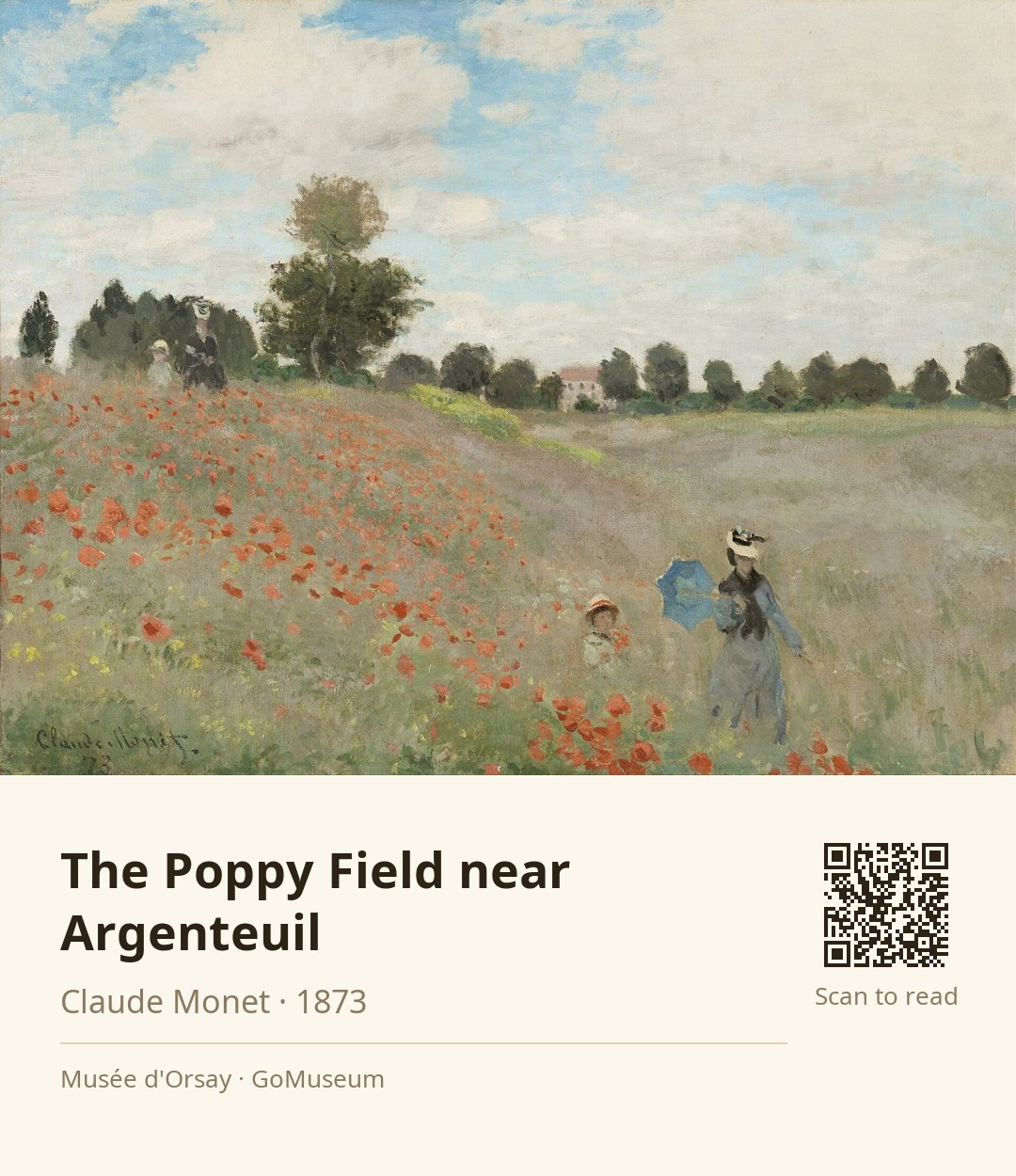
The Poppy Field near Argenteuil
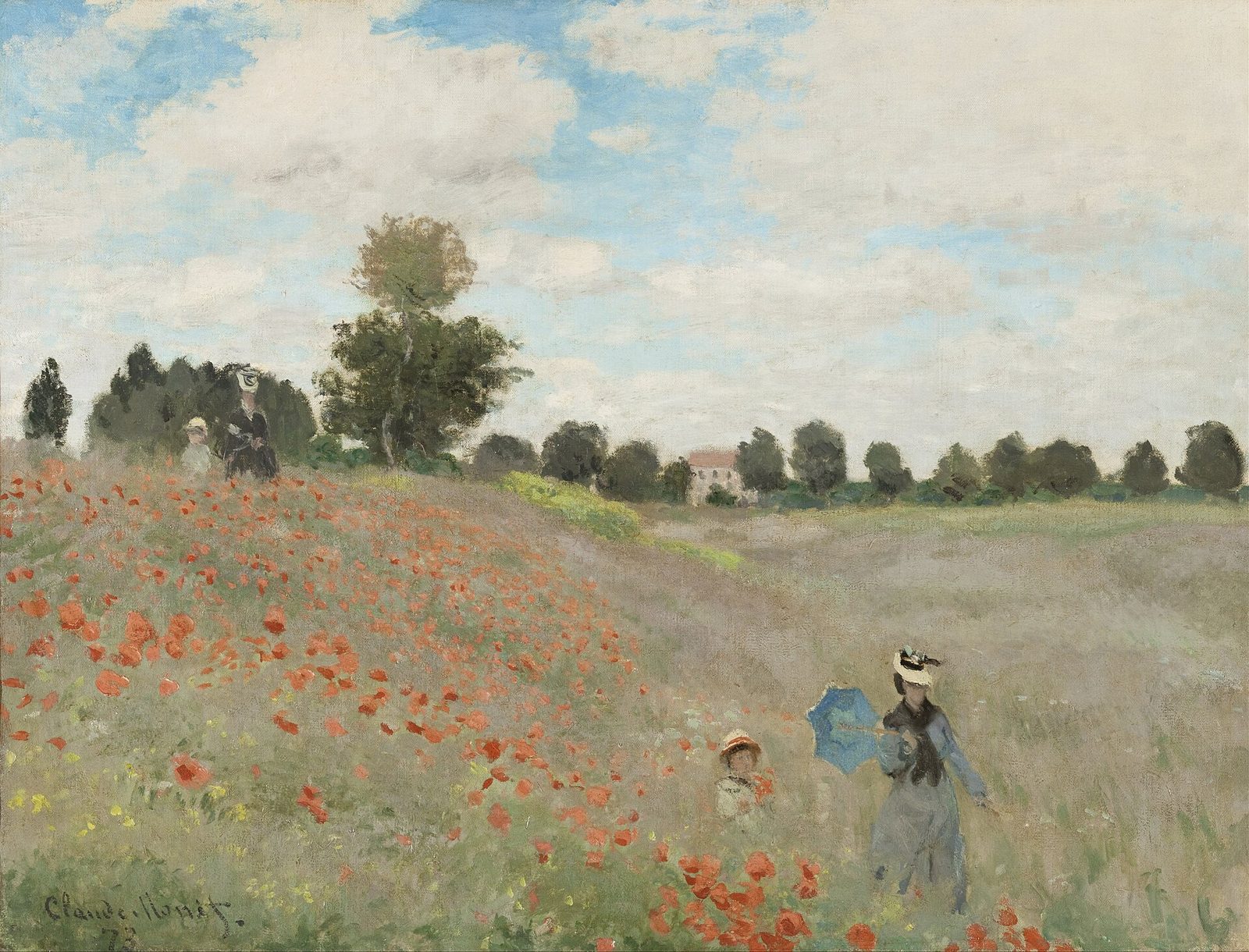
🎧 This work has audio narration — listen in the appTake a moment to really soak in the vibrant colors of "The Poppy Field near Argenteuil." Notice how the bright red poppies on the left side seem to dance in the breeze, almost inviting you into the scene. And look closely at the figures in the foreground—a woman with a delicate parasol and a child by her side. These details matter because they embody Monet's revolutionary approach to capturing everyday life. The poppies, with their vivid hues, symbolize the beauty of nature, while the figures represent the joy of family and leisure in the countryside. Monet painted this in 1873, a time when he was deeply influenced by the Impressionist movement, which sought to depict fleeting moments of light and color. At just 33 years old, Monet was living in Argenteuil, a picturesque village near Paris, where he found inspiration in the landscapes around him. This painting was showcased at the first Impressionist exhibition in 1874, marking a pivotal moment in art history. As you stand here, think about the connection between the artist and the scene—what emotions do you think he was trying to convey? What stories might the figures in the painting be sharing? Let your imagination wander through the field of poppies.
Oscar-Claude Monet, born on November 14, 1840, in Paris, was a pioneering French painter and a founder of Impressionism, a movement that transformed the art world. Raised in Le Havre, he developed a passion for nature and painting early on, encouraged by his mother, while his father hoped he would pursue a business career. After his mother's death in 1857, Monet moved in with his aunt, who supported his artistic ambitions.
Monet's career began with caricatures, but he soon sought formal training, studying under Eugène Boudin, who introduced him to plein air painting. His breakthrough came in 1866 with "La Femme à la robe verte," which garnered attention at the Salon. The term "Impressionism" originated from his work "Impression, Sunrise," exhibited in 1874, marking a shift away from traditional art.
Throughout his life, Monet focused on capturing the essence of light and color in nature, creating series of paintings that depicted the same scenes under varying conditions, such as his famous haystacks and water lilies. He settled in Giverny in 1883, where he cultivated a beautiful garden that became his muse. Despite personal hardships, including the loss of loved ones and health issues, Monet's relentless dedication to his craft solidified his place in art history as a master of modernism, influencing countless artists and leaving a lasting legacy. He died on December 5, 1926, in Giverny, celebrated as one of the most significant figures in art.
In 1873, Claude Monet, then just 33 years old, was living in the charming village of Argenteuil, where he found inspiration in the surrounding landscapes. The following year, it made its debut at the First Impressionist Exhibition in Paris, a groundbreaking event that showcased the new movement's fresh approach to art. The reception was mixed, with some praising the vibrant colors and loose brushwork, while others were bewildered by the departure from traditional techniques. After passing through several notable owners, including the painter Ernest Duez and the singer Jean-Baptiste Faure, the painting was donated to the French state in 1906 by Étienne Moreau-Nélaton. It has since been housed in prestigious institutions, including the Louvre and now the Musée d'Orsay, where it continues to captivate audiences.
As you gaze at 'The Poppy Field near Argenteuil,' take a moment to appreciate Monet's masterful technique. Notice how he employs loose brushwork, creating a sense of movement that mirrors the gentle sway of the poppies in the breeze. The vibrant reds on the left side of the canvas contrast beautifully with the cooler blue-greens on the right, establishing a dynamic balance. Monet's choice to depict the scene outdoors, or 'en plein air,' allows him to capture the fleeting effects of light and atmosphere. The composition is cleverly structured, with the two mother-child couples creating an oblique line that guides your eye across the canvas. This not only adds depth but also invites you to explore the relationship between the figures and their surroundings. The scale of the painting, at 50 by 65 centimeters, feels intimate yet expansive, drawing you into this idyllic moment in nature.
One surprising tidbit about 'The Poppy Field near Argenteuil' is that the woman depicted in the foreground is believed to be Camille Doncieux, Monet's wife, accompanied by their young son, Jean. This personal connection adds a layer of intimacy to the painting, as it captures a moment of family life amidst the vibrant beauty of nature.
The two mother-child couples in the painting create an oblique line that guides the viewer's eye across the canvas, adding depth and inviting exploration of the relationship between the figures and their surroundings.