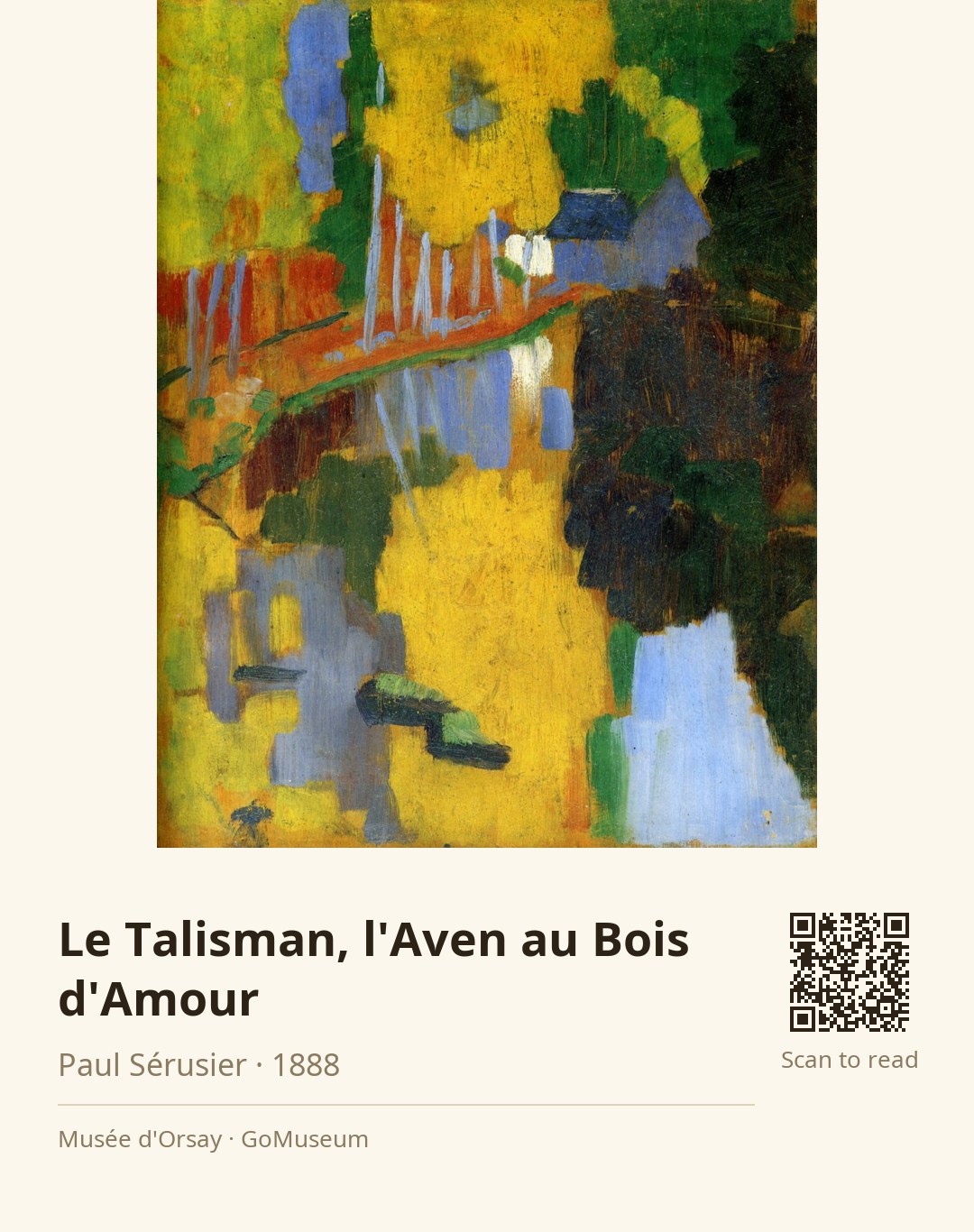
Le Talisman, l'Aven au Bois d'Amour
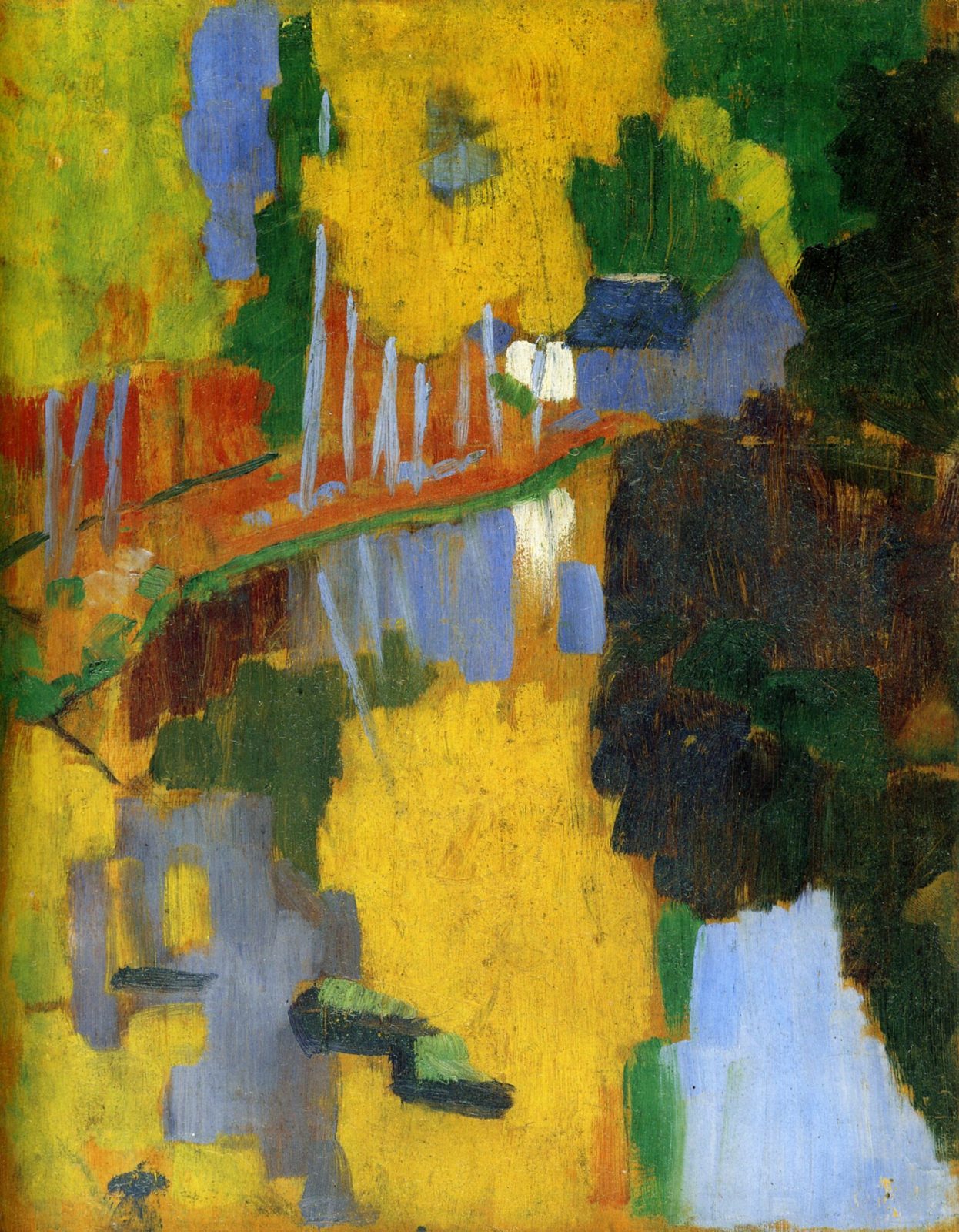
🎧 This work has audio narration — listen in the appTake a moment to really absorb the vibrant colors of "Le Talisman." Notice how the trees burst with bright yellows and the shadows are painted in deep blues. These aren’t just colors; they’re a direct challenge to how we typically see nature. Paul Sérusier, under the guidance of Paul Gauguin, was encouraged to exaggerate his perception, to let his emotions guide his brush rather than simply replicate the scene before him.
This painting, created in 1888, became a cornerstone for the Nabis movement, a group of young artists seeking to redefine art. Sérusier’s bold use of color and flat forms was revolutionary, moving away from the Impressionist focus on light and realism to a more symbolic and expressive approach. It’s fascinating to think that what started as a simple study of a landscape evolved into a manifesto for a new artistic philosophy.
Sérusier painted this piece in the picturesque Bois d'Amour in Brittany, a place that inspired many artists of his time. When he returned to Paris, his fellow students initially mocked it, but it was embraced by those who would become the Nabis, who saw its potential to reshape the future of art.
As you stand here, consider how this small painting, just 27 by 21.5 centimeters, sparked a movement. What do you think it means to see the world through such a vibrant lens?
Paul Sérusier was a French painter born on November 9, 1864, in Paris, who became a pivotal figure in the evolution of abstract art. A student at the Académie Julian, he was influenced by Paul Gauguin during his time at the Pont-Aven artist colony, where he created "The Talisman," a work that exemplified Cloisonnism and hinted at pure abstraction. Sérusier was a founding member of the Nabis group, which sought to express deeper meanings through color and form, moving beyond mere representation. His character was marked by a friendly disposition and a collaborative spirit, fostering connections with fellow artists like Pierre Bonnard and Édouard Vuillard.
Throughout his career, Sérusier engaged in teaching and writing, publishing "ABC de la peinture" in 1921, which reflected his artistic philosophy. He spent his later years in Brittany, where he continued to explore themes of spirituality and symbolism in his work. Sérusier's contributions to the Nabis movement and his innovative approaches to color and composition solidified his place in art history as a precursor to modern abstraction, influencing generations of artists who followed. He passed away on October 7, 1927, leaving behind a legacy that bridged the gap between Impressionism and the avant-garde.
In October 1888, Paul Sérusier, a 24-year-old artist, ventured to the picturesque artist colony of Pont-Aven in Brittany, armed with a letter of introduction to the influential Paul Gauguin. Sérusier, fresh from his studies at the Académie Julian in Paris, sought to capture the beauty of nature. Under Gauguin's mentorship, he painted 'Le Talisman,' a work that would become a cornerstone for the Nabis movement. Initially, Sérusier's peers at the Académie Julian mocked his bold colors and unconventional approach. However, a select group, including future Nabis members like Maurice Denis and Pierre Bonnard, recognized its revolutionary potential. They affectionately dubbed it 'The Talisman,' a name given by Paul-Élie Ranson, who hung it in their studio, humorously referred to as 'The Temple.' This small painting, intended as a mere sketch, became an emblem of their artistic philosophy, emphasizing flat surfaces and color over realism. Following Sérusier's death in 1927, the painting’s legacy was preserved by Denis, who championed its significance in the art world, ultimately leading to its place in the Musée d'Orsay in Paris.
As you gaze at 'Le Talisman,' take a moment to appreciate Sérusier's daring brushwork and the way he manipulates color. The painting is a vibrant tapestry of pure hues, where yellows, blues, and reds collide in a symphony of emotion rather than a mere representation of nature. Sérusier's technique, influenced by Gauguin, embraces a flatness that challenges traditional depth and perspective. Notice how the trees are not just green but a striking yellow, shadows are not gray but bold ultramarine, and the leaves pop with vermillion. This choice to exaggerate colors creates a sense of immediacy and emotional resonance, inviting you to feel rather than just see. The composition, though modest in size, packs a punch—its small scale draws you in, making you an intimate participant in Sérusier's vision. It’s a radical departure from the Impressionist focus on light and realism, marking a pivotal moment in the evolution of modern art.
Under the mentorship of Paul Gauguin, Sérusier broke away from traditional representation, embracing bold colors and flat forms. This radical approach inspired a generation of artists who sought to express emotions and sensations rather than mere likeness. The Talisman became a manifesto for the Nabis, emphasizing that a painting is fundamentally a flat surface of colors arranged in a meaningful way.
Sérusier used a poplar panel, which was a common support for painting at the time, but its humble beginnings as a potential box cover adds an intriguing layer to its story. This small canvas, which many dismissed at first, would go on to become a pivotal work in art history.
Initially, Sérusier intended 'Le Talisman' to be a simple sketch for a larger work, but he ultimately decided not to modify it, which led to its unexpected significance in art history.
Upon returning to Paris, many of Sérusier's fellow students at the Académie Julian mocked his bold colors and unconventional style, but a select few recognized its revolutionary potential and embraced it.