La Rue Montorgueil
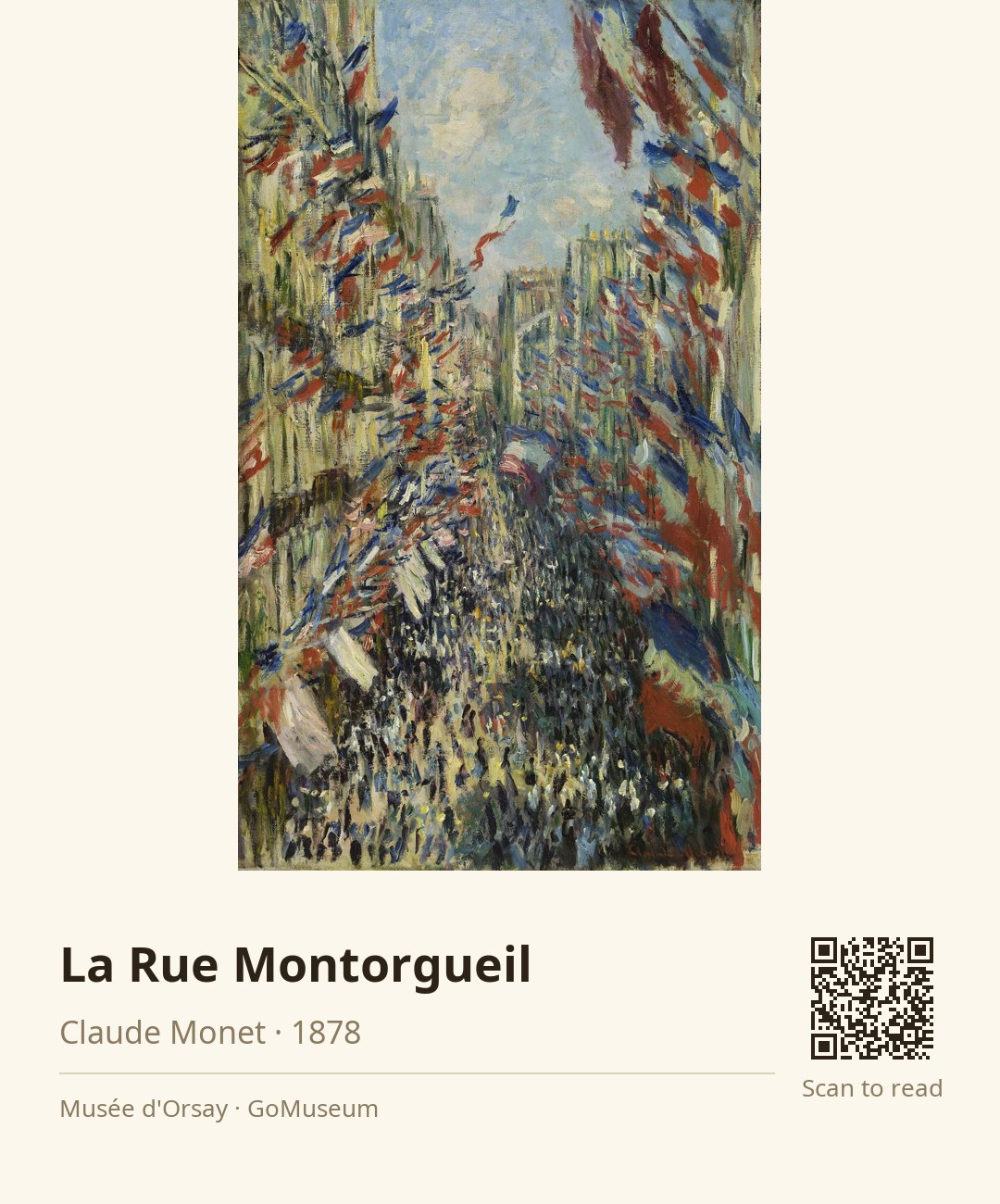
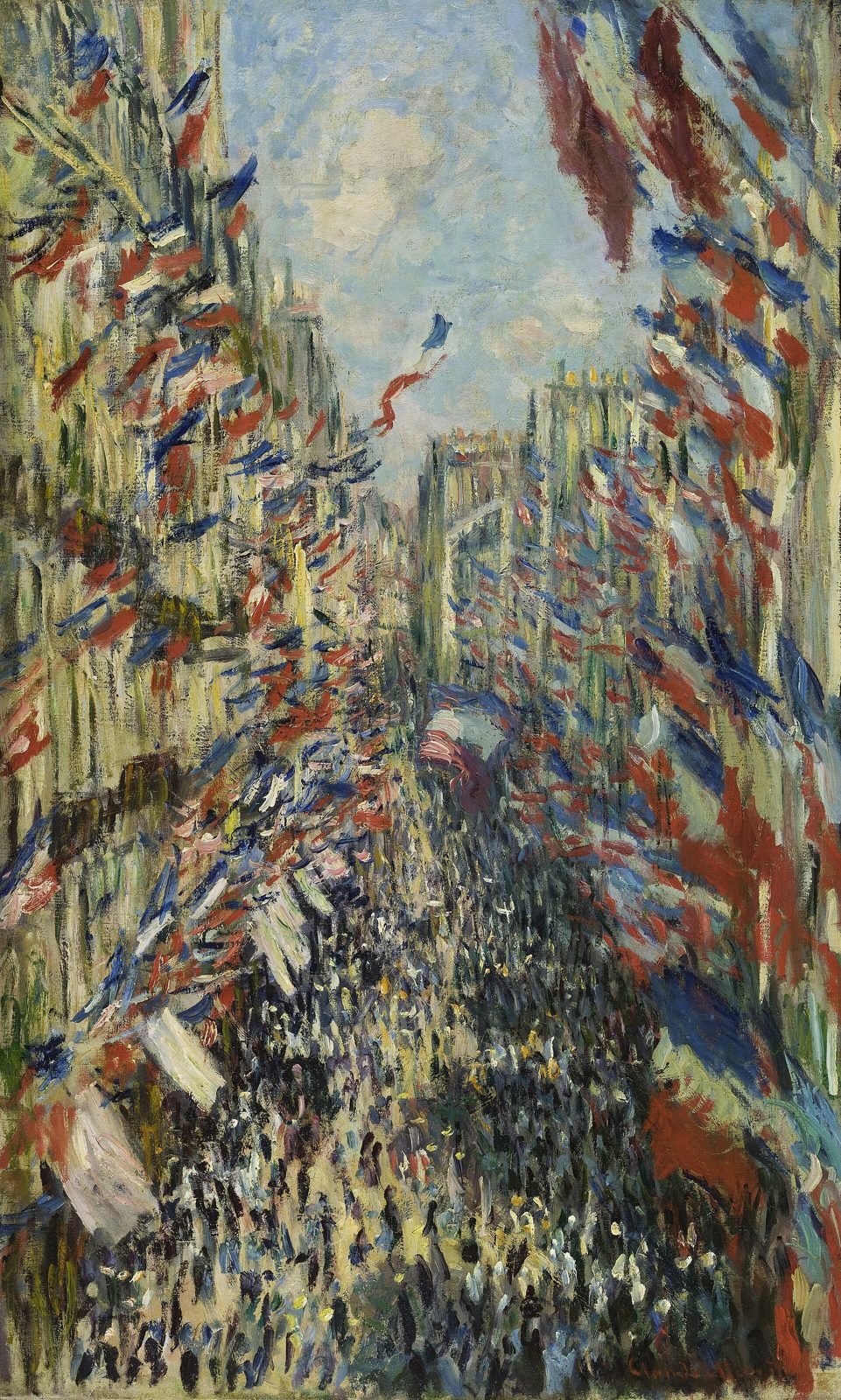
🎧 This work has audio narration — listen in the appTake a moment to really soak in the vibrant energy of Claude Monet's "La Rue Montorgueil." Look closely at the swirling colors and the lively crowd, all celebrating the national holiday on June 30, 1878. Notice how the flags flutter in the breeze, their reds, whites, and blues almost leaping off the canvas. These details aren't just for show; they capture a moment of joy and renewal in post-war France, a time when the nation was eager to celebrate peace and unity after the turmoil of the Franco-Prussian War. Monet, with his brush, immortalizes this festive spirit, inviting us to feel the excitement of the day. Painted while he strolled the bustling streets of Paris, this piece reflects not just a celebration but also Monet's personal connection to the city, as he was back in Paris for the birth of his son. The scene is alive with movement and light, showcasing his fascination with how sunlight dances on surfaces and through crowds. As you stand here, think about what it must have been like to be part of that celebration. What emotions do you think the people felt as they gathered, flags waving, in a city filled with hope? Let that feeling wash over you as you take in this masterpiece.
Oscar-Claude Monet, born on November 14, 1840, in Paris, was a pioneering French painter and a founder of Impressionism, a movement that transformed the art world. Raised in Le Havre, he developed a passion for nature and painting early on, encouraged by his mother, while his father hoped he would pursue a business career. After his mother's death in 1857, Monet moved in with his aunt, who supported his artistic ambitions.
Monet's career began with caricatures, but he soon sought formal training, studying under Eugène Boudin, who introduced him to plein air painting. His breakthrough came in 1866 with "La Femme à la robe verte," which garnered attention at the Salon. The term "Impressionism" originated from his work "Impression, Sunrise," exhibited in 1874, marking a shift away from traditional art.
Throughout his life, Monet focused on capturing the essence of light and color in nature, creating series of paintings that depicted the same scenes under varying conditions, such as his famous haystacks and water lilies. He settled in Giverny in 1883, where he cultivated a beautiful garden that became his muse. Despite personal hardships, including the loss of loved ones and health issues, Monet's relentless dedication to his craft solidified his place in art history as a master of modernism, influencing countless artists and leaving a lasting legacy. He died on December 5, 1926, in Giverny, celebrated as one of the most significant figures in art.
Claude Monet's 'La Rue Montorgueil' was painted on June 30, 1878, during a vibrant national holiday celebrating peace and labor, coinciding with the closure of the Exposition Universelle in Paris. This festive day was a significant moment for France, emerging from the shadows of the Franco-Prussian War. The painting was first exhibited at the fourth Impressionist exhibition in 1879, where it was received with enthusiasm, showcasing Monet's growing reputation. Over the years, it changed hands several times, starting from Dr. Georges de Bellio, who acquired it directly from the artist. Eventually, it found its way to the Musée d'Orsay in 1982, where it now resides, a testament to its enduring legacy and the joy it encapsulates.
As you gaze at 'La Rue Montorgueil,' notice how Monet's brushwork creates a sense of movement, almost as if the crowd is swirling around you. His use of vibrant colors, especially the reds and blues of the flags, draws your eye across the canvas, making it feel alive. The light dances on the surfaces, a hallmark of Monet's technique, where he captures the fleeting effects of sunlight. The composition is structured yet dynamic, with the flags leading your gaze through the bustling street. The scale of the painting, relatively small, invites intimacy, allowing you to step closer and feel the energy of the celebration. Monet's choice to paint en plein air—right there in the midst of the festivities—adds an authenticity that resonates with the viewer, immersing you in the moment.
Interestingly, on the same day Monet painted 'La Rue Montorgueil,' he also created another piece depicting the nearby Rue Saint-Denis, which is now housed in the Musée des Beaux-Arts in Rouen. This simultaneous creation highlights Monet's dedication to capturing the festive spirit of Paris, showcasing his ability to work quickly and effectively in the midst of a bustling celebration.
Monet painted en plein air, capturing the immediate atmosphere and light of the celebration, which allowed him to convey the vibrant energy of the scene as it unfolded around him.