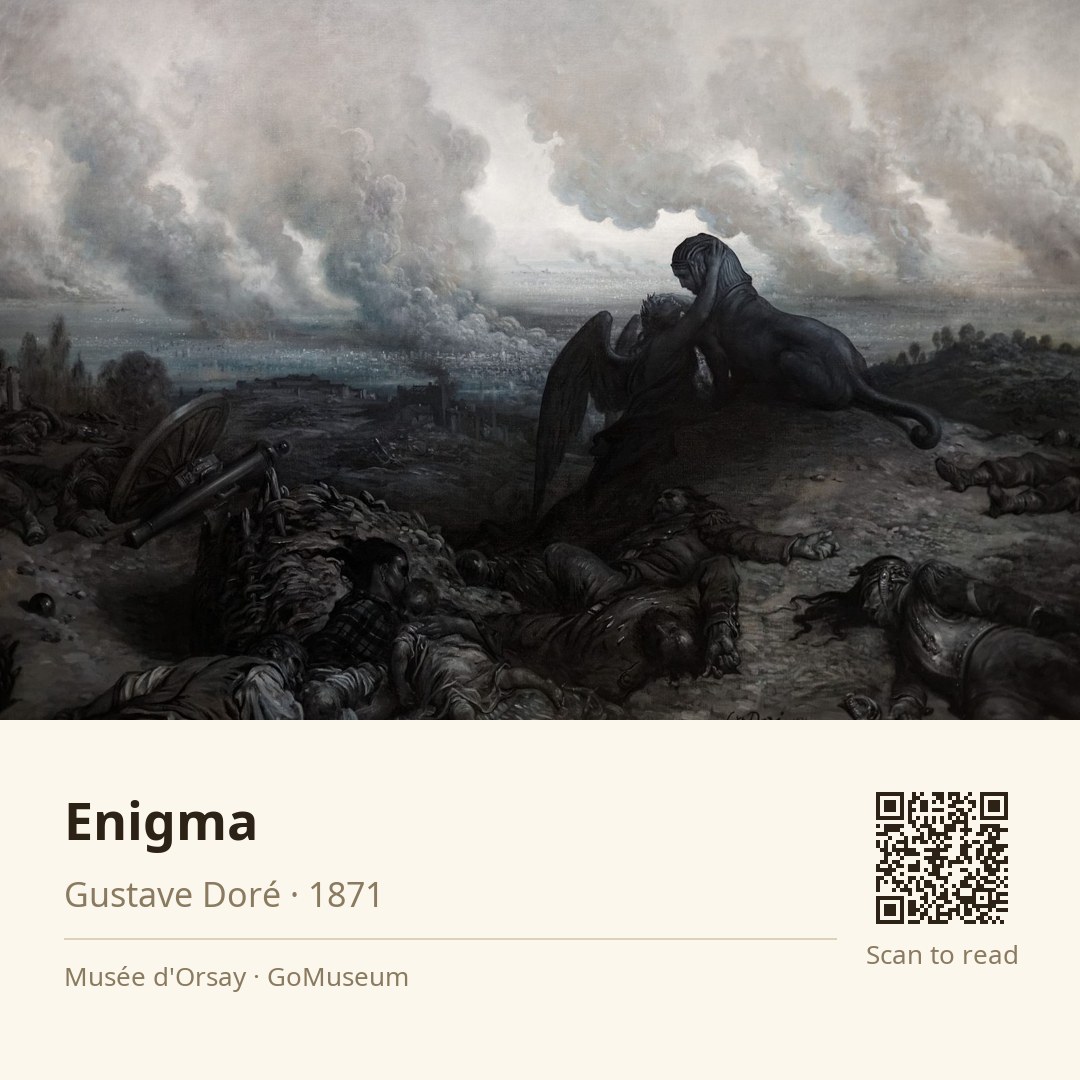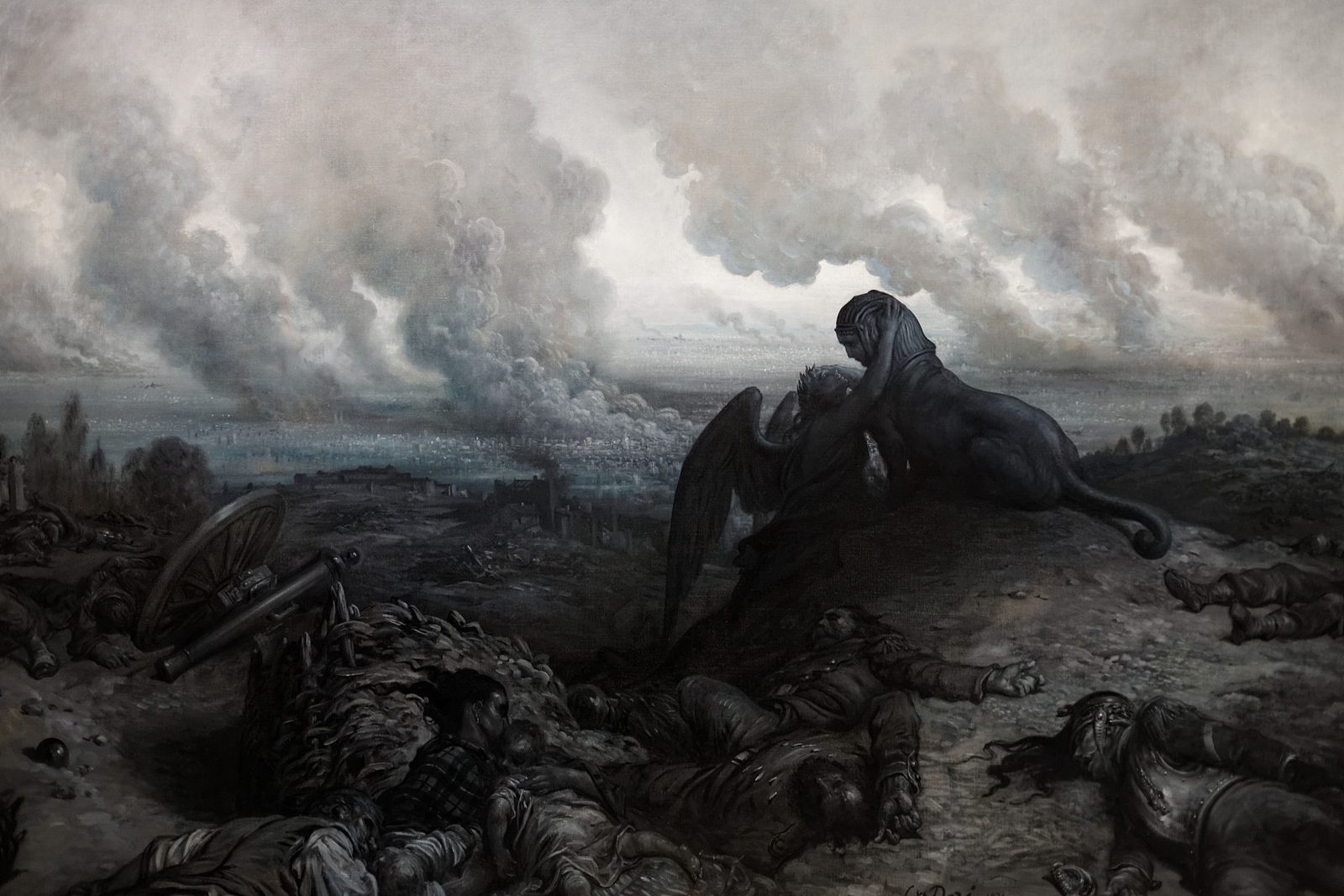
As you stand before "Enigma" by Gustave Doré, let your eyes wander over the haunting scene. Notice the ghostly figures, especially the winged being kneeling before the Sphinx. This isn't just a moment frozen in time; it’s a powerful dialogue between humanity and the eternal questions of war and suffering.
The starkness of the painting, with its almost monochrome palette, amplifies the sense of desolation. Look closely at the mother cradling her lifeless child—this heart-wrenching detail encapsulates the tragedy of conflict, a reminder of the human cost of war. Doré painted this in 1871, during a tumultuous period in French history, reflecting the pain of loss after the Franco-Prussian War.
Doré, a master of illustration and emotion, sought to capture not just the physical devastation but the deeper philosophical struggle. The Sphinx, a symbol of mystery, represents the unanswered questions that haunt humanity. What drives us to conflict? What truths remain hidden?
As you take in this artwork, think about the stories behind the faces. What do you believe the Sphinx would reveal if she could speak?
Paul Gustave Doré was a prolific French artist born on January 6, 1832, in Strasbourg. He began his career as a caricaturist at the young age of 15, quickly establishing a reputation for his detailed wood engravings. Doré's illustrations for classic literature, including the Vulgate Bible and Dante's Divine Comedy, garnered international acclaim, leading to the employment of numerous block-cutters to bring his designs to life. His work, while popular among the public, faced mixed reviews from critics during his lifetime.
Doré's artistic journey included notable commissions for works by Cervantes, Rabelais, and Byron, and his illustrations for "Don Quixote" and "The Raven" became iconic. His 1872 publication "London: A Pilgrimage" showcased the city's stark realities, earning both commercial success and critical scrutiny. Despite the challenges he faced, including accusations of exaggeration in his portrayals, his unique vision and talent left a lasting impact on the art world.
Recognized for his contributions, Doré was made a Knight of the Legion of Honour in 1861. His legacy continued to grow posthumously, influencing artists like Vincent van Gogh and earning admiration from literary figures such as H. P. Lovecraft. Doré passed away on January 23, 1883, leaving behind a rich body of work that solidified his place in art history as a master illustrator and visionary.
Gustave Doré's 'Enigma' was painted in 1871, a year steeped in the aftermath of the Franco-Prussian War and the Paris Commune. This turbulent backdrop deeply influenced Doré, who felt the sting of losing Alsace-Lorraine to Germany. The painting was first shown in 1884 during a posthumous sale of Doré's works, alongside two other pieces that reflected similar themes of conflict and loss. It was presented under the title 'Souvenirs de 1870,' a poignant reminder of the scars left by war. Notably, Victor Hugo's verses accompanied the painting during this exhibition, chosen by Doré himself, emphasizing the tragic spectacle of human creation and the abyss it leaves behind. The painting eventually found its home in the Musée d'Orsay, Paris, after being acquired by the Louvre in 1982, marking its journey through time and ownership.
As you gaze at 'Enigma,' pay attention to the almost monochrome palette that Doré employs. This choice amplifies the sense of desolation and despair, drawing your eyes to the haunting figures scattered across the canvas. The brushwork feels restless, almost frantic, as if echoing the chaos of war. Notice how Doré uses light and shadow to create a stark contrast between the living and the dead, enhancing the emotional weight of the scene. The composition is structured around the central figures—the winged being and the Sphinx—who are locked in a poignant dialogue. Their positioning, with the Sphinx looming over the kneeling figure, invites you to ponder the weight of their exchange. The scale of the painting, at nearly 130 by 195.5 centimeters, envelops you, making the tragedy feel immediate and personal.
Gustave Doré's 'Enigma' is more than just a painting; it's a haunting reflection of a tumultuous time in French history. Created in 1871, it emerged from the ashes of the Franco-Prussian War and the Paris Commune, capturing the despair and chaos of a nation in turmoil. The central figures—a winged entity and the Sphinx—invite viewers to ponder the eternal questions of humanity and conflict.
One fascinating tidbit about 'Enigma' is that during its posthumous sale in 1884, it was accompanied by verses from Victor Hugo's poem 'At the Arc de Triomphe.' These lines, chosen by Doré himself, poignantly reflect the despair and futility of human conflict, echoing the very themes present in the painting. This connection to Hugo, a towering literary figure, adds an extra layer of depth to the artwork, intertwining visual art with profound literary sentiment.
Doré's use of a monochrome palette was likely influenced by the somber historical context of the Franco-Prussian War, aiming to evoke a sense of desolation and despair that mirrored the devastation of the time.
Doré's extensive experience as an illustrator, particularly in creating dramatic and emotive scenes for literature, translated into his painting style, where he focused on capturing intense emotional moments and complex narratives within a single frame.
During its 1884 exhibition, 'Enigma' was accompanied by verses from Victor Hugo's poem 'At the Arc de Triomphe,' which Doré personally selected, highlighting the deep emotional resonance and thematic parallels between the painting and Hugo's reflections on human suffering.