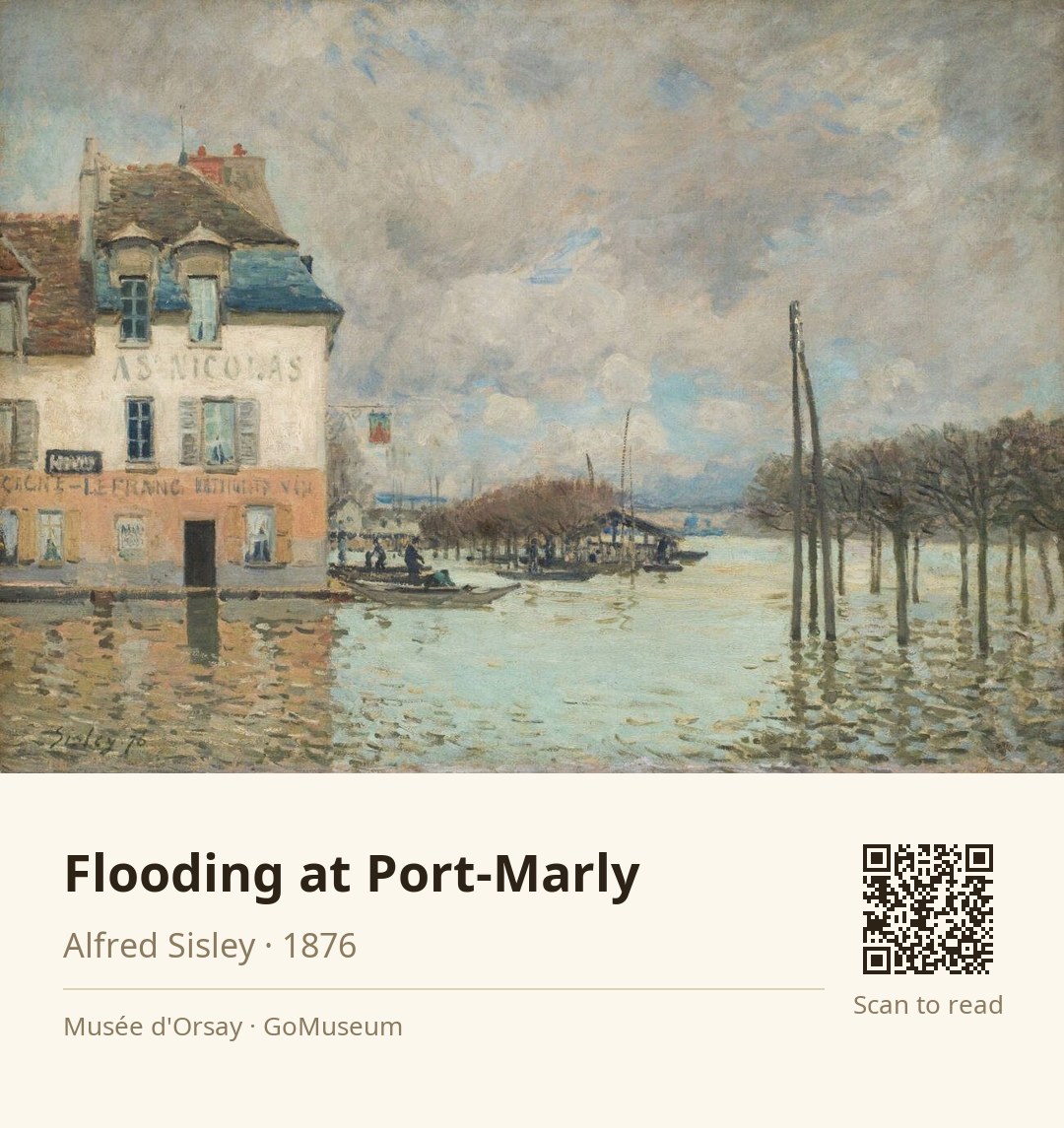
Flooding at Port-Marly
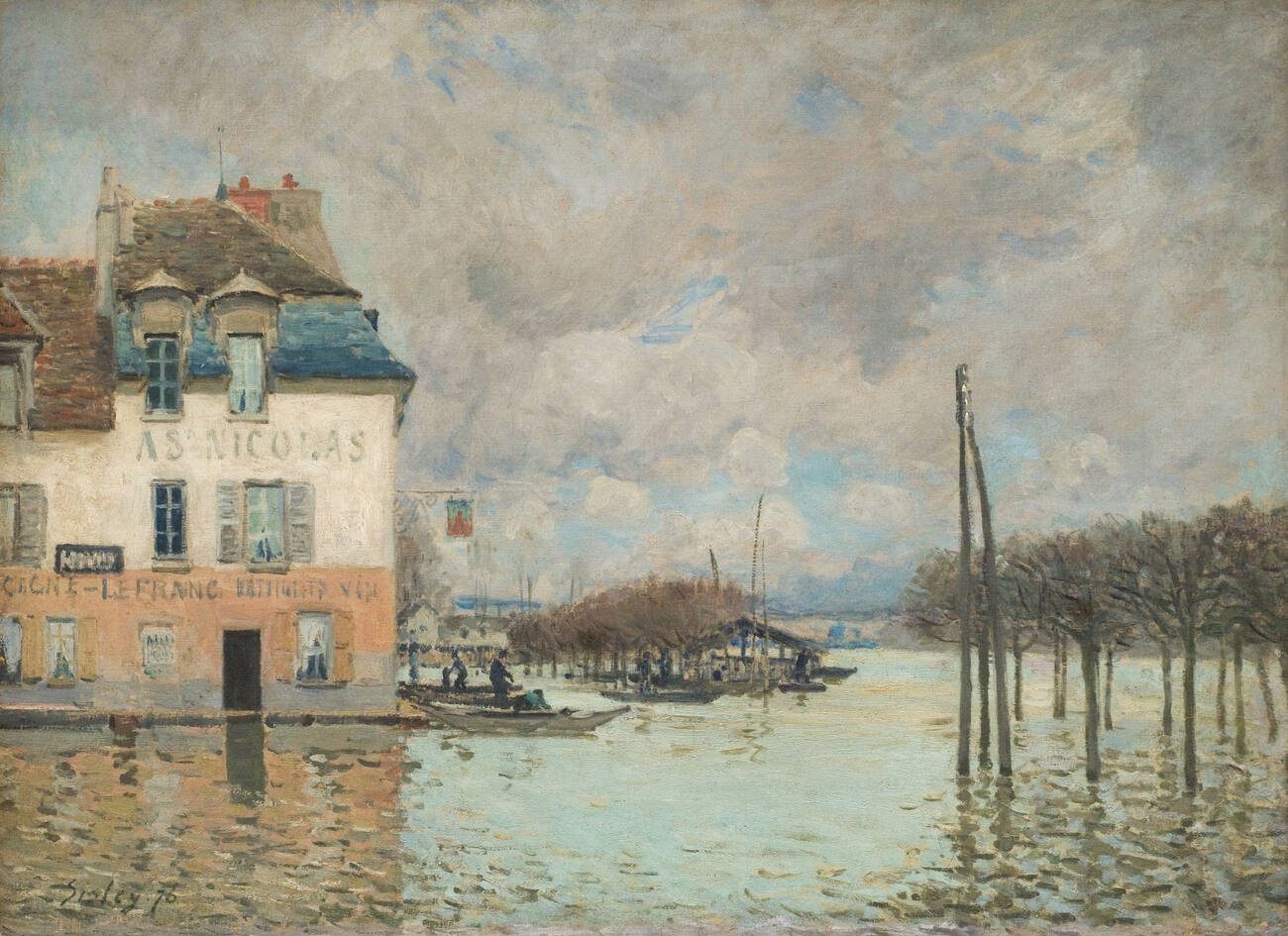
🎧 This work has audio narration — listen in the appTake a moment to really look at "Flooding at Port-Marly" by Alfred Sisley. Notice how the water stretches out before you, almost like a mirror reflecting the chaos of nature. The trees and pylons on the right seem to stand as silent witnesses to the flood, while the quaint wine merchant's house, "A St Nicolas," is almost swallowed by the rising waters.
These details matter because they capture a moment of turmoil, yet Sisley’s brushstrokes convey a sense of movement and life amidst the disaster. The colors, predominantly grays and browns, evoke the heaviness of the storm, but those splashes of blue in the sky hint at hope breaking through the clouds.
Painted in 1876, this piece is part of a series Sisley created during a time when the Seine was in flood, affecting the very landscape he loved to paint. It was showcased at the second Impressionist exhibition, a bold statement of the new artistic movement that sought to capture fleeting moments in nature.
As you stand here, think about the emotions this scene stirs in you. Do you feel the weight of the flood, or do you sense the resilience of the landscape? What stories might this place tell if it could speak?
Alfred Sisley was a British-born Impressionist landscape painter, born in Paris on October 30, 1839, to affluent expatriate parents. His dedication to painting outdoors, or en plein air, marked him as one of the most consistent figures within the Impressionist movement. Sisley’s work primarily focused on landscapes, with notable series depicting the River Thames, the floods at Marly-le-Roi, and the Gothic church at Moret-sur-Loing. Despite his talent, he struggled for recognition and financial stability throughout his life, often relying on the support of patrons and friends.
Sisley's artistic journey began in earnest after returning to Paris from London, where he had been sent to pursue a business career. Instead, he found his calling in art, studying at the École des Beaux-Arts and forming close friendships with fellow artists like Monet and Renoir. His personal life was marked by hardship, particularly after the Franco-Prussian War disrupted his family's financial support. He married Eugénie Lescouezec, and together they faced many challenges, including the loss of a child and Sisley’s ongoing financial instability.
Although Sisley’s work was largely overlooked during his lifetime, it has since gained significant appreciation, solidifying his place in art history as a key contributor to Impressionism and French landscape painting. His delicate depictions of nature continue to resonate, showcasing the beauty of the world around him. Sisley passed away on January 29, 1899, in Moret-sur-Loing, leaving behind a legacy that would flourish posthumously.
Alfred Sisley's 'Flooding at Port-Marly' was painted in 1876, during a time when the Seine was experiencing significant flooding, impacting the landscape Sisley cherished. This painting is part of a series he created, with earlier works from 1872. The 1876 version was showcased at the second Impressionist exhibition in Paris, a pivotal moment for the movement that aimed to capture the ephemeral beauty of nature. The painting eventually passed through several notable owners, including Alphonse Legrand and Auguste Pellerin, before being acquired by the Comte Isaac de Camondo in 1900 for a substantial sum of 43,000 francs. It later found its way to the Louvre and then to the Musée d'Orsay, where it resides today, reflecting its journey through the art world and its growing recognition over time.
In 'Flooding at Port-Marly', Sisley employs a loose, almost chaotic brushwork that captures the tumultuous nature of the flood. Notice how he forgoes strict outlines, opting instead for dabs of color that suggest form and movement. The palette is dominated by grays and browns, evoking the heaviness of the storm, yet Sisley cleverly introduces splashes of blue in the sky, hinting at a glimmer of hope. The composition balances the chaos of the flood with the solidity of the trees and pylons on the right, creating a sense of stability amidst the turmoil. The reflections in the water are masterfully rendered, enhancing the feeling of depth and movement, as if the landscape itself is alive and responding to the flood's fury.
Interestingly, Sisley, despite being a key figure in the Impressionist movement, struggled for recognition during his lifetime. Unlike many of his contemporaries, he never achieved financial success while alive, and it was only posthumously that his work gained the acclaim it deserved. This painting, like many others, reflects his deep connection to the landscapes of France, yet he remained a British national throughout his life, which added a layer of complexity to his identity as an artist.
Sisley's loose brushwork and use of dabs of color create a sense of movement and chaos, which is characteristic of his Impressionist style. This technique allows the viewer to feel the tumult of the flood while also capturing the fleeting effects of light on the water.