 Image: Rama · juliendorra · Chatsam · Chatsam · Chatsam
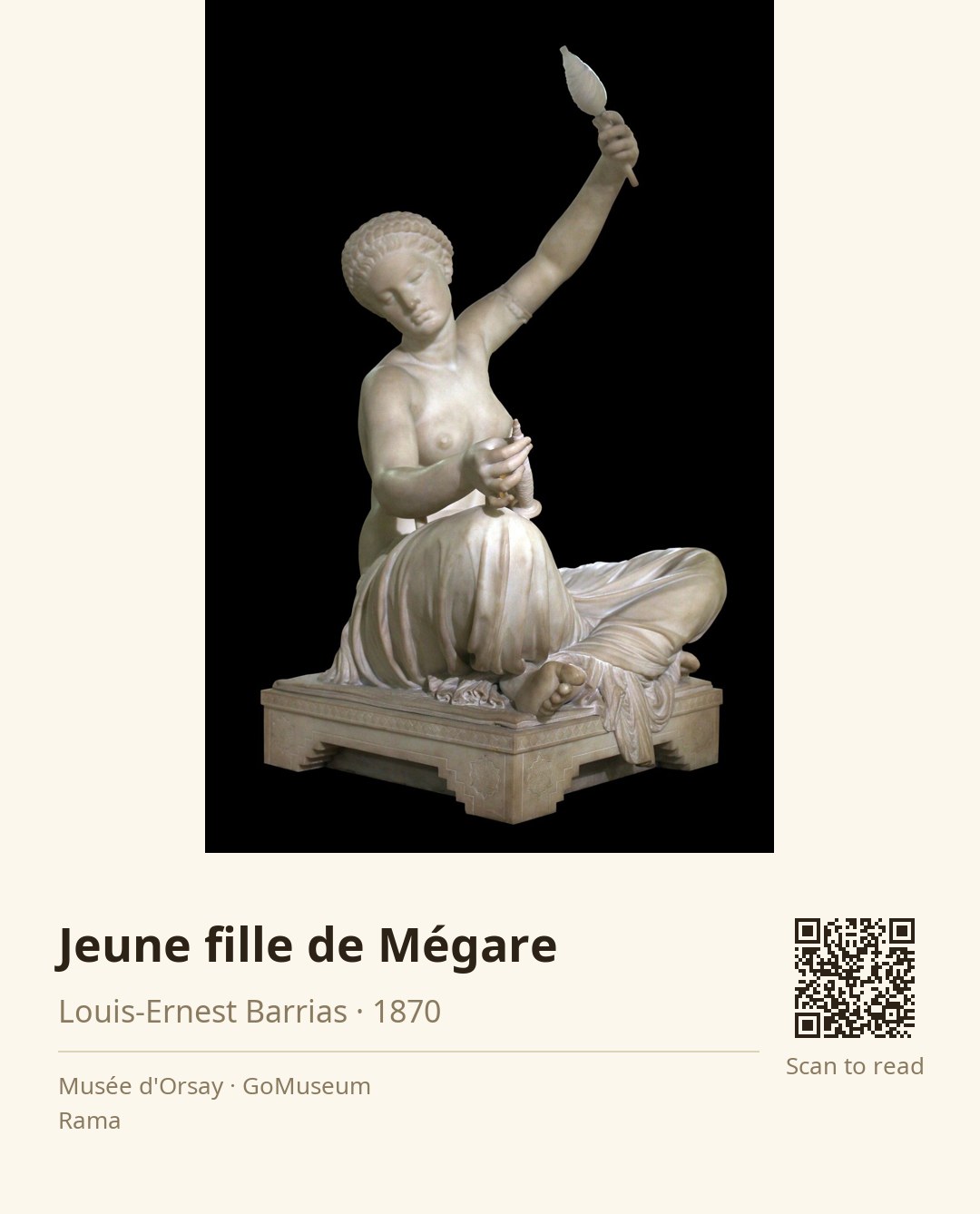
Jeune fille de Mégare
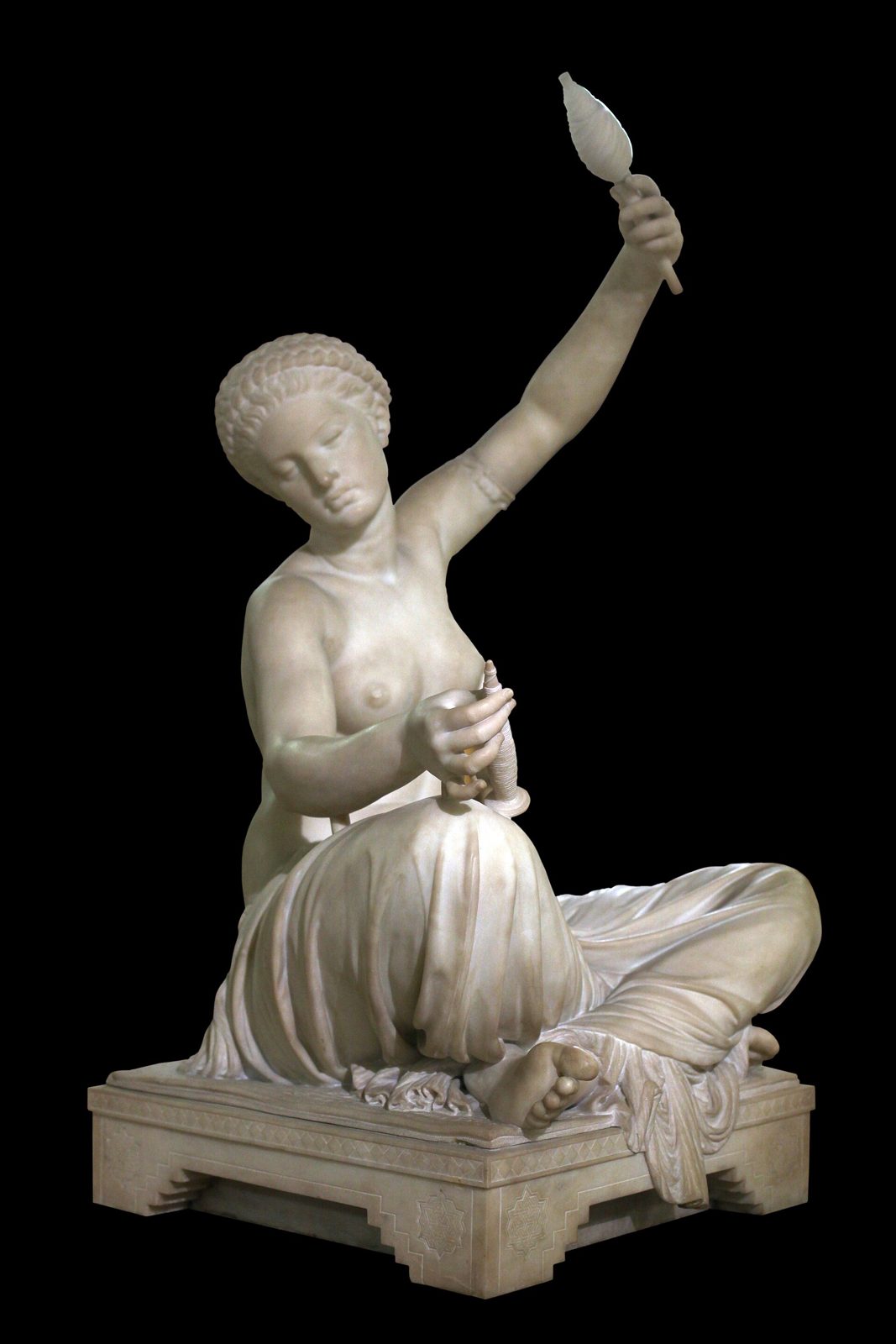
🎧 This work has audio narration — listen in the appThe young girl from Megara, captured in marble by Louis-Ernest Barrias, embodies a moment of serene concentration as she spins thread. Her left hand raises a spindle above her head, while her right hand guides the delicate thread, showcasing both her skill and the tranquility of her expression. The intricate folds of the drapery, carved with remarkable precision, cascade over her lower body, enhancing the sense of movement and grace in her seated pose.
This sculpture not only highlights the technical mastery of Barrias but also reflects the Romantic realist style that characterized his work. The smooth marble surface emphasizes the girl's youthful features and the texture of her clothing, creating a striking contrast between the grounded position of her body and the upward motion of the spindle. The choice of a Greek subject connects to the classical ideals of beauty and craftsmanship, which were highly revered in the 19th century.
Created in 1870, "Jeune fille de Mégare" was first exhibited at the Salon des artistes français in Paris, where it was acquired the same year.
Louis-Ernest Barrias was a prominent French sculptor born on April 13, 1841, in Paris, into a family of artists. His father painted porcelain, and his brother was a recognized painter, which influenced his artistic journey. Initially a painter, Barrias shifted to sculpture under the guidance of Pierre-Jules Cavelier and later studied at the École nationale supérieure des Beaux-Arts. He gained significant recognition after winning the Prix de Rome in 1865, allowing him to study at the French Academy in Rome.
Barrias's work, characterized by a Romantic realist style, often drew inspiration from nature and literature, reflecting the Art Nouveau movement of his time. Notable pieces include "Nature Unveiling Herself Before Science" and "The Oath of Spartacus." His contributions to public art include decorations for the Paris Opéra and the Hôtel de la Païva. He was honored with the Legion of Honour and served as a professor at the École des Beaux-Arts, mentoring future artists.
Barrias's legacy endures in his dynamic sculptures that blend emotion and form, securing his place in the history of French sculpture. He passed away on February 4, 1905, leaving behind a rich body of work celebrated in various public collections.
Barrias sculpted 'Jeune fille de Mégare' from fine marble, a material prized for its smoothness and ability to capture intricate details. The artist employed a technique called 'taille avec mise aux points,' which involves careful carving and refining to achieve a lifelike quality. You can see how the drapery flows around the figure, each fold meticulously crafted to suggest movement. The contrast between the polished skin and the textured fabric showcases Barrias's skill in manipulating marble to evoke both softness and strength.
This sculpture later traveled to the 1873 Exposition Universelle in Vienna and returned to Paris for the 1878 Exposition Universelle, further solidifying Barrias's reputation. The piece has since found a permanent home at the Musée d'Orsay, where it continues to be celebrated for its embodiment of Romantic realism. Barrias, who had previously won the Prix de Rome, was already an established figure in the art world, and this work contributed to his legacy.
The work's focus on the serene beauty of a simple act—spinning thread—encapsulates a shift towards portraying everyday life with dignity and grace. This approach inspired artists to explore more intimate, human experiences in their sculptures, paving the way for modern interpretations of realism in art history.
Interestingly, Barrias's family background played a significant role in shaping his artistic journey. Born into a family of artists, he initially pursued painting before fully committing to sculpture. His brother, Félix-Joseph Barrias, was a well-known painter, which likely influenced Louis-Ernest's artistic development and ambitions.
Barrias was born into a family of artists, with his father being a porcelain painter and his brother a well-known painter, which likely inspired his pursuit of art.
The Art Nouveau style, known for its organic forms and intricate designs, had a significant impact on Barrias's sculptures during the late 19th century.