Hôtel des Roches Noires
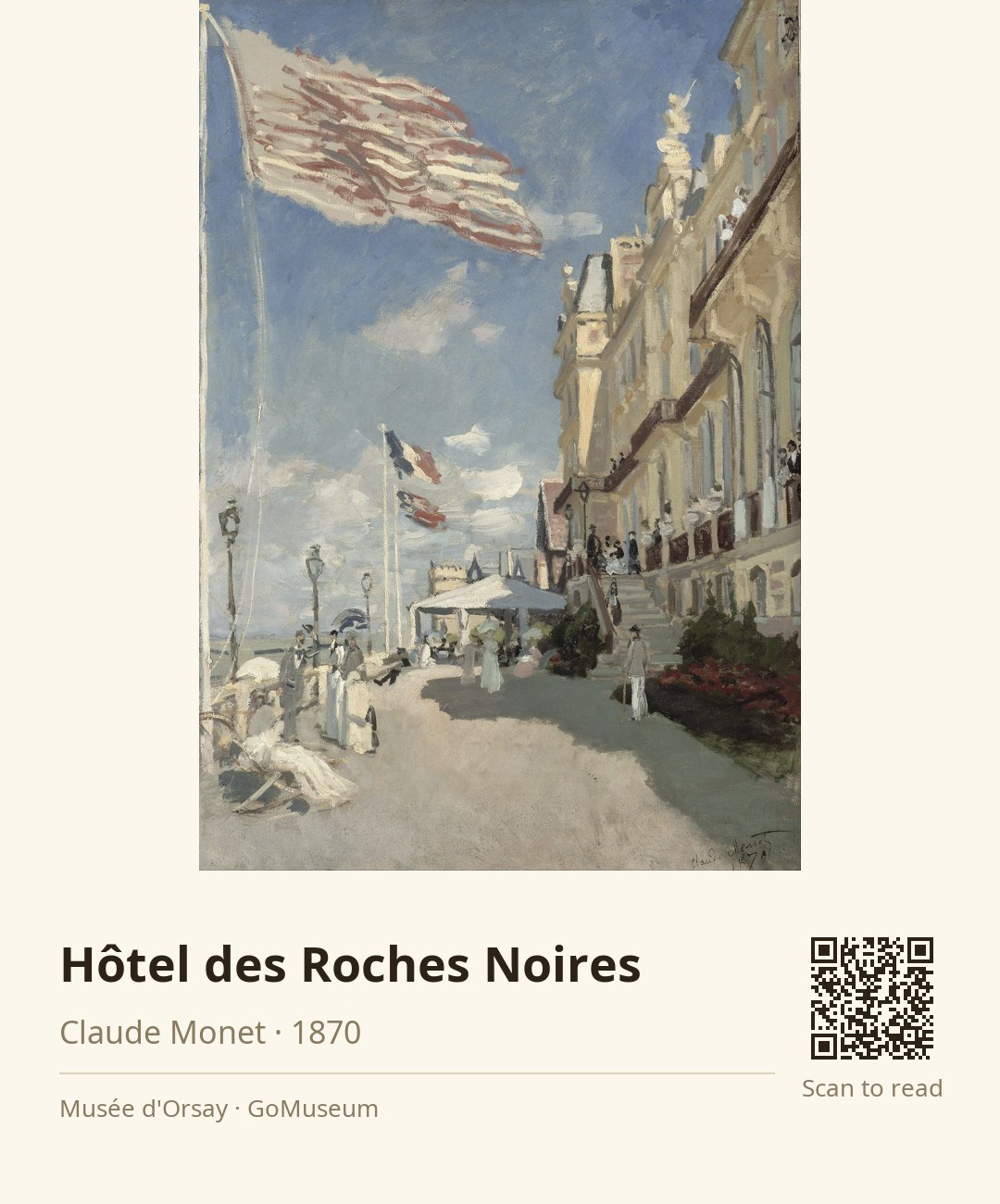
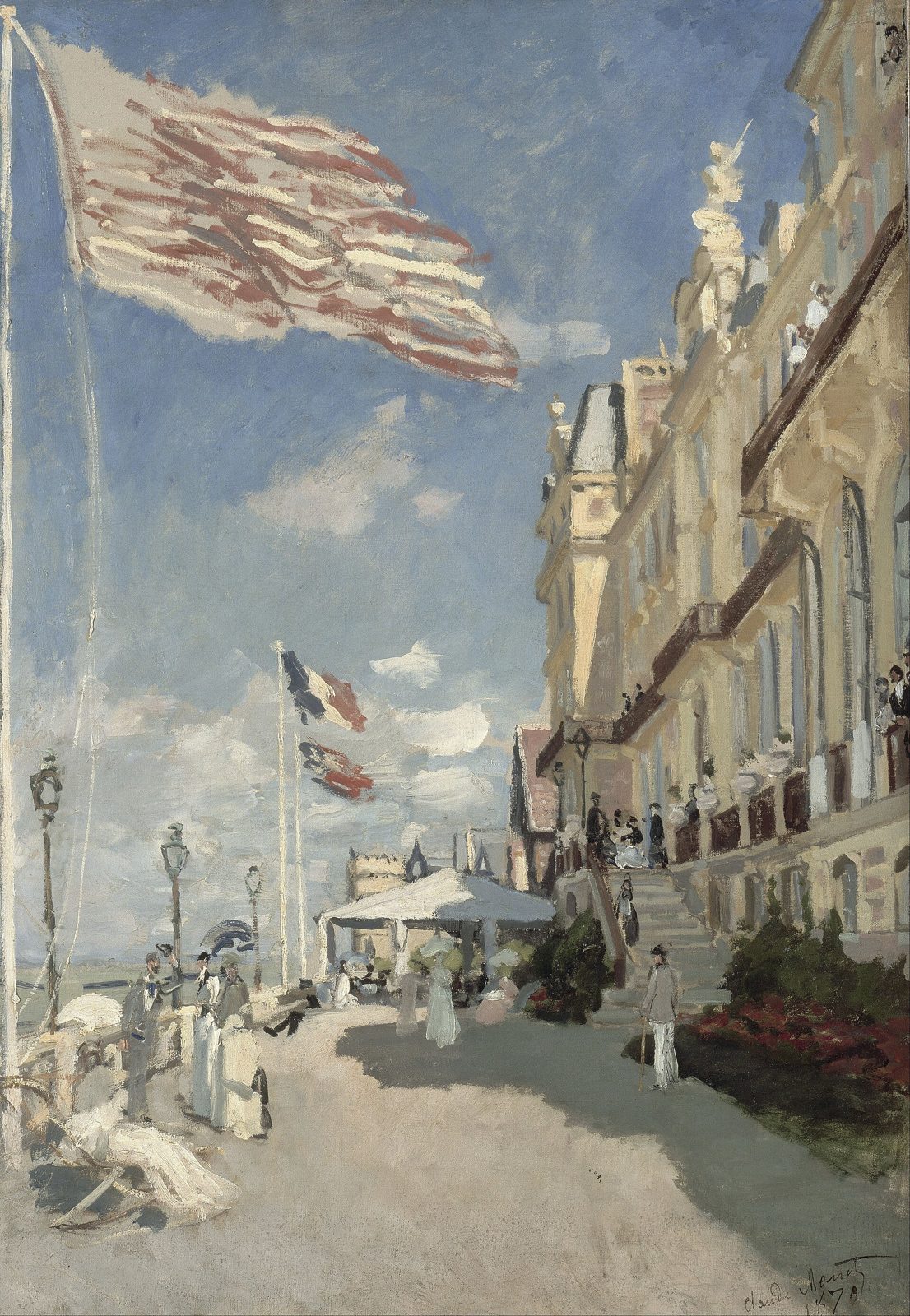
🎧 This work has audio narration — listen in the appTake a moment to really absorb the scene in front of you. This is Claude Monet's "Hôtel des Roches Noires," painted in 1870, and it’s a vibrant snapshot of life at the beach in Trouville-sur-Mer. Notice how the hotel’s façade is bustling with figures, their movements almost animated as they gaze out at the sea. Look closely at the flags fluttering in the summer breeze; Monet captures their texture with just a few swift brushstrokes, a hallmark of his impressionist style. These details matter because they transport you to a specific moment in time, just as the French bourgeoisie began flocking to seaside resorts. The lively terrace, filled with well-dressed patrons, reflects a society on the brink of change, with the advent of railways making such leisure accessible. Monet, himself escaping the tensions of war, found inspiration here, painting the very people who might buy his work. Monet was deeply influenced by his mentor, Eugène Boudin, who taught him to paint outdoors, capturing the essence of the moment. This painting not only showcases his skill but also serves as a historical document of a shifting social landscape. As you stand here, think about the stories these figures might tell. What were their lives like? What dreams did they chase along this vibrant shoreline?
Oscar-Claude Monet, born on November 14, 1840, in Paris, was a pioneering French painter and a founder of Impressionism, a movement that transformed the art world. Raised in Le Havre, he developed a passion for nature and painting early on, encouraged by his mother, while his father hoped he would pursue a business career. After his mother's death in 1857, Monet moved in with his aunt, who supported his artistic ambitions.
Monet's career began with caricatures, but he soon sought formal training, studying under Eugène Boudin, who introduced him to plein air painting. His breakthrough came in 1866 with "La Femme à la robe verte," which garnered attention at the Salon. The term "Impressionism" originated from his work "Impression, Sunrise," exhibited in 1874, marking a shift away from traditional art.
Throughout his life, Monet focused on capturing the essence of light and color in nature, creating series of paintings that depicted the same scenes under varying conditions, such as his famous haystacks and water lilies. He settled in Giverny in 1883, where he cultivated a beautiful garden that became his muse. Despite personal hardships, including the loss of loved ones and health issues, Monet's relentless dedication to his craft solidified his place in art history as a master of modernism, influencing countless artists and leaving a lasting legacy. He died on December 5, 1926, in Giverny, celebrated as one of the most significant figures in art.
Claude Monet's 'Hôtel des Roches Noires' was painted in 1870 during a pivotal moment in his life. As tensions mounted leading to the Franco-Prussian War, Monet, struggling with financial instability, sought refuge in Trouville-sur-Mer. Monet's work was later donated to the French state in 1947 and has been part of the Musée d'Orsay's permanent collection since its opening in 1986. Over the years, it has been exhibited in various prestigious locations, including multiple exhibitions in Paris and even abroad in Edinburgh and London, showcasing its enduring appeal and significance in the art world.
In 'Hôtel des Roches Noires,' Monet employs a dynamic composition that draws the viewer's eye across the canvas. The open space of the sea on one side contrasts with the bustling hotel façade on the other, creating a sense of movement and life. Notice how the figures on the terrace are painted with quick, expressive brushstrokes, giving them an almost animated quality. The vibrant colors, particularly the reds and blues of the flags, are applied in a way that captures the light and atmosphere of a summer day. Monet's technique of using short, choppy strokes allows the viewer to feel the texture of the scene, as if the wind is rustling through the flags and the air is filled with the sounds of laughter and conversation. The perspective leads your gaze toward the horizon, where the distant city of Le Havre is subtly hinted at, grounding the painting in a specific location and moment.
Did you know that Monet painted this piece during a tumultuous time in his life? Just before creating 'Hôtel des Roches Noires,' he was facing a financial crisis and the looming threat of war. He had just married Camille Monet, and the couple was forced to leave Paris, seeking refuge in Trouville-sur-Mer. While staying at a modest hotel, Monet seized the opportunity to capture the vibrant life of the beachgoers and the luxurious hotel, a stark contrast to his own circumstances.
Facing financial difficulties and the looming threat of war, Monet chose to depict the wealthy bourgeoisie enjoying leisure at the beach, likely hoping to appeal to potential buyers among his subjects.