Homage to Cézanne
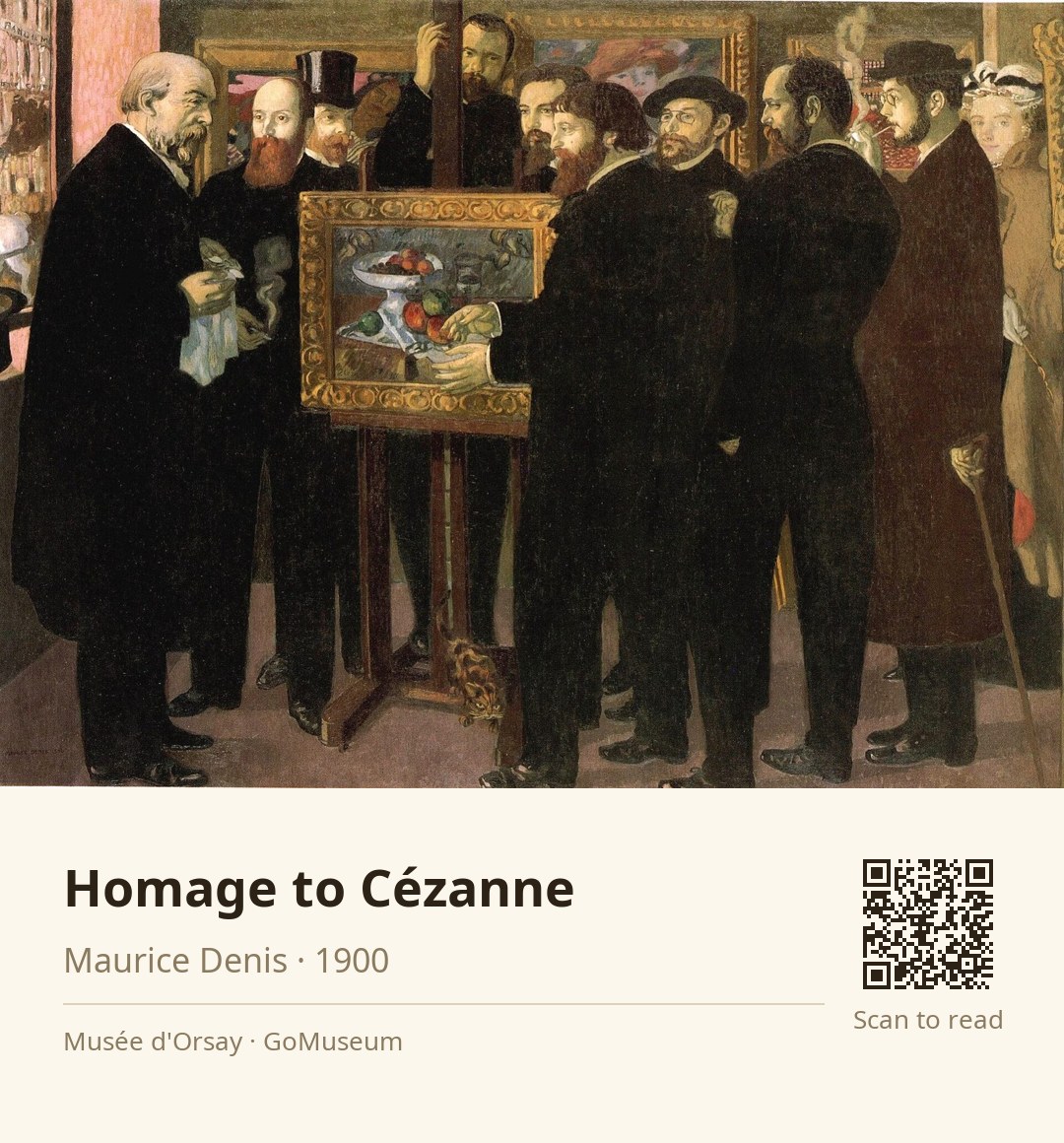
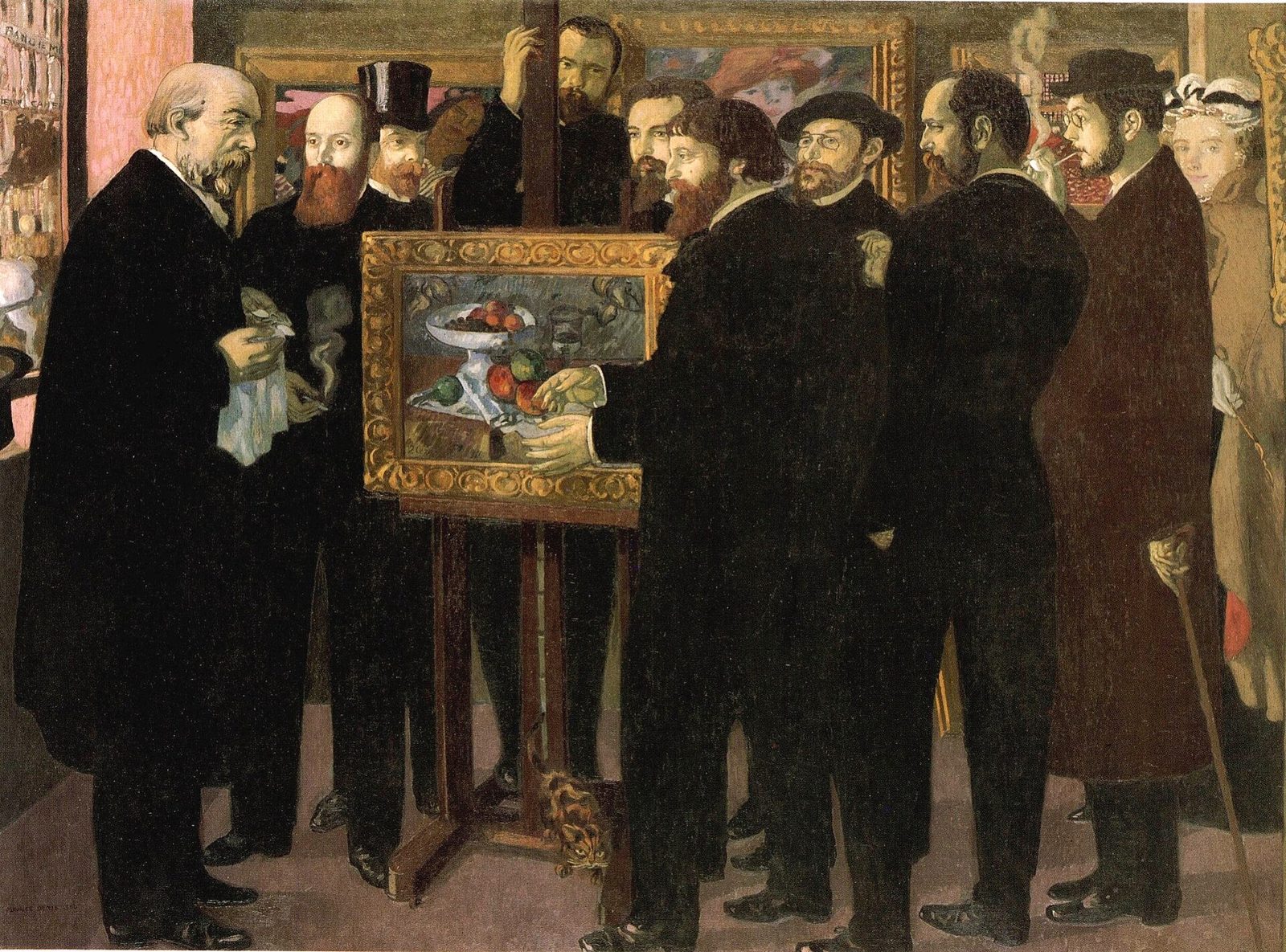
🎧 This work has audio narration — listen in the appTake a moment to really absorb the scene in front of you. Maurice Denis’s "Homage to Cézanne" isn’t just a painting; it’s a vibrant gathering of artistic minds, all paying tribute to the masterful Paul Cézanne. Look closely at the figures—can you spot Odilon Redon on the far left, his attention captivated? And right in the center, the easel displaying Cézanne's still life, "Fruit Bowl, Glass and Apples," almost bursting with color.
These details matter because they encapsulate a pivotal moment in art history. This painting, created in 1900, reflects the camaraderie of the Nabis, a group of artists who sought to break free from traditional representation. The way Denis has arranged his friends around the easel creates a sense of dialogue, a celebration of Cézanne’s influence on their work. It’s a nod to the past, but also a step toward the future of modern art.
Denis was not just painting a scene; he was documenting a turning point. By this time, the Nabis were beginning to drift apart, and this gathering serves as a bittersweet farewell to their collective spirit. The painting was first exhibited at the Salon de la Société nationale des beaux-arts in Paris, where reactions were mixed—some laughed, while others recognized its significance.
As you stand here, think about the connections between these artists and the legacy they left behind. What do you think they were discussing? What ideas were brewing in that crowded space?
Maurice Denis was a French painter, decorative artist, and writer born on November 25, 1870, in Granville, Normandy. He emerged as a significant figure in late 19th-century art, closely associated with the Nabis group, which sought to blend spirituality with artistic expression. Influenced by the works of Fra Angelico and Gauguin, Denis believed that art transcended mere representation, famously stating that a painting is fundamentally a flat surface covered with colors. His early life was marked by a deep passion for religion and art, leading him to pursue a career that celebrated Christian themes.
Denis's artistic journey began at the Académie Julian, where he formed connections with fellow artists like Paul Sérusier and Pierre Bonnard. Together, they founded Les Nabis, advocating for a more decorative and symbolic approach to painting. His work evolved through various influences, including Japanese art, which inspired his stylized compositions. After World War I, Denis shifted focus to sacred art, founding the Ateliers d'Art Sacré to revive religious themes in contemporary art.
Throughout his life, Denis's contributions laid foundational ideas for movements such as Cubism and Fauvism. His legacy endures as a bridge between traditional and modern art, reflecting a unique synthesis of spirituality and aesthetic innovation. He passed away on November 13, 1943, leaving behind a rich body of work that continues to inspire artists today.
Maurice Denis's 'Homage to Cézanne' was created in 1900 and first exhibited at the Salon de la Société nationale des beaux-arts in Paris in 1901. This gathering of key figures from the Nabis movement was a pivotal moment, as the group was beginning to disband. The initial reception was mixed; some viewers laughed at its unconventional style, while others recognized its significance in the evolving art scene. Denis himself noted in his diary that the painting still made the public laugh, hinting at the tension between avant-garde aspirations and traditional expectations. After its debut, it remained largely unseen until it resurfaced in exhibitions in 1948, marking a long period of obscurity for this important work.
In 'Homage to Cézanne,' Denis employs a vibrant palette and dynamic composition to draw viewers into the scene. The painting measures an impressive 180 by 240 centimeters, almost life-size, which enhances the intimacy of the gathering. Notice how the vertical lines created by the figures and the easel contrast with the horizontal rhythm of their heads, creating a sense of movement and dialogue. The brushwork feels both deliberate and spontaneous, capturing the energy of the moment. The figures are dressed in conservative black suits, which juxtaposes the bright colors of Cézanne's still life at the center, emphasizing the tension between tradition and modernity. The crowded composition leaves little room for anything else, making it feel alive and full of conversation. Denis's careful arrangement of the figures around the easel not only highlights their admiration for Cézanne but also reflects the camaraderie and intellectual exchange that characterized the Nabis.
One intriguing aspect of 'Homage to Cézanne' is that it features a still life by Cézanne that once belonged to Paul Gauguin, who is notably absent from the painting. Gauguin described this still life as 'an exceptional pearl, the apple of my eye,' highlighting the deep respect and admiration the Nabis had for Cézanne's work. This connection adds a layer of poignancy to the gathering, as it evokes the spirit of Gauguin's influence even in his physical absence.
The painting takes place in the shop of the art dealer Ambroise Vollard, a key figure in promoting modern art in Paris. This location not only emphasizes the commercial aspect of art during that period but also highlights the social interactions among the artists and critics present.
Although Gauguin is not depicted in the painting, his influence looms large, particularly through the still life that once belonged to him. His absence adds a layer of poignancy, as it reflects the disbanding of the Nabis and the shift in artistic direction following his departure.