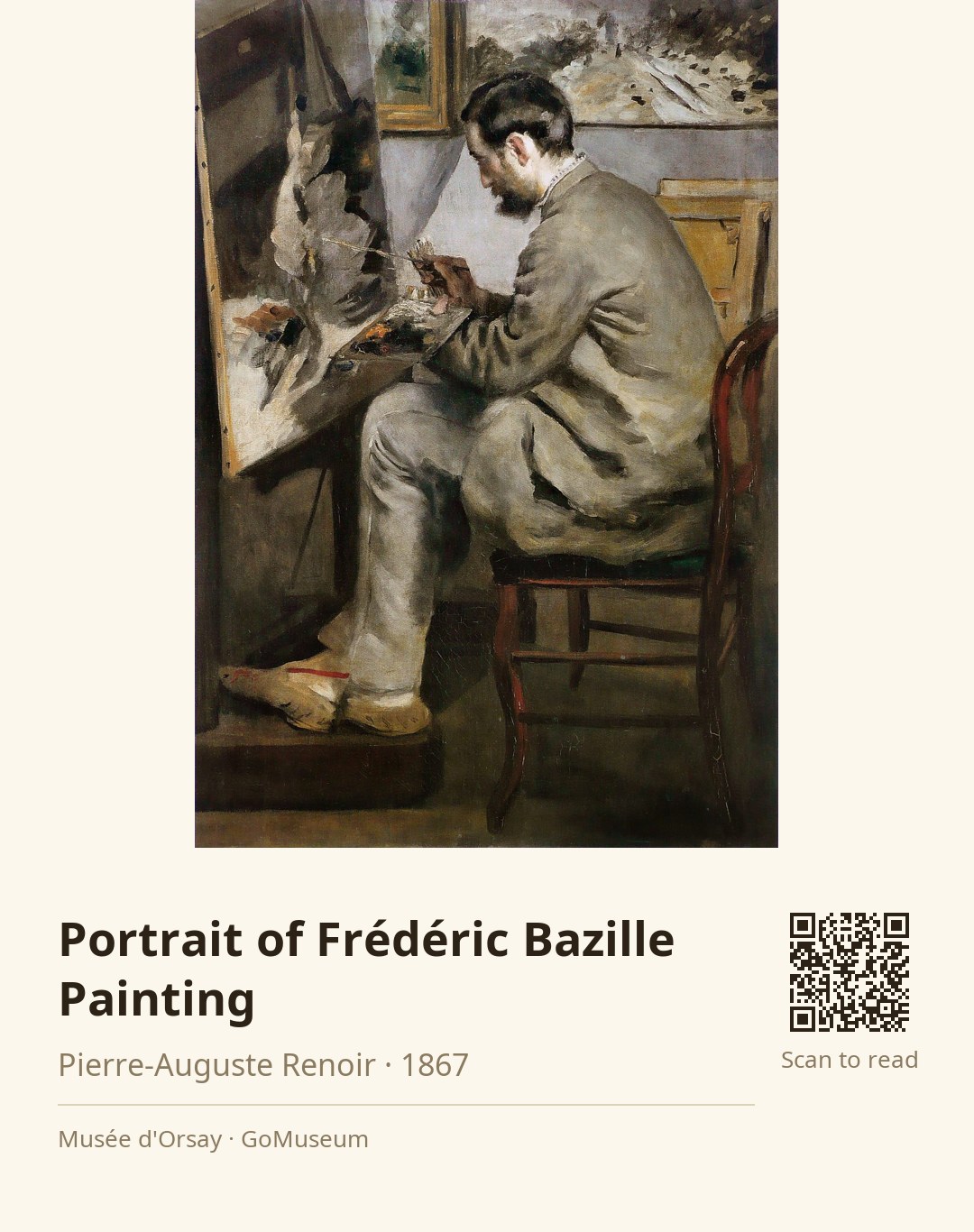
Portrait of Frédéric Bazille Painting
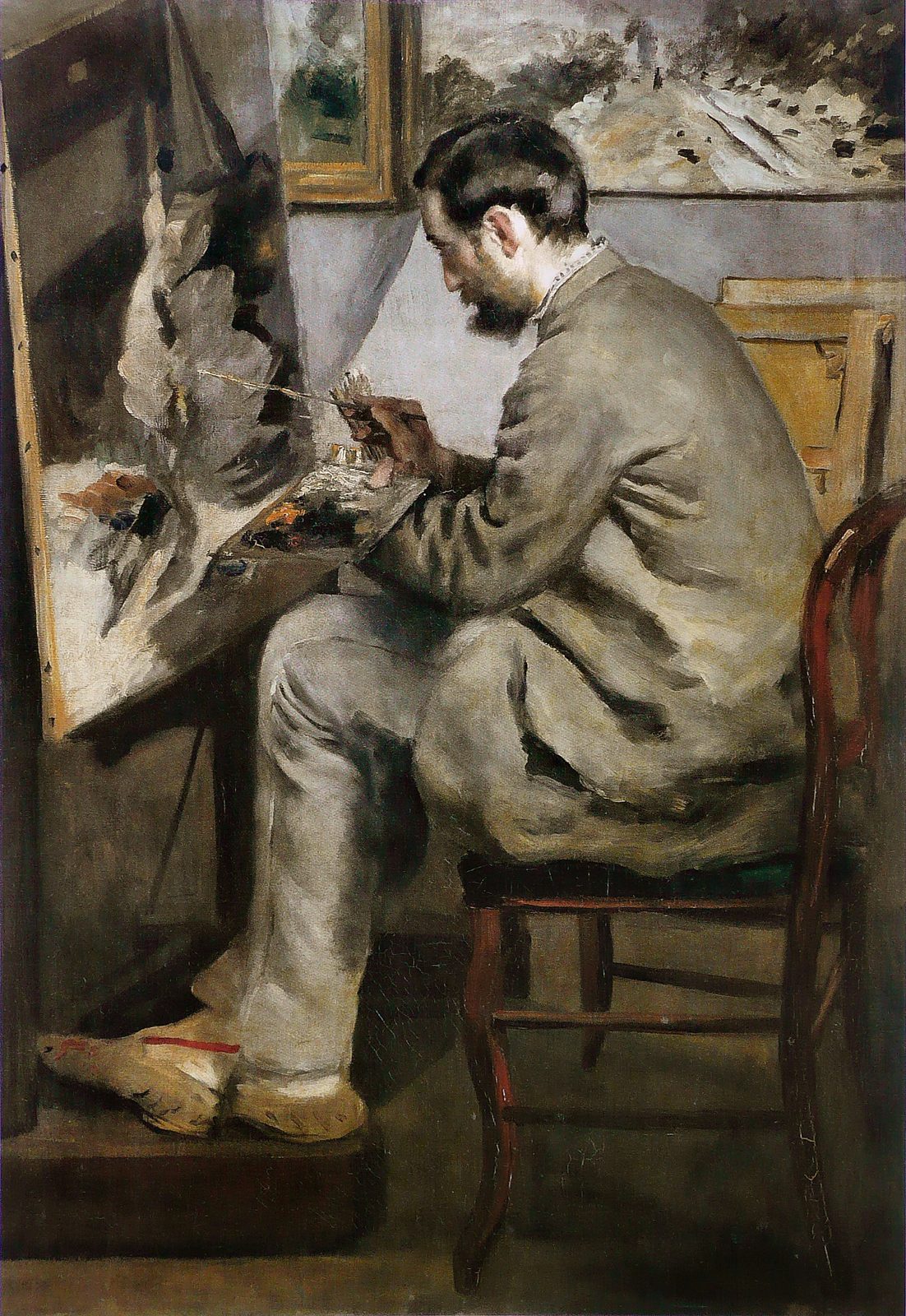
🎧 This work has audio narration — listen in the appTake a moment to really look at Renoir's "Portrait of Frédéric Bazille." Notice how the artist captures his friend in the act of creation, seated at his easel, deeply focused on his work. The way Bazille's body is angled, almost turned away from us, invites you into a private moment of artistic endeavor.
Now, pay attention to the subtle hues of gray that dominate the canvas. This choice of color not only reflects the mood of the scene but also emphasizes the camaraderie between the two painters. Renoir’s palette here is a nod to the Impressionist movement, where light and shadow play crucial roles in conveying emotion and atmosphere.
This painting, created in 1867, is more than just a portrait; it’s a response to Bazille’s earlier portrait of Renoir. Their friendship was rooted in shared struggles and artistic aspirations, both men navigating the challenging world of 19th-century Parisian art. Bazille, who tragically died young in the Franco-Prussian War, was a significant figure in the Impressionist circle, and this work immortalizes their bond.
As you stand here, think about the fleeting nature of creativity and friendship. What do you think Renoir wanted to convey about Bazille in this moment?
Pierre-Auguste Renoir, born on February 25, 1841, in Limoges, France, emerged as a pivotal figure in the Impressionist movement. His early life in a modest family led him to Paris, where he honed his artistic skills amidst the masterpieces of the Louvre. Initially apprenticed in a porcelain factory, Renoir's passion for painting flourished, particularly after studying under Charles Gleyre, where he befriended fellow artists like Monet and Sisley.
Renoir's work celebrated feminine beauty and vibrant social scenes, exemplified in iconic pieces like "Dance at Le Moulin de la Galette." Despite facing criticism early on, he gained recognition, especially after participating in the first Impressionist exhibition in 1874. His style evolved over the years, transitioning towards realism influenced by classical masters like Raphael.
Throughout his life, Renoir balanced personal struggles, including health issues, with a prolific output, reportedly creating around four thousand works. He became a beloved figure in art history, known for his warm palette and expressive brushwork. Renoir passed away on December 3, 1919, leaving a legacy that continues to inspire artists and art lovers alike.
Renoir's 'Portrait of Frédéric Bazille' was painted in 1867 and holds a rich history. Initially acquired by Édouard Manet, it remained in his collection until 1876 when he lent it for the second Impressionist exhibition in Paris. This act was a show of solidarity with the Impressionist movement, which was still struggling for recognition. After Bazille's untimely death in the Franco-Prussian War, his father, Gaston Bazille, sought to purchase the painting, leading to a fascinating exchange where Manet offered it in return for another artwork. The painting eventually passed through the hands of Bazille's brother, Marc, who bequeathed it to the Musée du Luxembourg in 1924. It later found its way to the Musée d'Orsay and has been on deposit at the Musée Fabre since 2006, Bazille's birthplace, making its journey a testament to the bonds of friendship and artistic legacy.
As you gaze at the painting, notice how Renoir employs a limited color palette dominated by subtle grays and browns, creating a harmonious yet dynamic atmosphere. The brushwork feels both fluid and deliberate, capturing the essence of Bazille in a moment of concentration. The composition is structured around the horizontal alignment of the canvases in the background, which draws your eye across the scene. Renoir's choice to depict Bazille almost in profile, with his body slightly turned away, invites you into a private moment, enhancing the intimacy of the scene. The play of light across Bazille's face and the textures of his clothing adds depth, while the few vibrant accents, like the red of his shoelaces, punctuate the otherwise monochromatic scheme, making them pop and drawing your attention back to the artist's focused expression.
Interestingly, the painting features two other works in the background, one of which is a snowy landscape by Claude Monet. This detail not only showcases the camaraderie among the artists but also serves as a subtle nod to the collaborative environment in which they thrived, painting side by side and influencing each other's styles.
Bazille's financial stability allowed him to support Renoir during difficult times, providing him with an atelier and models, which significantly contributed to Renoir's artistic development and ability to focus on his painting without the burden of financial stress.