 Image: Rama · Internet Archive Book Images · Internet Archive Book Images · Gautier Poupeau from Paris, France · Gautier Poupeau from Paris, France
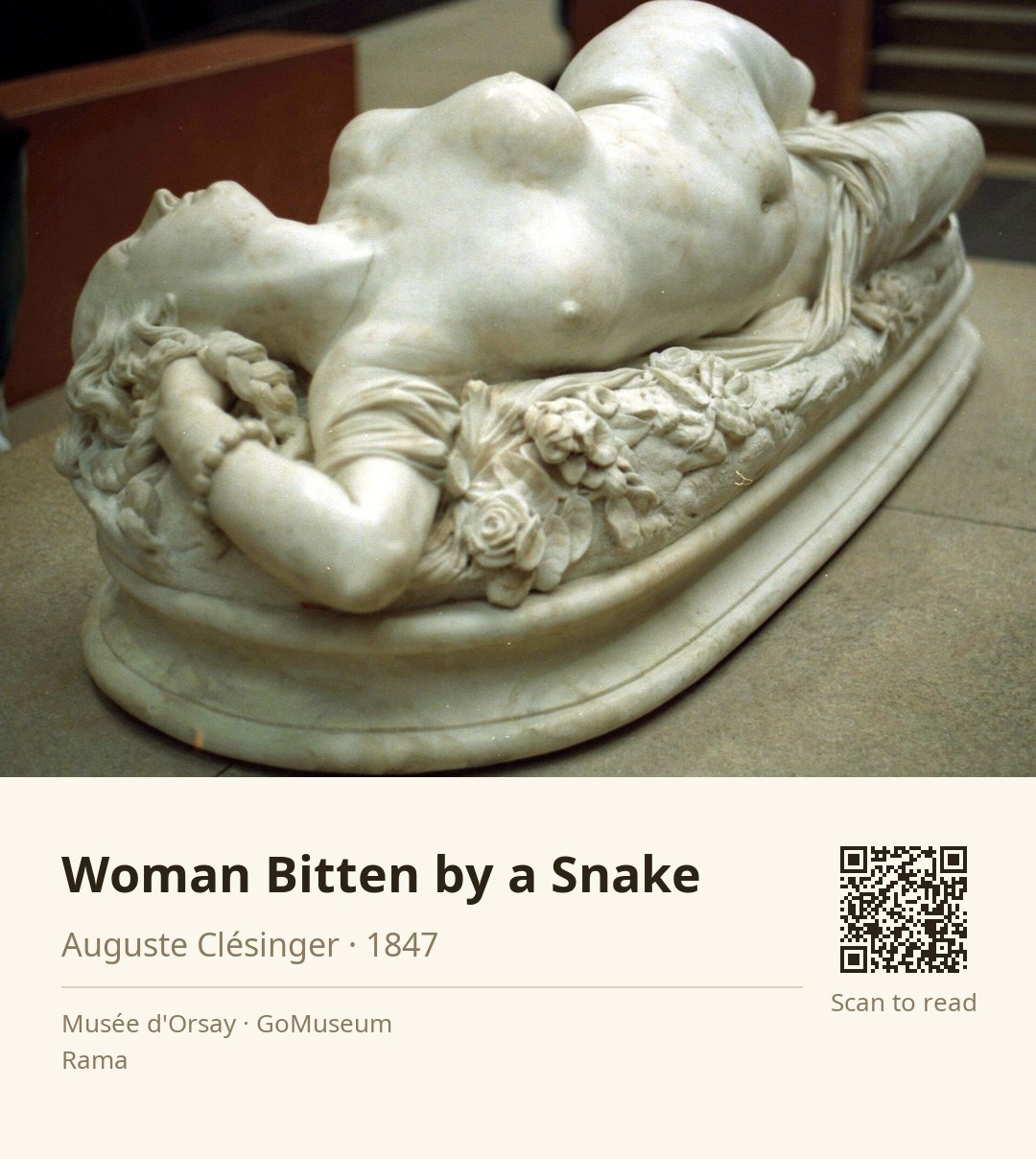
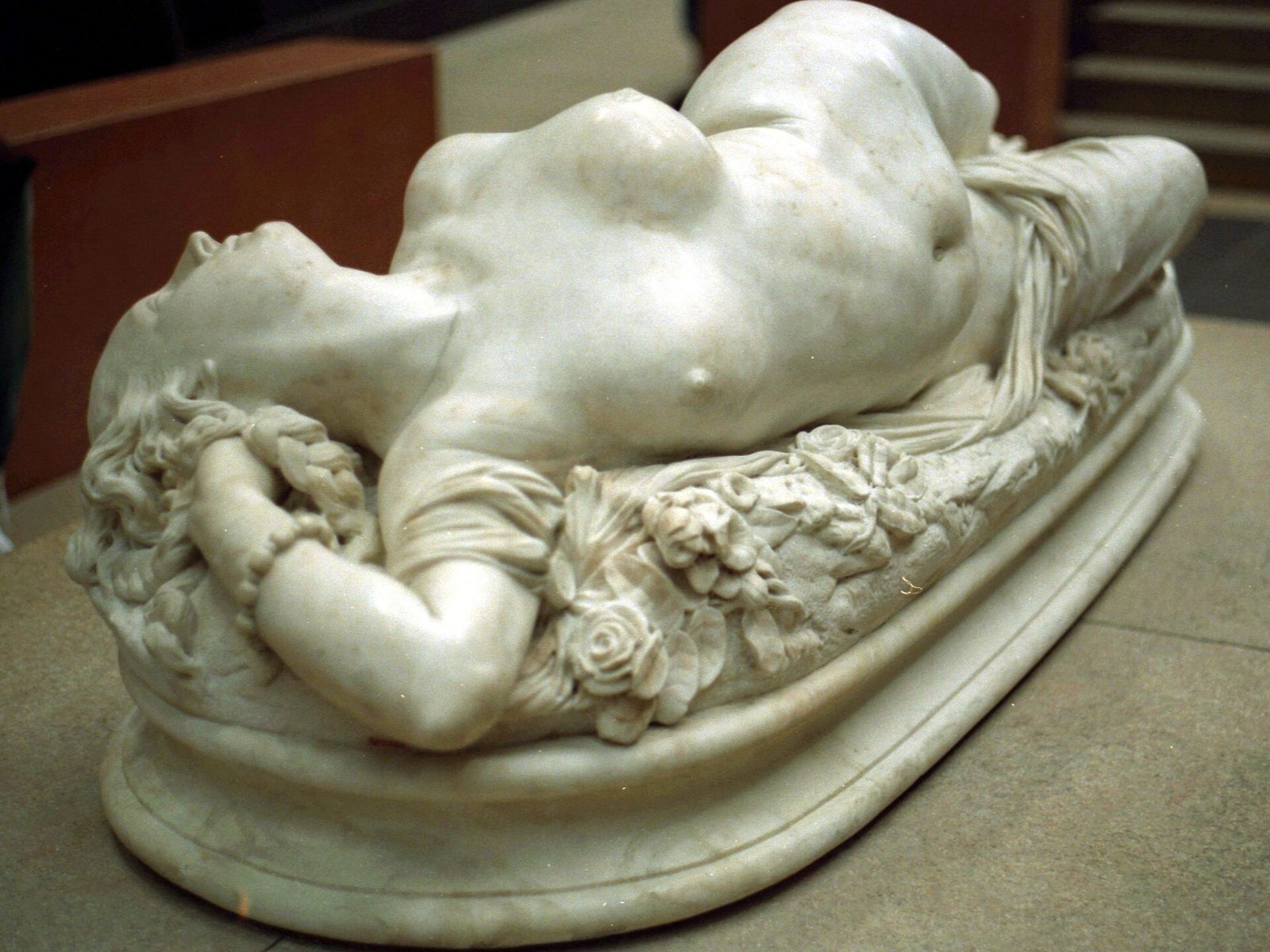
Woman Bitten by a Snake
🎧 This work has audio narration — listen in the appTake a moment to really look at "Woman Bitten by a Snake." Notice how the figure twists in agony, her body caught in a moment of both beauty and distress. The delicate flowers surrounding her contrast sharply with the fierce grip of the snake on her arm. This tension between life and death, pleasure and pain, is what makes this sculpture so compelling. Clésinger crafted this piece in 1847, using a life cast of his mistress, Apollonie Sabatier. The realism is striking—look closely at the details, even the cellulite on her thighs. This was revolutionary for its time, pushing the boundaries of how the female form was depicted in art. Critics were scandalized, suggesting that the woman’s expression hinted at ecstasy rather than suffering. This controversy only fueled its fame, making it one of the most talked-about works of the Paris Salon that year. Clésinger's bold choice to depict a real woman, rather than an idealized figure, challenged societal norms and sparked intense debate about art and sexuality in the 19th century. As you stand here, think about how this piece reflects not just a moment in time, but a shift in artistic expression. What emotions does it evoke for you?
Jean-Baptiste Auguste Clésinger was a prominent French sculptor and painter born on October 22, 1814, in Besançon. Trained by his sculptor father, he made his debut at the Paris Salon in 1843 and gained fame with his provocative work, "Woman Bitten by a Serpent," in 1847, which showcased his model and muse, Apollonie Sabatier. This piece stirred controversy for its erotic undertones and was lauded for its beauty by critics like Théophile Gautier.
Clésinger's career flourished as he created notable busts and statues, including works of Rachel Félix and Louise of Savoy. His marriage to Solange Dudevant, daughter of the writer George Sand, intertwined his life with notable literary figures, including Frédéric Chopin, for whom he crafted a death mask and a tombstone. Despite personal struggles, including the tragic loss of his daughter and a tumultuous marriage, Clésinger's artistic contributions were recognized with honors, including the Légion d'honneur.
He became the artistic director of the Société générale de photosculpture in 1867, further cementing his legacy in the art world. Clésinger passed away on January 5, 1883, in Paris and was buried in Père Lachaise Cemetery, leaving behind a significant mark on 19th-century sculpture and romantic art.
As you gaze at 'Woman Bitten by a Snake,' pay attention to the marble's texture. Clésinger employed a technique called 'taille avec mise aux points,' which means he meticulously carved the marble to achieve a lifelike quality. Notice how the smoothness of her skin contrasts with the intricate details of the flowers around her. The way he captured the model's cellulite is particularly striking—it's a bold choice that adds an unsettling realism to the piece, making it feel almost alive.
Commissioned in 1847 by industrialist Alfred Mosselman, 'Woman Bitten by a Snake' was first unveiled at the Paris Salon that same year, where it became one of the most talked-about pieces. The sculpture, modeled after Mosselman's mistress, Apollonie Sabatier, stirred significant controversy. Critics were shocked not only by the nudity but also by the raw emotion depicted—was she in pain or ecstasy? Clésinger's choice to use a life cast of Sabatier's body was groundbreaking yet contentious, as it challenged the artistic norms of the time. The scandal surrounding the piece was so intense that Théophile Gautier, a close friend of Clésinger, actively defended it, helping to secure its place in art history. The work was later exhibited at the 1889 Exposition Universelle in Paris, further cementing its legacy.
This sculpture was commissioned by Alfred Mosselman, a wealthy industrialist, as a tribute to his mistress, Apollonie Sabatier. What makes it even more fascinating is that Clésinger used a life-cast of Apollonie for the sculpture, capturing her likeness in stunning detail, even down to the cellulite on her thighs. This level of realism was shocking for the 19th century, sparking debates about morality and artistic integrity. Critics were scandalized, suggesting that the woman's contorted pose resembled ecstasy rather than pain, igniting a firestorm of controversy at its debut in the 1847 Salon.
The choice of Apollonie Sabatier, a known demi-mondaine and mistress of the industrialist who commissioned the work, added a layer of scandal to the sculpture. Many critics were outraged not only by the nudity but also by the suggestion of eroticism, which they felt blurred the lines between art and immorality.
Clésinger's relationship with Apollonie Sabatier, who was both his model and mistress, deeply influenced the emotional intensity of 'Woman Bitten by a Snake.' Their tumultuous relationship and her status as a muse for other artists, including Charles Baudelaire, added a personal dimension to the sculpture's creation.