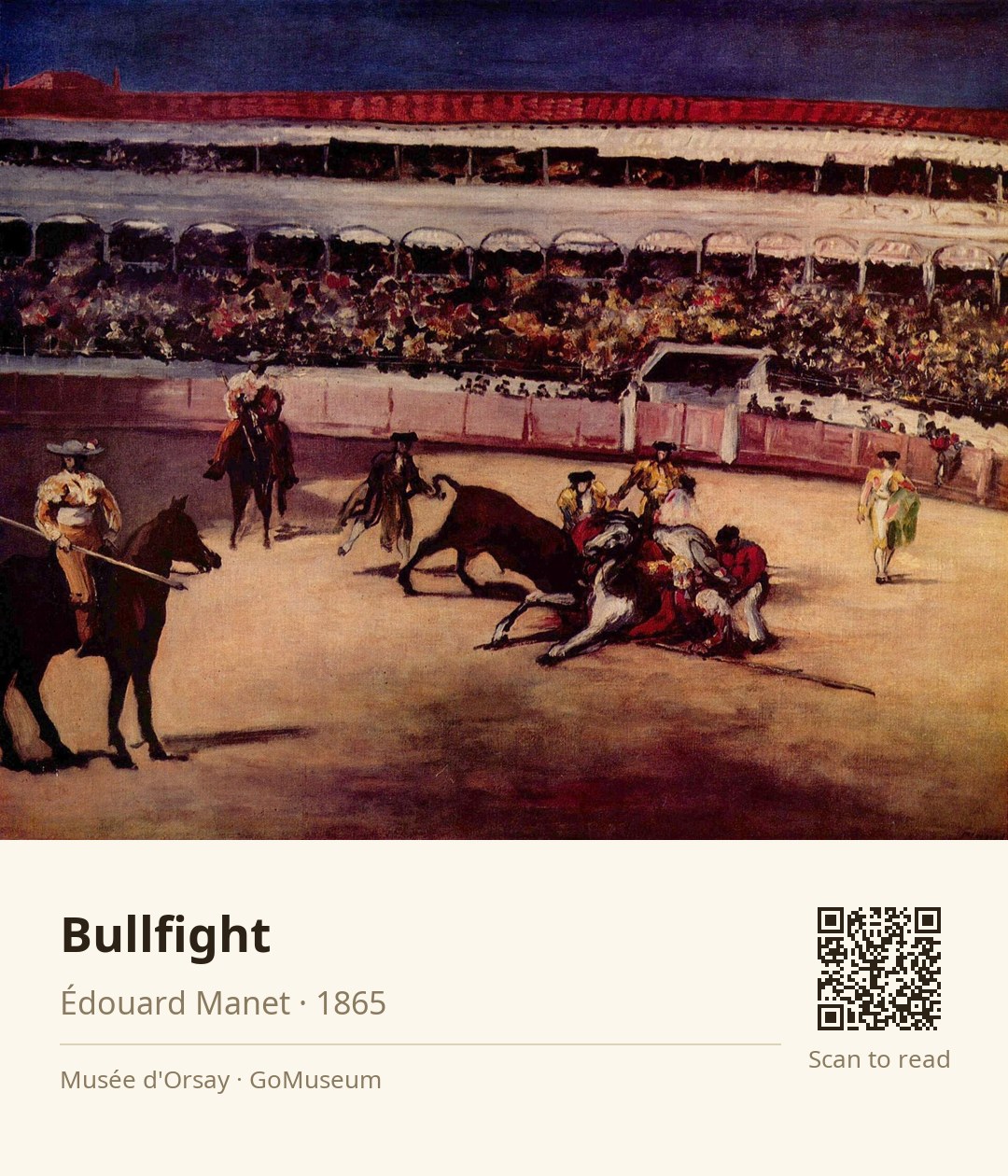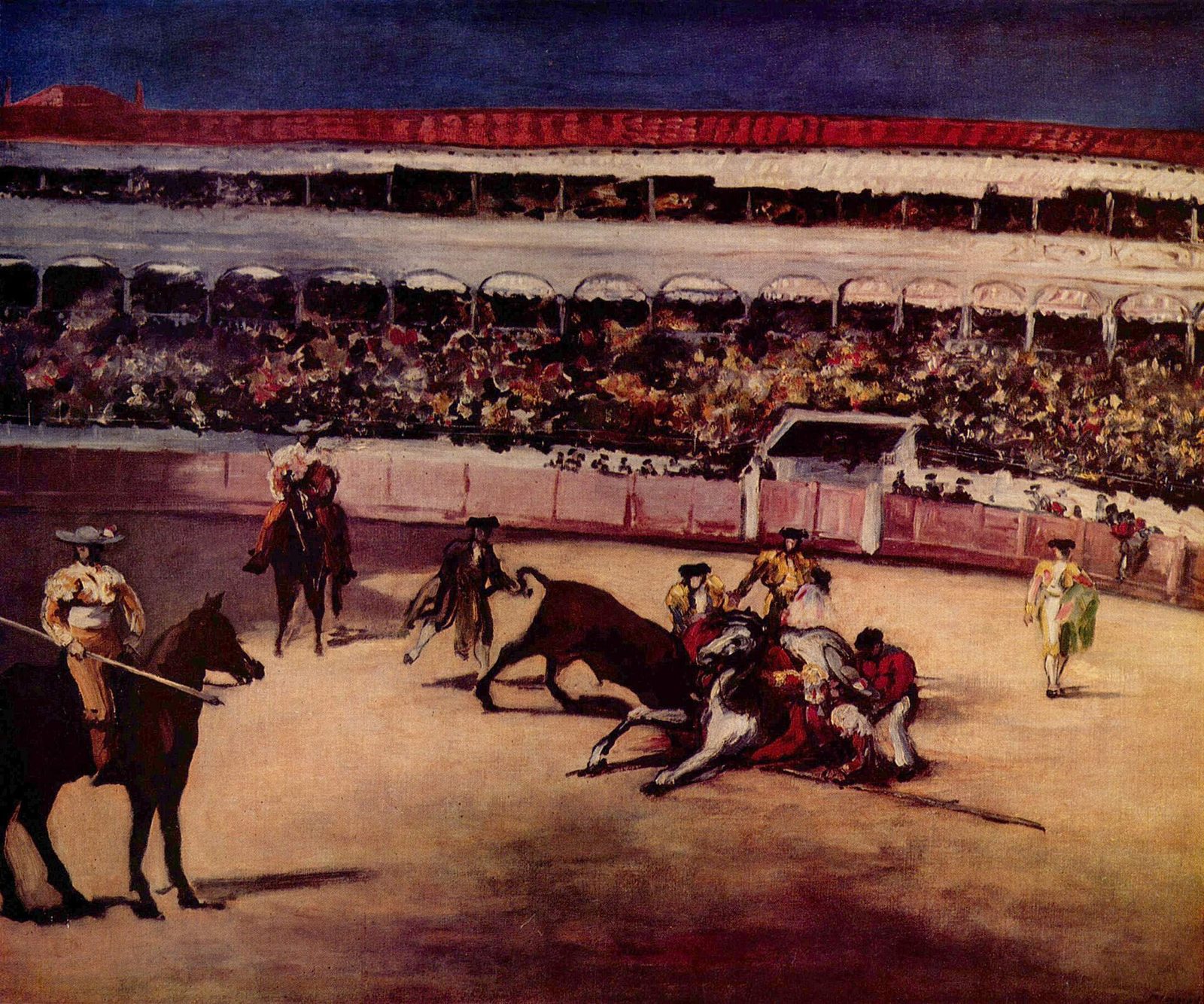
Take a moment to really look at Manet's "Bullfight." Notice how the bull, fierce and defiant, is charging right at you, while the picador on horseback is thrown off balance, his horse collapsing beneath him. This moment captures the raw intensity of the bullfight, a spectacle that Manet was deeply fascinated by after his trip to Spain in 1865.
What’s striking here is the way Manet uses color and brushwork to convey chaos. The vibrant reds and yellows contrast sharply with the dark tones of the bull and the horse, creating a sense of urgency and drama. This isn’t just a depiction of a bullfight; it’s a commentary on the unpredictability of life and the struggle between man and beast.
At the time, this painting was controversial. Critics didn’t understand Manet’s approach, which deviated from traditional representations of bullfighting. Instead of glorifying the event, he presents it in a raw, almost brutal light. This was part of his broader exploration of modern life, pushing boundaries and challenging the status quo in art.
So, as you stand here, think about what this scene evokes for you. Does it remind you of any struggles or confrontations in your own life? Manet invites you to reflect on the tension between beauty and brutality, a theme that resonates through time.
Édouard Manet, born on January 23, 1832, in Paris, emerged as a pivotal figure in 19th-century art, bridging Realism and Impressionism. From an affluent family, he initially faced pressure to pursue a naval career but instead dedicated himself to painting, influenced by his uncle and the Old Masters. His early works, including "The Luncheon on the Grass" and "Olympia," sparked controversy and challenged traditional artistic norms, marking him as a revolutionary force.
Manet's style, characterized by loose brushwork and a focus on contemporary life, diverged from the meticulous techniques of his predecessors. He often depicted modern Parisian scenes, capturing the essence of leisure and social dynamics. Despite initial rejection from the art establishment, he gained recognition among progressive artists and became a mentor to the Impressionists.
Throughout his life, Manet formed connections with influential figures like Baudelaire and Zola, who defended him against critics. His later works, such as "A Bar at the Folies-Bergère," showcased his evolving style and mastery of color. Manet's contributions to art history are profound; he is celebrated not only for his innovative techniques but also for elevating still life and modern subjects to the forefront of artistic expression. He passed away on April 30, 1883, leaving behind a legacy that continues to inspire artists today.
Édouard Manet's "Bullfight" was painted between 1865 and 1866, shortly after his transformative trip to Spain. This painting, which captures a dramatic moment in a bullfight, was part of a series that reflected Manet's fascination with Spanish culture and bullfighting. The painting faced harsh criticism upon its exhibition in 1884, where it was displayed at the Exposition des œuvres de Edouard Manet in Paris. Critics were baffled by Manet's raw portrayal, which deviated from the glorified representations typical of the time. Despite the backlash, it found support from influential figures like Charles Baudelaire and Émile Zola. Manet kept the work in his studio for years, only releasing it after receiving praise from the Goncourt brothers in 1872. The painting's journey continued through various collections, ultimately being accepted by the French state in 1976 and now residing in the Musée d'Orsay in Paris.
In "Bullfight," Manet employs a striking technique that combines bold brushwork with a vivid color palette to evoke the chaos of the bullfighting arena. The brushstrokes are energetic and loose, creating a sense of movement that mirrors the intensity of the scene. Notice how the vibrant reds and yellows clash with the darker tones of the bull and the fallen horse, heightening the drama. Manet's composition is dynamic; the bull's powerful charge is directed towards the viewer, pulling you into the action. The scale of the painting, relatively large at 1.1 by 0.9 meters, enhances its impact, making you feel as if you're part of the spectacle. This choice of scale, combined with the dramatic moment captured, invites a visceral reaction, as if you are witnessing the chaos firsthand. Manet's technique reflects not just the physical struggle but also the emotional turmoil inherent in the bullfight.
Painted in 1865, it reflects Manet's fascination with the dramatic and colorful spectacle of Spanish bullfighting, a theme he explored after a transformative trip to Spain. This work, admired by contemporaries like Baudelaire and Zola, challenged the artistic norms of the time, steering away from idealized representations and embracing the raw, chaotic energy of modern life. Its bold approach to subject matter and technique influenced a generation of artists, laying groundwork for Impressionism and beyond. Remember this: Manet didn't just paint a bullfight; he captured the very essence of modernity, forever changing how we perceive art's role in society.
One fascinating tidbit about Manet's 'Bullfight' is that it depicts a rare moment in the bullfighting spectacle: the bull successfully attacking and bringing down the horse. This dramatic scene was so controversial that it led to fierce criticism from art critics of the time. In fact, the backlash was so intense that Manet kept the painting in his studio for several years, only unveiling it after receiving praise from influential figures like the Goncourt brothers. Imagine the tension in Manet's studio, waiting for the right moment to share this bold work with the world!
Manet depicted a rare moment in bullfighting where the bull successfully attacks and brings down the horse, a scene that highlights the unpredictability and danger of the event, contrasting with the more glorified portrayals typical of the time.
After attending a bullfight in Spain, Manet expressed his desire to capture the vibrant and chaotic atmosphere of the event, which he described as both beautiful and terrible, reflecting his fascination with the spectacle.