Clair de lune sur le port de Boulogne
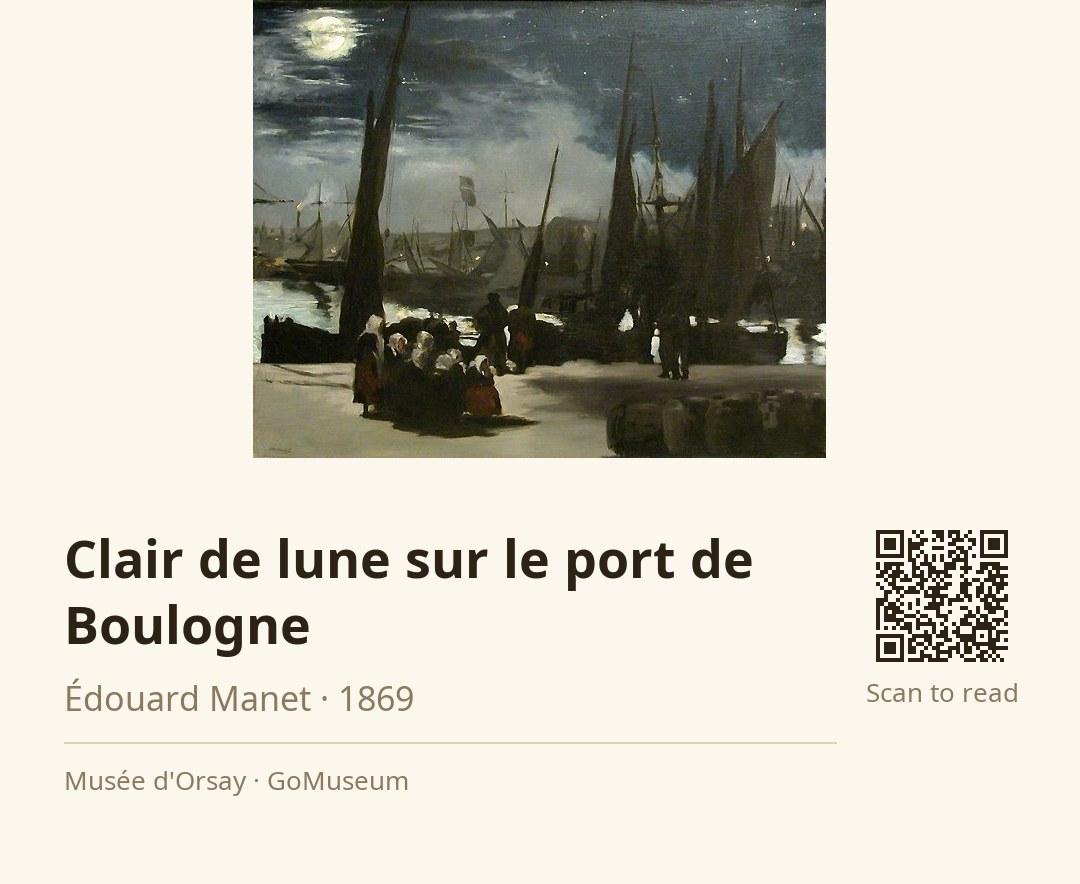
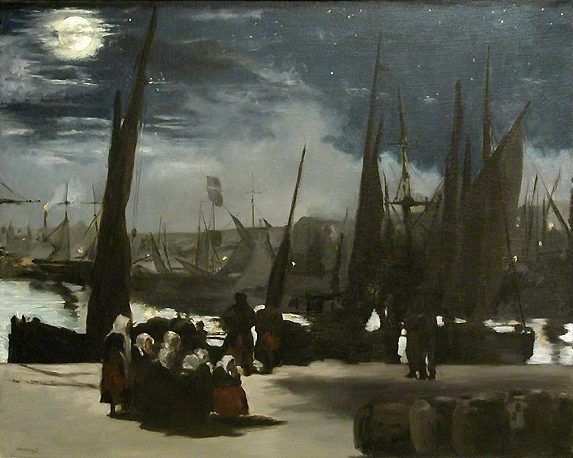
🎧 This work has audio narration — listen in the appTake a moment to soak in the enchanting scene before you in Édouard Manet's "Clair de lune sur le port de Boulogne." Notice how the moonlight casts a silvery glow over the harbor, illuminating the fishing boat returning home. Look closely at the group of women huddled together on the quay, their traditional costumes almost blending into the shadows.
These details matter because they capture a fleeting moment of life at sea, a tribute to the everyday struggles and hopes of the fishermen and their families. The way the moonlight dances on the water not only evokes a sense of calm but also hints at the emotional weight of waiting—each woman is a silent testament to the resilience of those who depend on the sea.
Manet painted this scene in 1868 during one of his summer stays in Boulogne, a time when the Parisian elite sought solace along the Channel coast. This painting, born from a window of the Hôtel Folkestone, reflects his fascination with light and shadow, reminiscent of the great Dutch masters like Rembrandt, yet infused with his own modern touch.
As you stand here, think about the stories these women could tell, waiting for their loved ones to return. What emotions do you think the moonlight stirred in them that night?
Édouard Manet, born on January 23, 1832, in Paris, emerged as a pivotal figure in 19th-century art, bridging Realism and Impressionism. From an affluent family, he initially faced pressure to pursue a naval career but instead dedicated himself to painting, influenced by his uncle and the Old Masters. His early works, including "The Luncheon on the Grass" and "Olympia," sparked controversy and challenged traditional artistic norms, marking him as a revolutionary force.
Manet's style, characterized by loose brushwork and a focus on contemporary life, diverged from the meticulous techniques of his predecessors. He often depicted modern Parisian scenes, capturing the essence of leisure and social dynamics. Despite initial rejection from the art establishment, he gained recognition among progressive artists and became a mentor to the Impressionists.
Throughout his life, Manet formed connections with influential figures like Baudelaire and Zola, who defended him against critics. His later works, such as "A Bar at the Folies-Bergère," showcased his evolving style and mastery of color. Manet's contributions to art history are profound; he is celebrated not only for his innovative techniques but also for elevating still life and modern subjects to the forefront of artistic expression. He passed away on April 30, 1883, leaving behind a legacy that continues to inspire artists today.
Édouard Manet's 'Clair de lune sur le port de Boulogne' was painted in the summer of 1868, during one of his frequent stays in Boulogne-sur-Mer, a popular retreat for the Parisian elite at the time. This piece was created around midnight on the night of August 3rd to 4th, from a window of the Hôtel Folkestone, where Manet had a clear view of the harbor. The painting was first exhibited in Brussels in 1869, and it later made its way to notable exhibitions, including the 1889 Exposition Universelle in Paris. Over the years, it changed hands several times, being owned by notable figures such as Alfred Stevens and Jean-Baptiste Faure, before finding its home in the Musée d'Orsay.
As you gaze at 'Clair de lune sur le port de Boulogne,' take a moment to appreciate Manet's masterful handling of light and shadow. The moonlight, rendered with a silvery glow, creates a soft, ethereal quality that envelops the scene, contrasting with the deep shadows that suggest the weight of the night. Notice how the brushwork feels both fluid and spontaneous, capturing the fleeting moment of a fishing boat's return. Manet's choice of composition draws your eye across the canvas, from the silhouetted women on the quay to the shimmering water, creating a sense of depth and movement. The painting's scale, relatively large at 82 by 101 centimeters, allows for an immersive experience, inviting you to step into the quiet tension of the scene.
Painted in 1868, it showcases Manet's innovative approach to light and shadow, drawing inspiration from the Dutch masters like Rembrandt and Aert van der Neer. This work not only reflects the changing tides of artistic expression in the 19th century but also influenced a generation of artists who sought to capture modern life in a new light. Manet's casual brushwork and focus on contemporary subjects paved the way for future movements, making this painting a cornerstone in the evolution of modern art. Remember, it’s not just a painting; it’s a moment in time that reshaped artistic boundaries.
One intriguing detail about 'Clair de lune sur le port de Boulogne' is that it was painted during a specific moment in time—around midnight on August 3rd to 4th, 1868. Manet captured this scene from the window of the Hôtel Folkestone, where he was staying. Imagine the artist, perhaps with a glass of wine in hand, watching the moonlight dance on the water as he painted the returning fishing boats and the anxious wives waiting on the quay. This painting wasn't just a casual creation; it was a snapshot of a fleeting moment, meticulously crafted under the glow of the moon.
Manet frequently stayed at the Hôtel Folkestone during his summer visits to Boulogne, where he found inspiration for many of his seascapes, making it a significant location in his artistic development.
While Manet was influenced by Aert van der Neer, known for his precise night scenes, Manet's approach was more casual and spontaneous, reflecting a modern interpretation of light and shadow rather than meticulous detail.