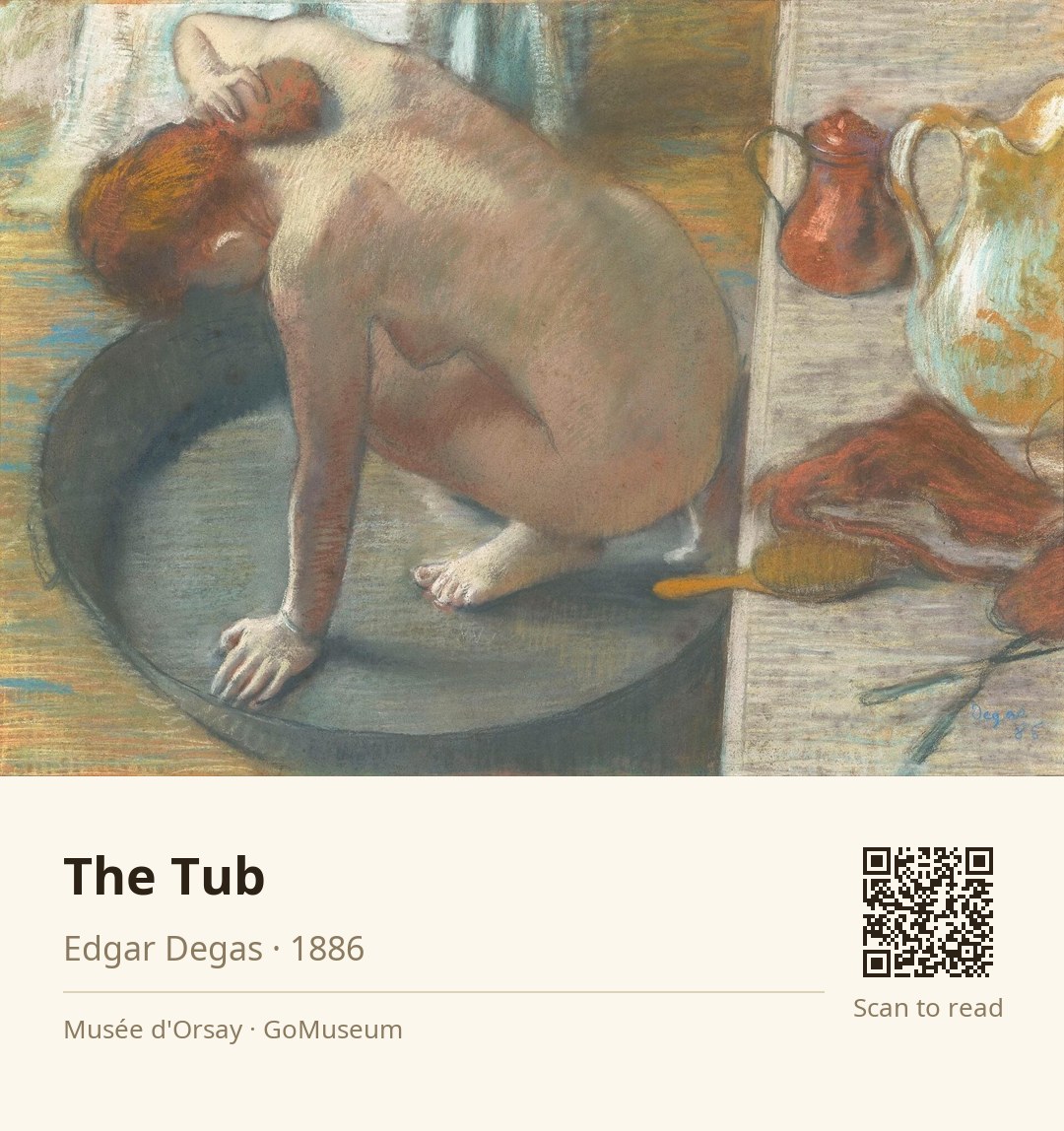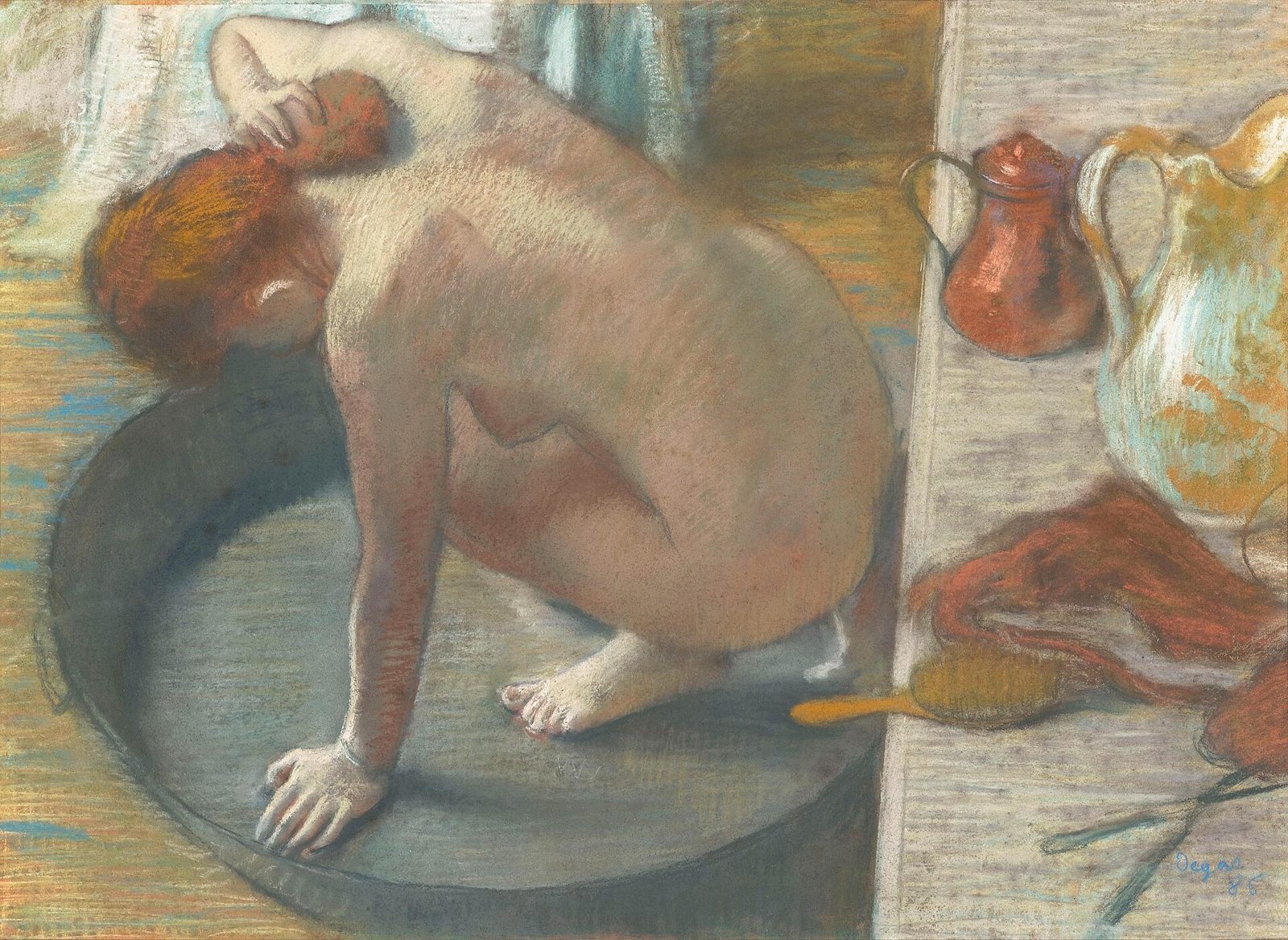
Take a moment to really look at "The Tub" by Edgar Degas. Notice how the soft morning light bathes the figure of the woman, illuminating her back and shoulders with a delicate, almost ethereal glow. The way Degas captures the texture of her skin against the cool surface of the water is nothing short of mesmerizing. Well, it’s not just about the beauty of the moment; it’s about how Degas invites you into an intimate, unguarded moment of everyday life. This isn’t a posed, idealized nude; it’s a genuine glimpse into a private ritual, a celebration of the ordinary that was revolutionary for its time. The angled edge of the cupboard adds to this sense of spontaneity, making you feel like you’ve stumbled upon a secret. Created in 1886, this pastel drawing is part of a series where Degas explored the theme of women bathing, breaking away from the traditional depictions of nudes that were common in art. Instead of mythological figures, he chose real women, showcasing their humanity and vulnerability. As you stand here, think about the connection between the viewer and the subject. What emotions does this scene evoke for you? How does it challenge your perception of beauty and intimacy? Let that linger as you take in the artwork.
Edgar Degas, born on July 19, 1834, in Paris, was a pivotal figure in the Impressionist movement, though he preferred to be labeled a realist. Known for his exceptional skill in drawing, Degas focused on capturing movement, particularly in his depictions of dancers, which constitute over half of his oeuvre. His works also include racehorses and portraits that reveal psychological depth and human isolation.
Degas came from a cultured, affluent family; his mother was a Creole from New Orleans, and his father was a banker. After his mother's death, he pursued art against his father's wishes, studying at the École des Beaux-Arts and drawing inspiration from classical masters during his time in Italy. His early ambition to be a history painter shifted as he embraced contemporary subjects, influenced by artists like Édouard Manet.
Despite being a founding member of the Impressionists, Degas's approach diverged from his peers, as he often worked in his studio rather than en plein air. His innovative techniques and themes sparked debate among critics and continue to influence art history today. Degas passed away on September 27, 1917, leaving behind a legacy that challenges traditional boundaries in art.
Edgar Degas created 'The Tub' in 1886, during a pivotal moment in his career when he was exploring the theme of women bathing. This pastel drawing was part of a series he exhibited at the Eighth Impressionist Exhibition in Paris that same year, where it garnered significant attention. Critics were largely positive, praising its realism and beauty, although some expressed discomfort with Degas's unconventional portrayal of the nude. The work was later donated to the Louvre in 1908 and has since found its home at the Musée d'Orsay, where it continues to captivate audiences. The provenance of 'The Tub' traces back to notable collectors, including Comte Isaac de Camondo and Boussod, Valadon et Cie, highlighting its esteemed status in the art world.
He employs soft, delicate strokes of pastel that create a luminous quality, bathing the figure in a cool morning light. Notice how he covers the entire paper surface, which not only enhances the vibrancy of the colors but also gives the composition a cohesive feel. The figure's form emerges through a combination of chromatic hatching and textured color zones, rather than traditional outlines. This approach allows the viewer to experience a tactile sensitivity to the subject, blurring the lines between representation and abstraction. The angled edge of the cupboard introduces a dynamic tension, making it feel like a candid, unguarded moment rather than a staged scene. The careful arrangement of objects on the dresser echoes the curves of the woman's body, creating a rhythm that unifies the composition.
Interestingly, Degas initially used pastels as a medium for sketching but grew to prefer them for their expressive potential. By the time he created 'The Tub', pastels had become his primary medium, reflecting both his artistic evolution and practical considerations, as they were less costly and easier to sell than oil paintings.
Degas carefully arranged the objects on the dresser to echo the curves of the woman's body, creating a rhythm that unifies the composition. This thoughtful placement enhances the intimate atmosphere of the scene, making it feel both spontaneous and cohesive.
Degas initially used pastels for sketching but came to prefer them as his primary medium by the 1880s, as they allowed for greater expressive potential and were more cost-effective than oil paints. This shift marked a significant evolution in his artistic practice, particularly evident in works like 'The Tub'.
At the Eighth Impressionist Exhibition, 'The Tub' was regarded as one of the highlights, with critics largely praising its realism and beauty. However, some expressed discomfort with Degas's unconventional portrayal of the nude, reflecting the mixed reception of his innovative approach.