Berthe Morisot with a Bouquet of Violets
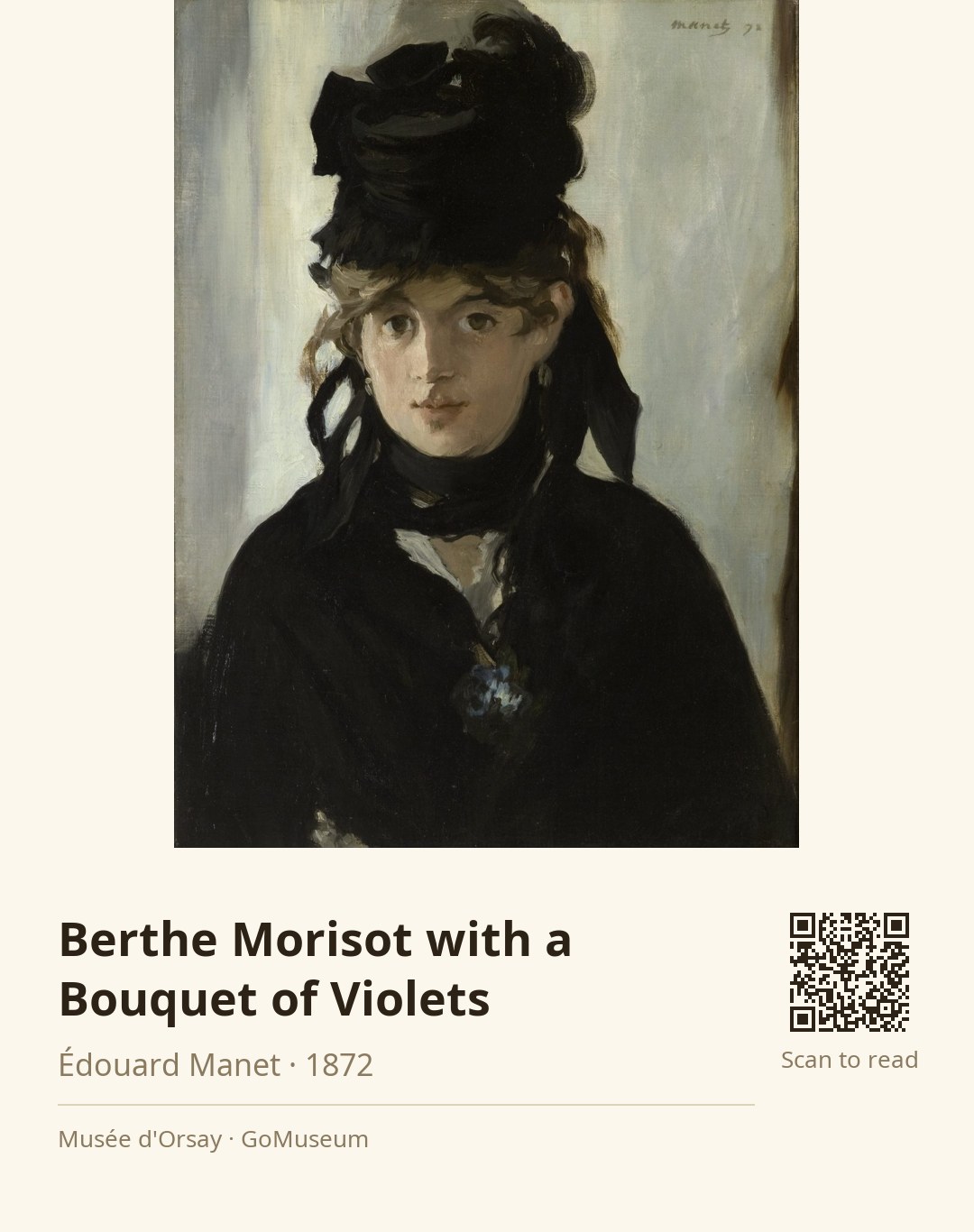
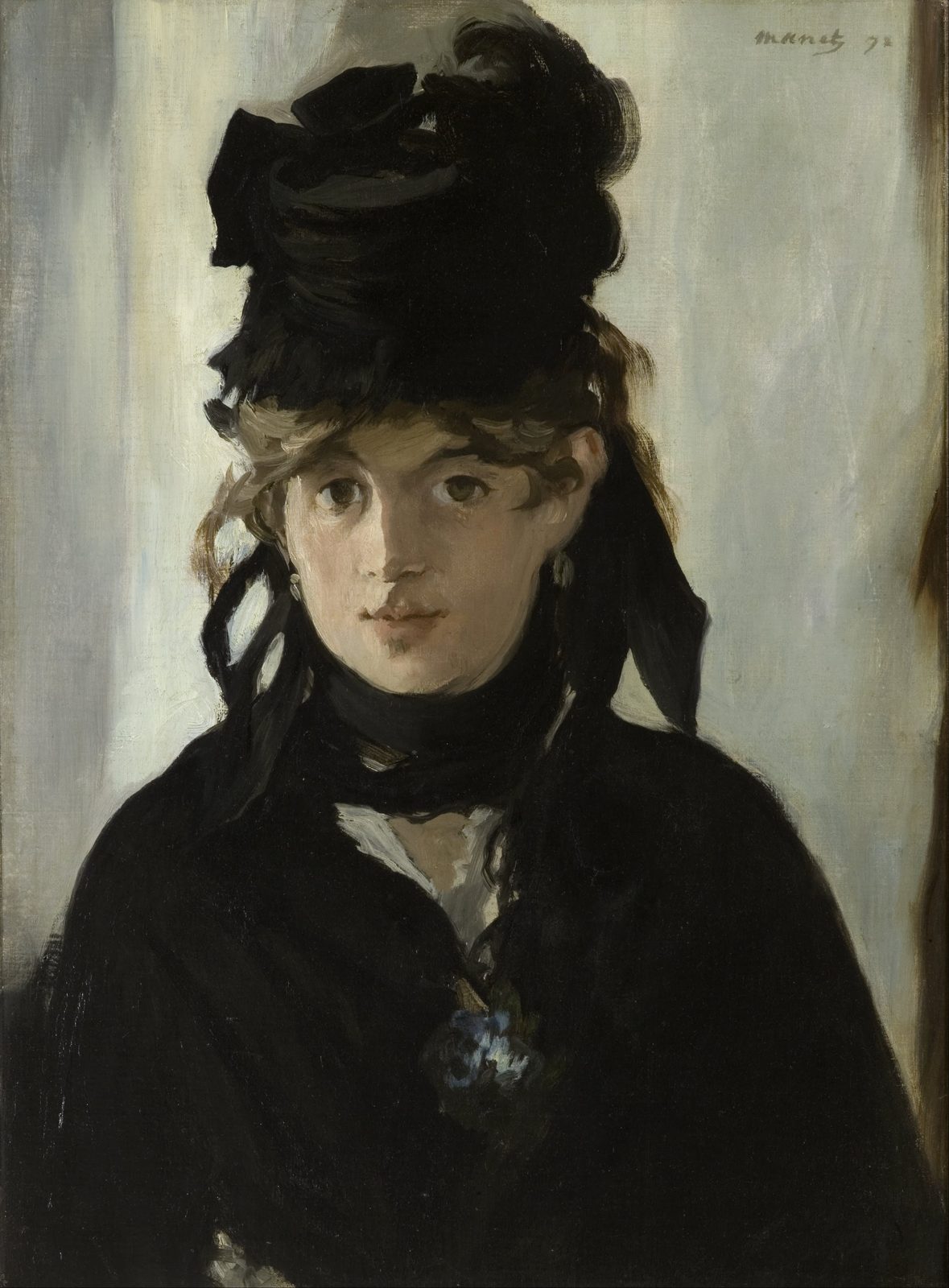
🎧 This work has audio narration — listen in the appTake a moment to really look at this captivating portrait of Berthe Morisot, painted by Édouard Manet in 1872. Notice how Morisot’s black mourning dress contrasts sharply with the soft, lighter background. The way the light hits her right side creates a striking play of shadows, almost as if she’s emerging from the darkness. Now, focus on the delicate bouquet of violets nestled at her neckline. It’s subtle, almost hidden, yet it adds a poignant touch to the composition. Manet and Morisot shared a deep artistic bond, influencing each other’s work significantly. This portrait is one of several he painted of her, capturing not just her likeness but the essence of their friendship. It’s a moment frozen in time, a glimpse into the world of two pioneering artists of the Impressionist movement. As you stand here, think about the layers of meaning in this painting. What do you feel when you see Morisot’s gaze? Does it evoke a sense of presence or absence for you?
Édouard Manet, born on January 23, 1832, in Paris, emerged as a pivotal figure in 19th-century art, bridging Realism and Impressionism. From an affluent family, he initially faced pressure to pursue a naval career but instead dedicated himself to painting, influenced by his uncle and the Old Masters. His early works, including "The Luncheon on the Grass" and "Olympia," sparked controversy and challenged traditional artistic norms, marking him as a revolutionary force.
Manet's style, characterized by loose brushwork and a focus on contemporary life, diverged from the meticulous techniques of his predecessors. He often depicted modern Parisian scenes, capturing the essence of leisure and social dynamics. Despite initial rejection from the art establishment, he gained recognition among progressive artists and became a mentor to the Impressionists.
Throughout his life, Manet formed connections with influential figures like Baudelaire and Zola, who defended him against critics. His later works, such as "A Bar at the Folies-Bergère," showcased his evolving style and mastery of color. Manet's contributions to art history are profound; he is celebrated not only for his innovative techniques but also for elevating still life and modern subjects to the forefront of artistic expression. He passed away on April 30, 1883, leaving behind a legacy that continues to inspire artists today.
Édouard Manet first met Berthe Morisot in 1868, and their artistic relationship blossomed into a profound friendship. This portrait, painted in 1872, was one of several he created of her, showcasing her in various poses and attire. Morisot, a talented painter in her own right, would later marry Manet's brother, Eugène, in 1874. Manet, who had served in the Garde Nationale, returned to painting in 1871 after a hiatus. This particular work was quickly celebrated as a masterpiece, earning praise from critics and collectors alike. It was eventually sold to art critic Théodore Duret, and later acquired by Morisot herself in 1894. After her passing in 1895, the painting remained in her family's possession until it was acquired by the Musée d'Orsay in 1998, ensuring its place in the heart of Parisian art history.
As you gaze at this portrait, notice how Manet plays with light and shadow in a way that feels almost theatrical. The stark contrast between the bright illumination on Morisot's right side and the deep shadows on her left creates a sense of depth and drama. This technique, known as chiaroscuro, draws your eye to her face, which is framed by her black mourning attire. The brushwork is loose yet deliberate, giving a sense of immediacy and intimacy. The delicate violets at her neckline are painted with a subtle touch, almost as if they are shyly peeking out from the darkness of her dress. Manet's choice to depict Morisot with dark eyes, despite her actual green ones, adds an air of mystery, hinting at his perception of her character. The overall composition, with Morisot slightly turned and her gaze directed outward, invites you into a moment of contemplation, as if she is both present and withdrawn.
This painting, created in 1872, captures Morisot in a moment that speaks volumes about her role in the art world, as she was one of the few women to gain recognition in a male-dominated field. Manet's unique approach to light and shadow in this work influenced future generations of artists, particularly the Impressionists, who admired his ability to convey emotion and presence through subtle contrasts. The way Morisot's gaze seems to both engage and withdraw creates a haunting quality that has resonated with viewers and critics alike, marking this piece as a significant contribution to the evolution of modern art. Remember, this painting isn't just a portrait; it's a dialogue between two artists that changed the landscape of art history.
Did you know that Manet painted Berthe Morisot multiple times? This particular portrait, created in 1872, is one of several where she appears in a black mourning dress. Interestingly, Morisot's eyes were actually green, but Manet chose to depict them as black, perhaps influenced by his impression that she looked Spanish. This choice adds a layer of intrigue to the painting, inviting viewers to ponder the artist's intentions and perceptions.