Around the Piano
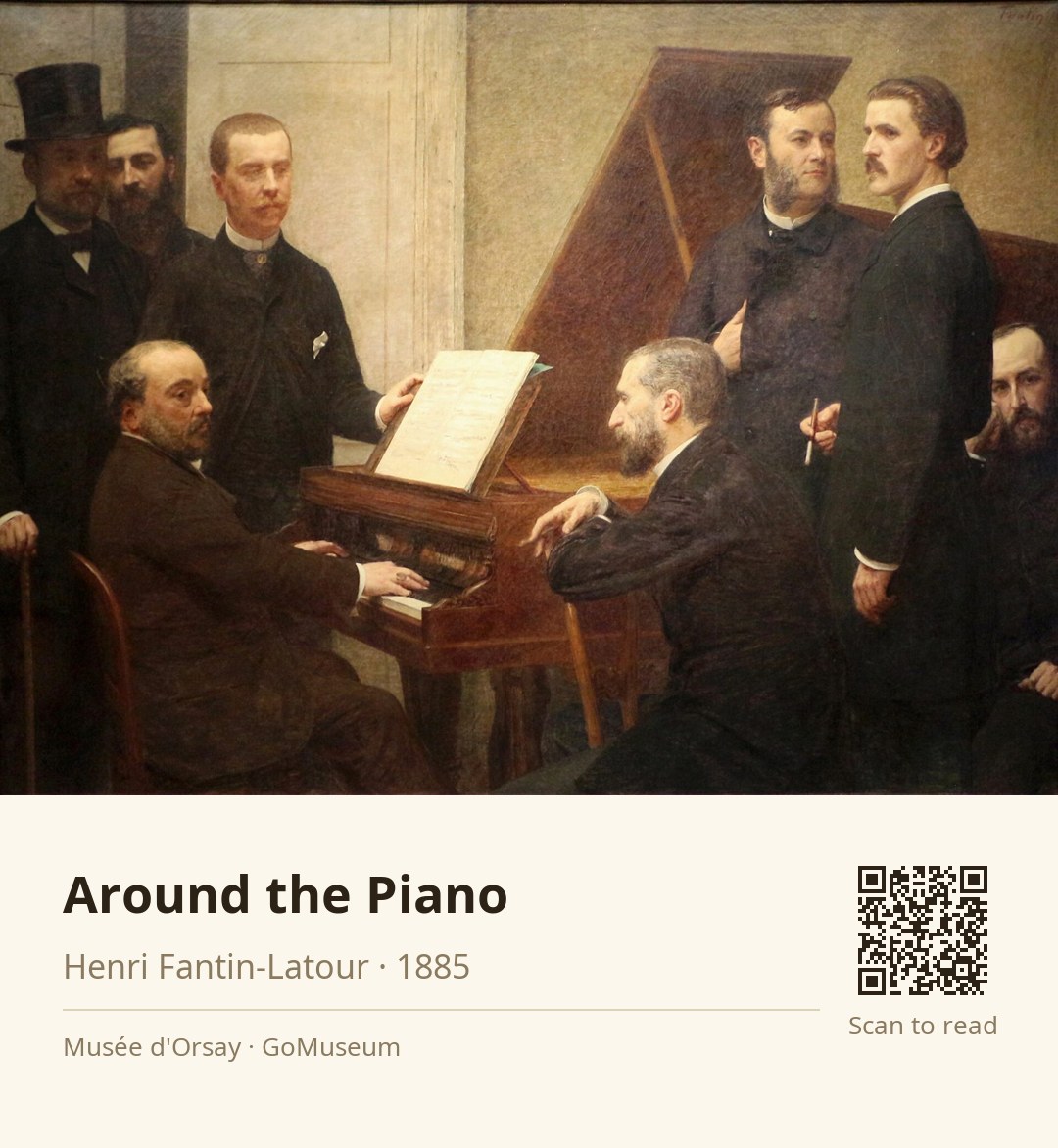
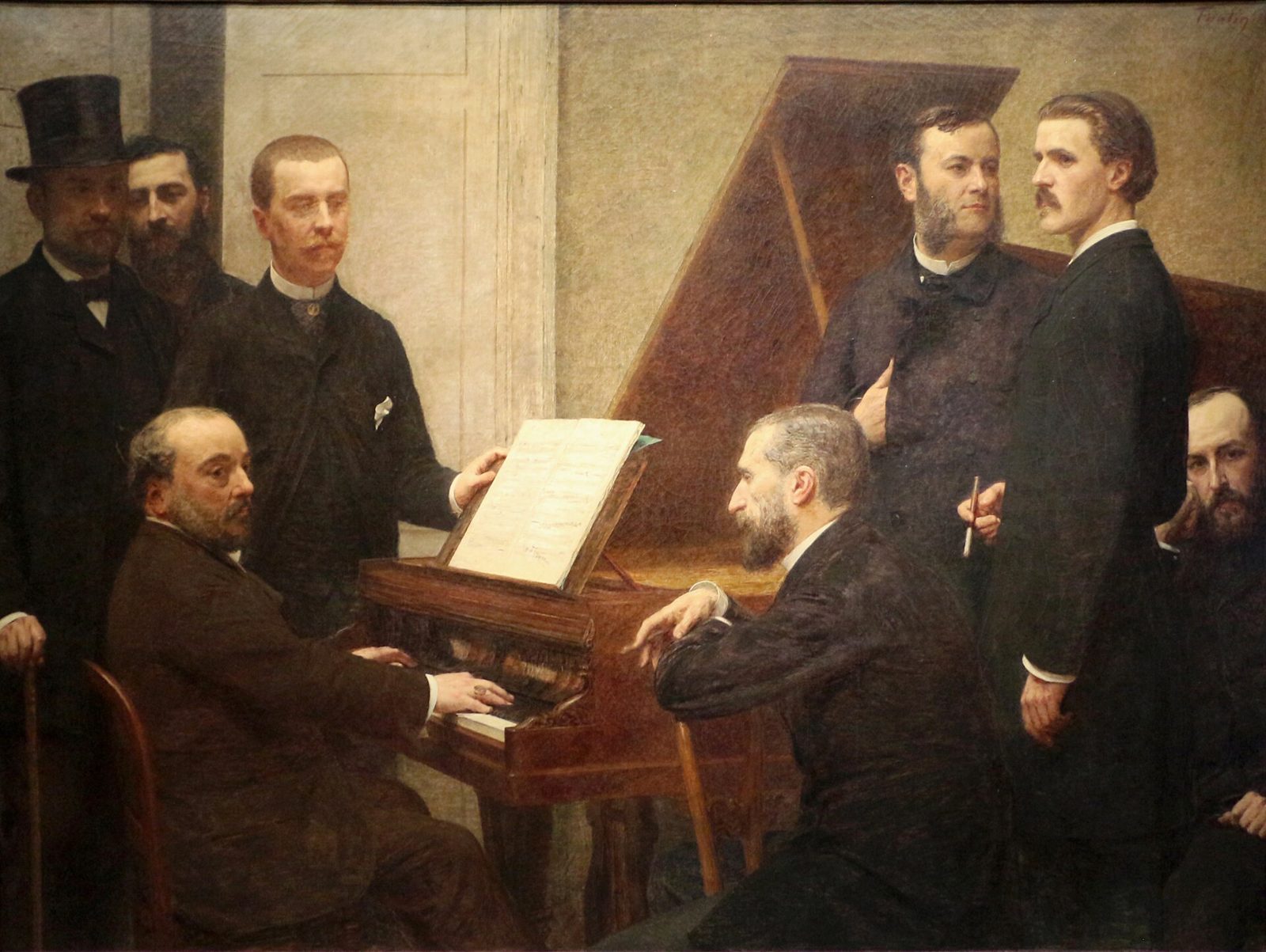
🎧 This work has audio narration — listen in the appTake a moment to really soak in the scene before you in Henri Fantin-Latour's "Around the Piano." Notice how the eight figures are clustered together, their expressions a mix of concentration and camaraderie. Look closely at the man at the piano—Emmanuel Chabrier—his fingers poised over the keys, as if the music is about to leap off the canvas.
These details matter because they capture a moment of artistic intimacy among friends, a gathering that celebrates not just music, but the bonds of creativity. Fantin-Latour painted this in 1885, during a time when such gatherings were a vital part of Parisian cultural life.
This painting is the last in a series of group portraits that Fantin-Latour created of his artistic circle, known as "Le Petit Bayreuth." While the figures here may not be as famous as others he painted, they represent a community of artists who admired Wagner and shared a deep love for music.
As you take in the scene, think about the friendships that shaped these artists' lives. What kind of music do you think they were playing, and how might it have echoed in the room?
Ignace Henri Jean Théodore Fantin-Latour, born on January 14, 1836, in Grenoble, was a notable French painter and lithographer renowned for his exquisite flower paintings and group portraits of contemporary artists and writers. His artistic journey began under the guidance of his father, a painter, and continued in Paris, where he studied at the École des Beaux-Arts alongside future Impressionists like Edgar Degas and Alphonse Legros. Despite his connections to the avant-garde, Fantin-Latour's style remained rooted in realism and tradition.
In the 1860s, he gained acclaim for his still lifes, particularly in England, where his works were celebrated for their vibrant colors and textures. Encouraged by James McNeill Whistler, he embraced this genre, which was often undervalued in the hierarchy of art. His still lifes, characterized by their simplicity and focus on form, defied academic conventions and showcased his mastery of color.
Fantin-Latour's contributions to collective portraiture, such as "A Studio at Les Batignolles," positioned him as a bridge between Romanticism and Impressionism. Despite being overshadowed by his contemporaries, his legacy endures, with his works held in prestigious museums and a lasting influence on subsequent generations of artists. He passed away on August 25, 1904, leaving behind a rich artistic heritage that continues to be appreciated today.
Henri Fantin-Latour's "Around the Piano" was painted in 1885, marking the last of four group portraits he created of his artistic circle. This particular work was exhibited at the Salon des artistes français that same year, where it garnered more acclaim than his earlier pieces, although it remains the least known of the series. The painting was initially misidentified by viewers as featuring Camille Saint-Saëns at the piano, but Adolphe Jullien, a close friend of Fantin, clarified that it was Emmanuel Chabrier instead. Following its debut, the painting was acquired by Jullien and later moved to the Musée du Luxembourg in 1915, then to the Louvre until 1986, and is now housed in the Musée d'Orsay. Its reception was significant, as it represented a moment of camaraderie among artists who admired Wagner, reflecting the cultural milieu of Paris at the time.
Take a closer look at the brushwork in "Around the Piano". Fantin-Latour employs a soft yet deliberate technique, with each stroke contributing to the intimate atmosphere of the gathering. The figures are arranged in a semi-circle around the piano, creating a sense of unity and shared experience. Notice how the light falls on their faces, highlighting expressions of concentration and joy. The color palette is warm, dominated by earthy tones that evoke a cozy, inviting space. The scale of the painting, at 160 by 222 centimeters, allows you to feel almost as if you could step into the scene, joining this circle of friends. Fantin-Latour's choice to depict a moment of musical engagement rather than a grand historical narrative invites you to ponder the everyday joys of artistic collaboration.
Interestingly, when "Around the Piano" was first exhibited, many viewers mistakenly believed the figure at the piano was Camille Saint-Saëns, a prominent composer and early supporter of Wagner. This misidentification highlights how the painting's context was deeply intertwined with the cultural conversations of the time, as the audience projected their own knowledge of the music scene onto the artwork.