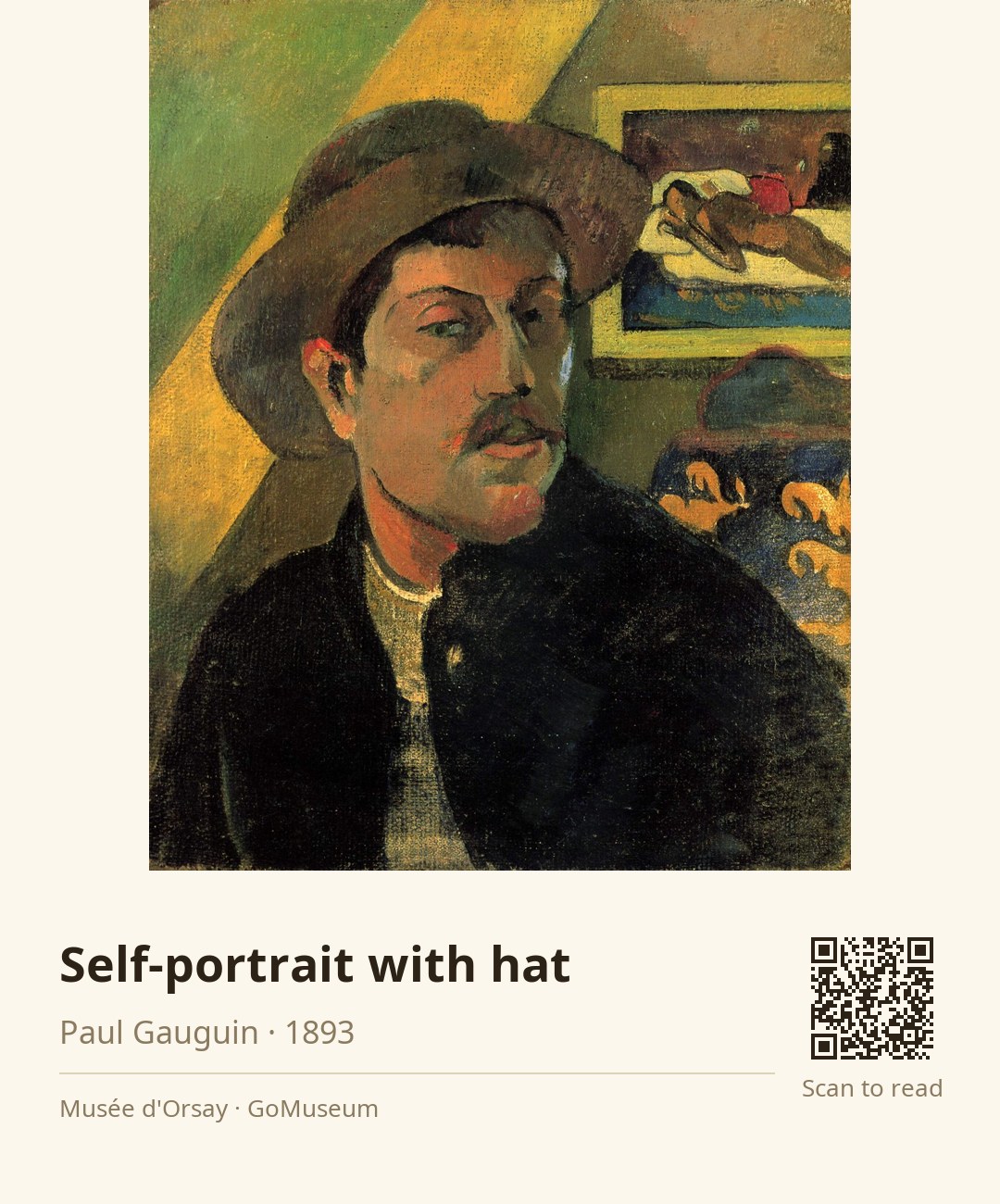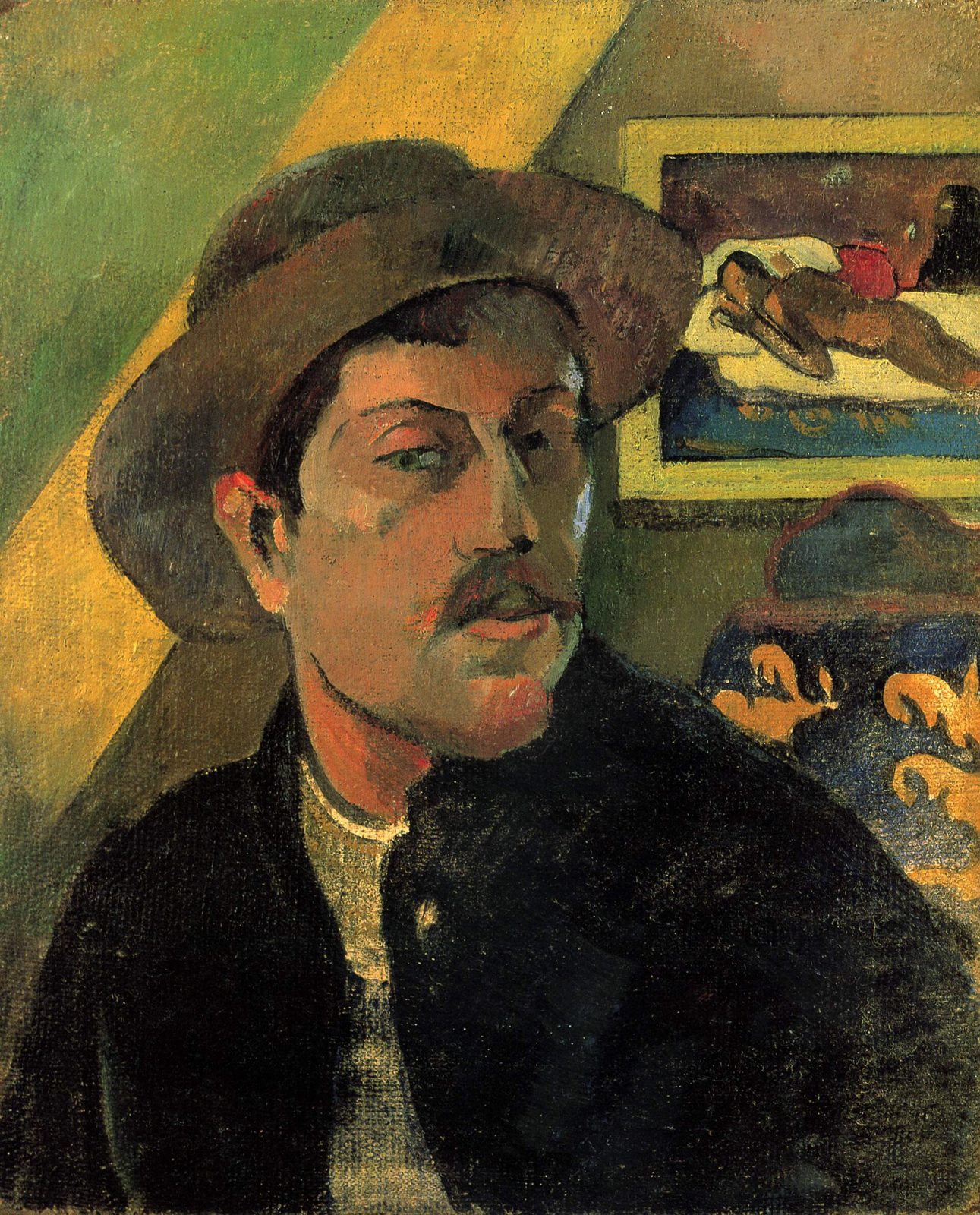
Self-portrait with hat
🎧 This work has audio narration — listen in the appTake a moment to really look at Paul Gauguin's "Self-Portrait with Hat." Notice how he’s dressed in dark colors, with a striking hat perched on his head, almost as if he’s inviting you into his world. His gaze, directed slightly to the left, seems to pull you in, while his body is oriented towards the right, creating a tension between past and future. This isn’t just a casual self-portrait; it’s a reflection of Gauguin’s inner conflict. The yellow beam cutting through the canvas symbolizes the divide between his memories of Tahiti—represented by the vibrant objects behind him—and the uncertain future he faces. That beam is like a line in the sand, separating what he cherishes from what he cannot predict. Created in 1893, after his transformative trip to Tahiti, this painting encapsulates Gauguin’s struggle with his identity and his desire to escape the constraints of Western civilization. He was deeply affected by the colonialism he witnessed, and through his art, he sought to honor the culture he admired. As you stand here, think about this: what does it mean to look back at our past while stepping into an unknown future? How does Gauguin’s journey resonate with your own experiences?
Eugène Henri Paul Gauguin was a French artist born on June 7, 1848, in Paris. His early life in Peru, where he experienced a privileged childhood, deeply influenced his artistic vision. Initially a stockbroker, Gauguin turned to painting full-time after a financial crisis in 1882. He was largely self-taught, drawing inspiration from his connections with artists like Camille Pissarro, who introduced him to Impressionism.
Gauguin's work evolved into a distinct style characterized by bold colors and symbolic themes, diverging from traditional Impressionism. His time in Brittany and later in Tahiti marked significant phases in his career, where he sought to capture the essence of native life and spirituality. Despite struggling with health and financial issues in his later years, his art gained recognition posthumously, largely due to the efforts of art dealer Ambroise Vollard.
Today, Gauguin is celebrated as a key figure in Post-Impressionism and a precursor to modern art, influencing artists like Picasso and Matisse. His exploration of color and form continues to resonate, securing his place in art history as a visionary who sought to transcend the confines of Western civilization.
Paul Gauguin's 'Self-Portrait with Hat' was created in 1893, shortly after his life-changing trip to Tahiti. The piece was first shown at the Salon d'Automne in Paris in 1906, where it was displayed alongside other works by Gauguin, marking a pivotal moment in his posthumous recognition. Over the years, it has changed hands several times, with notable provenance including collectors like William Mollard and Ambroise Vollard, a prominent art dealer who played a crucial role in promoting Gauguin's work after his death. The painting now resides in the Musée d'Orsay, where it continues to captivate audiences with its emotional depth and vibrant colors.
As you gaze at 'Self-Portrait with Hat,' take a moment to appreciate Gauguin's masterful use of color and composition. The diagonal lines created by the yellow beam and the positioning of his shoulders suggest a tension between his past and future. Notice how the brushwork feels both bold and restless, reflecting his inner turmoil. The vibrant hues of the objects behind him, particularly the blue floral tablecloth and the haunting presence of 'Manao Tupapau,' create a vivid backdrop that enhances the emotional weight of the portrait. Gauguin's choice to depict himself in dark attire against this colorful setting emphasizes his isolation and the struggle he faced within himself.
This painting, created after his transformative trip to Tahiti, reflects Gauguin's struggle between nostalgia for his past and an uncertain future. It influenced generations of artists by challenging conventional Western aesthetics and embracing the exoticism of Polynesian culture. His bold use of color and form paved the way for modern art movements, inspiring figures like Picasso and Matisse. Remember, this self-portrait isn't just about Gauguin; it's a window into the broader dialogue about identity and cultural representation in art history.
One intriguing aspect of 'Self-Portrait with Hat' is its dual identity; while it is primarily a self-portrait, the reverse side of the canvas features a portrait of William Mollard, a musician and friend of Gauguin. This hidden layer adds a fascinating twist to the painting, revealing Gauguin's connections and the collaborative spirit of the artistic community he was a part of.