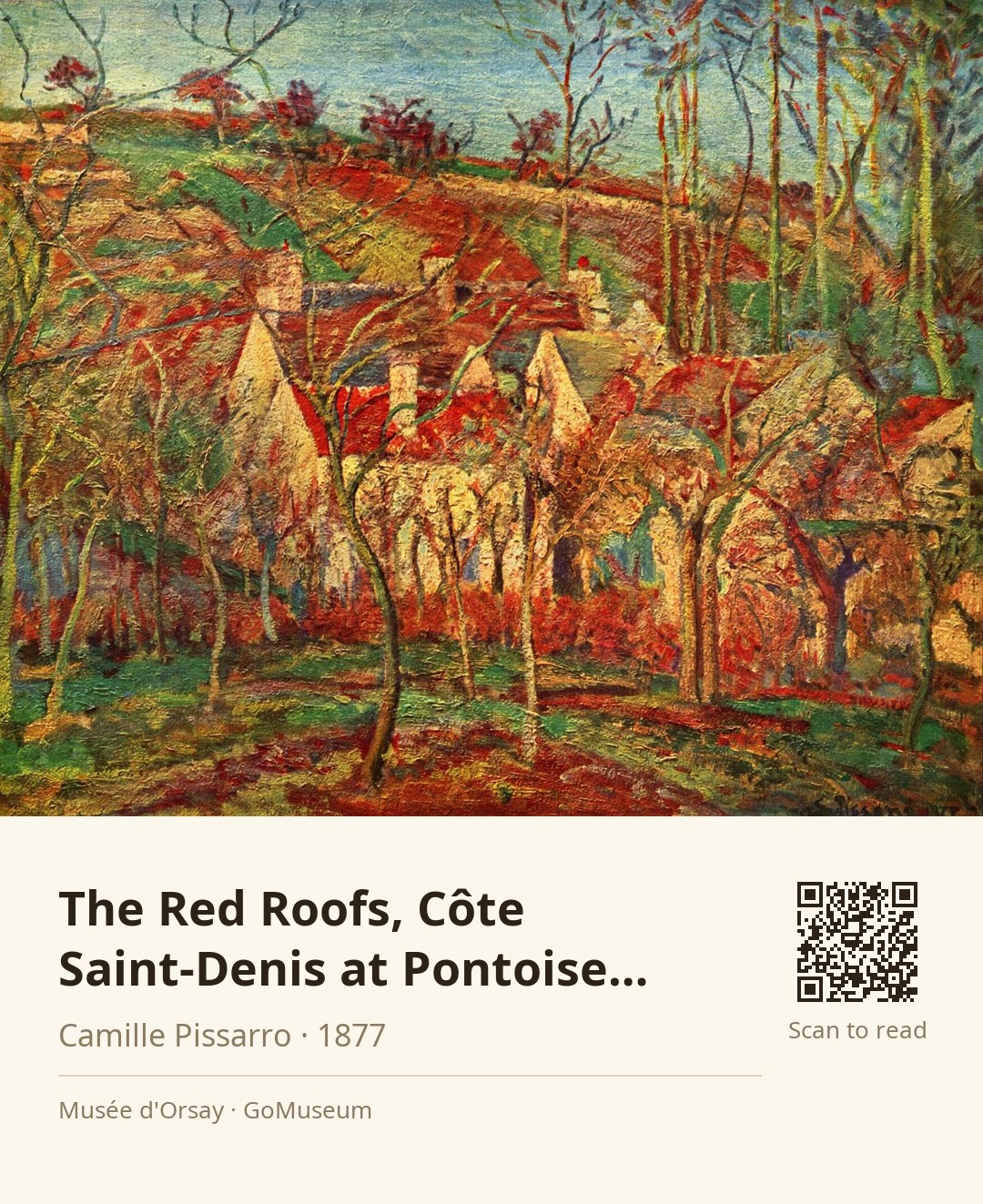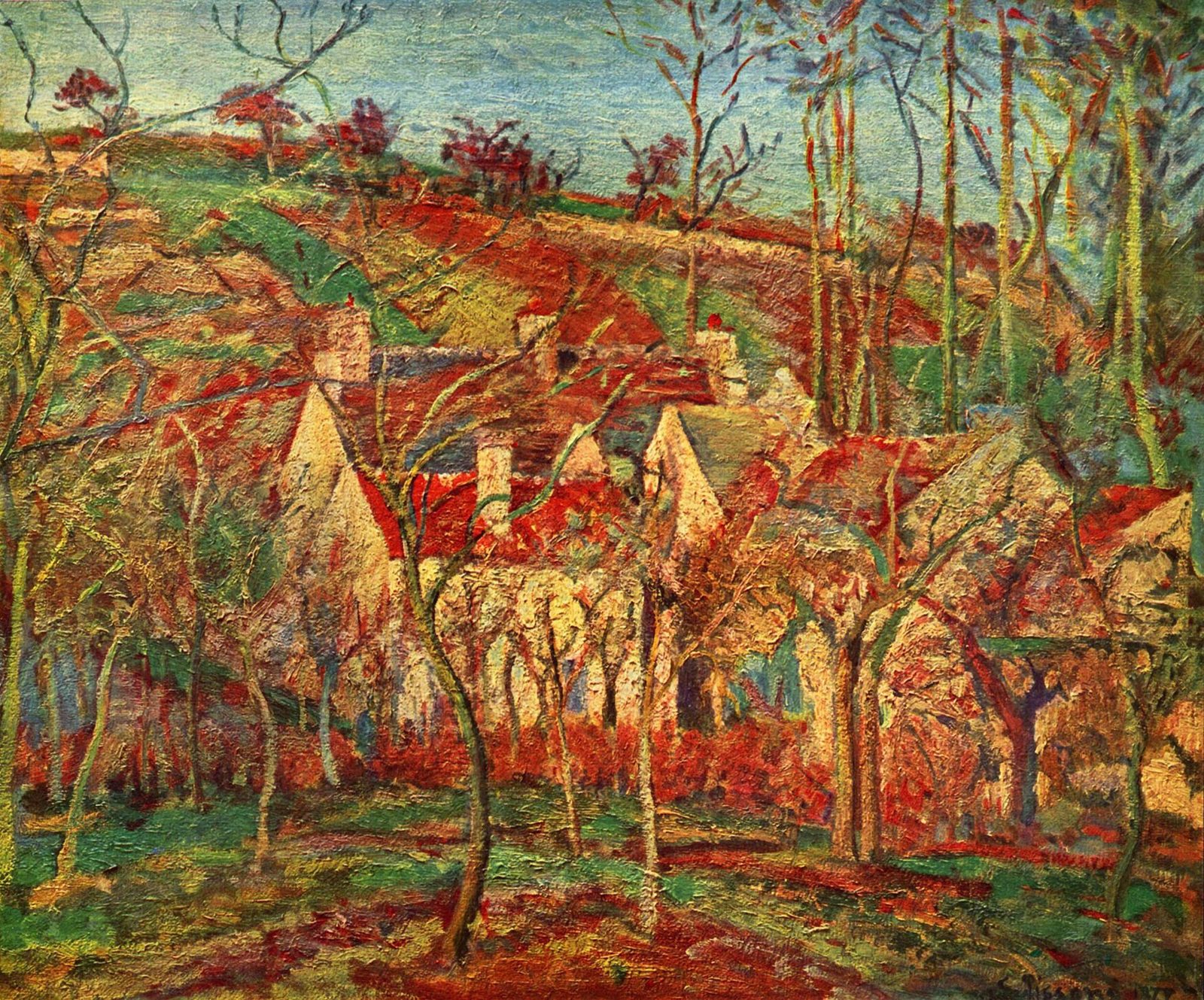
The Red Roofs, Côte Saint-Denis at Pontoise, Winter Effect
🎧 This work has audio narration — listen in the appTake a moment to really look at "The Red Roofs, Côte Saint-Denis at Pontoise, Winter Effect." Notice how the vibrant red roofs pop against the soft, muted tones of winter. Pissarro’s brushstrokes are quick and lively, almost as if he’s capturing the chill in the air with each stroke.
These details matter because they reflect Pissarro's innovative approach to light and color, a hallmark of Impressionism. The contrast between the warm roofs and the cool winter landscape creates a dynamic tension that draws your eye across the canvas. It’s not just a scene; it’s a feeling of winter’s embrace, a moment frozen in time.
Created in 1877, this painting showcases Pissarro's fascination with rural life and the changing seasons. He was deeply influenced by his contemporaries, yet he carved out his own unique perspective, focusing on the everyday beauty of village life.
As you stand here, think about the stories these rooftops could tell. What do you imagine life was like in this village during a winter day?
Jacob Abraham Camille Pissarro, born on July 10, 1830, in Saint Thomas, was a Danish-French painter pivotal to the Impressionist and Neo-Impressionist movements. His artistic journey began under the influence of masters like Courbet and Corot, and he later collaborated with Seurat and Signac, embracing Neo-Impressionism at age 54. Pissarro's dedication to depicting rural life and the working class set him apart; he painted everyday scenes without grandeur, focusing on authenticity.
As a mentor, Pissarro played a crucial role in the development of fellow artists, including Cézanne, Gauguin, and Van Gogh, earning him the title "dean of the Impressionist painters." His warm personality and wisdom made him a father figure within the art community. Pissarro was the only artist to exhibit in all eight Paris Impressionist exhibitions from 1874 to 1886, solidifying his legacy. Despite facing criticism for his subjects, he remained committed to his vision, advocating for a personal approach to classicism. Pissarro passed away on November 13, 1903, leaving an indelible mark on art history.
In 1877, Camille Pissarro created 'The Red Roofs, Côte Saint-Denis at Pontoise, Winter Effect,' a striking oil painting that captures a winter scene in a rural village. This piece was showcased at the Troisième exposition impressionniste in Paris, marking a significant moment in the Impressionist movement. The painting, measuring 54.5 by 65.6 centimeters, was later part of Gustave Caillebotte's collection, a fellow artist and patron of the Impressionists. Over the years, it has found its home at the Musée d'Orsay, where it continues to draw viewers into its vibrant winter landscape. Yet, this very choice is what makes his art resonate deeply with audiences today.
Notice how he employs quick, lively strokes that create a sense of movement, almost as if the cold winter air is swirling around the canvas. The juxtaposition of the warm reds of the rooftops against the cooler, muted tones of the landscape is striking; it pulls your gaze across the painting. The composition is structured yet fluid, with the roofs leading your eye toward the horizon, where a hint of blue sky peeks through. This careful balance of color and form not only captures the chill of winter but also evokes a deeper emotional response, making the viewer feel the atmosphere of the village.
Painted in 1877, it showcases Pissarro's commitment to capturing the essence of rural life, a theme that resonated deeply with his contemporaries and later artists. His technique—characterized by rapid brush strokes and a vibrant palette—challenged traditional artistic norms and influenced the likes of Cézanne and Gauguin. Pissarro's focus on everyday subjects and natural settings laid the groundwork for future movements, emphasizing authenticity over grandeur.
Did you know that Camille Pissarro's 'The Red Roofs' was part of the third Impressionist exhibition in Paris in 1877? This was a pivotal moment for the Impressionist movement, showcasing the works of artists who were often dismissed by the traditional art establishment. Pissarro, being a central figure in this group, helped to foster a sense of community among these revolutionary artists, many of whom would go on to become household names. His dedication to this collective spirit is a testament to his belief in the power of collaboration over competition.
Pissarro was a mentor to many prominent artists, including Paul Cézanne and Paul Gauguin, which not only influenced their styles but also solidified his role as a central figure in the Impressionist movement. His collaborative spirit and willingness to share ideas helped foster a community of innovation among his peers.