Avenue of Poplars near Moret-sur-Loing
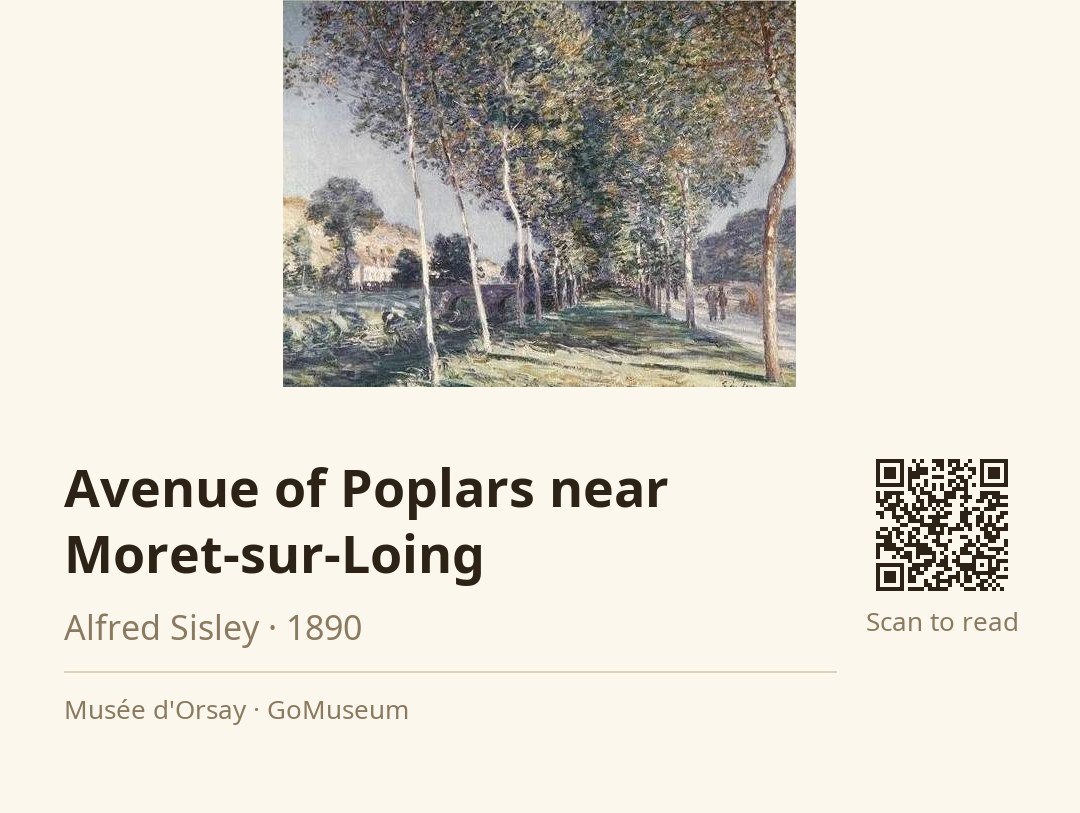
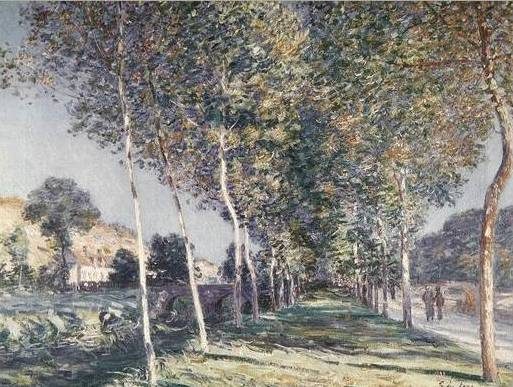
🎧 This work has audio narration — listen in the appTake a moment to really absorb the scene before you in "Avenue of Poplars near Moret-sur-Loing." Notice how the tall, slender poplar trees stretch skyward, their leaves fluttering in the breeze, casting dappled shadows on the path below. The soft, muted colors Sisley uses create a sense of tranquility, inviting you to step into this serene landscape.
These details matter because they capture the essence of Impressionism, where light and atmosphere are just as important as the subject itself. Sisley, unlike some of his contemporaries, focused on the quiet beauty of nature, and here, he perfectly encapsulates a peaceful moment in time. The way the light filters through the trees suggests a fleeting moment, a reminder of the beauty that surrounds us but often goes unnoticed.
Created in 1890, this painting reflects Sisley's deep connection to the landscapes of Moret-sur-Loing, where he spent much of his life. His dedication to painting outdoors allowed him to capture the ever-changing effects of light and weather, which is evident in the gentle brushstrokes and harmonious colors of this work.
As you stand here, think about the serenity of this avenue. What feelings does it evoke in you? Can you imagine taking a stroll down this path, feeling the cool shade of the trees and the warmth of the sun filtering through? Let that sense of peace linger with you as you move on.
Alfred Sisley was a British-born Impressionist landscape painter, born in Paris on October 30, 1839, to affluent expatriate parents. His dedication to painting outdoors, or en plein air, marked him as one of the most consistent figures within the Impressionist movement. Sisley’s work primarily focused on landscapes, with notable series depicting the River Thames, the floods at Marly-le-Roi, and the Gothic church at Moret-sur-Loing. Despite his talent, he struggled for recognition and financial stability throughout his life, often relying on the support of patrons and friends.
Sisley's artistic journey began in earnest after returning to Paris from London, where he had been sent to pursue a business career. Instead, he found his calling in art, studying at the École des Beaux-Arts and forming close friendships with fellow artists like Monet and Renoir. His personal life was marked by hardship, particularly after the Franco-Prussian War disrupted his family's financial support. He married Eugénie Lescouezec, and together they faced many challenges, including the loss of a child and Sisley’s ongoing financial instability.
Although Sisley’s work was largely overlooked during his lifetime, it has since gained significant appreciation, solidifying his place in art history as a key contributor to Impressionism and French landscape painting. His delicate depictions of nature continue to resonate, showcasing the beauty of the world around him. Sisley passed away on January 29, 1899, in Moret-sur-Loing, leaving behind a legacy that would flourish posthumously.
Painted by Alfred Sisley in 1890, this piece was initially lost to history, only to be rediscovered in a private home in Kölblöd, Bavaria, in 1949. It had a tumultuous past, believed to have been bought on the black market or seized by Hermann Brandl during World War II. After its return to France, it was assigned to the Louvre, but its troubles were far from over. It was stolen in 1978, recovered the following year, and then again stolen in 2007 from the Musée des beaux-arts de Nice, only to be recovered once more in 2008. Today, it resides in the Musée d'Orsay in Paris, a testament to its resilience and the intrigue surrounding its history.
As you gaze at this painting, notice the way Sisley’s brushwork dances across the canvas. His technique is all about capturing the fleeting moments of light and shadow, and here, he employs soft, delicate strokes that create a sense of movement in the leaves and branches. The colors are muted yet harmonious, blending greens, yellows, and browns to evoke the tranquility of the scene. The composition draws your eye upward along the towering poplars, while the path below invites you to step into the landscape. Sisley’s choice to paint en plein air allows the natural light to influence his palette, resulting in a work that feels alive and ever-changing, much like the landscape itself.
This painting, created in 1890, not only reflects Sisley's mastery of light and color but also influenced future generations of landscape artists. His commitment to painting en plein air, or outdoors, set a precedent for artists who sought to depict the world with immediacy and emotional resonance. Sisley’s work, often overshadowed by his more famous contemporaries, has gained recognition for its tranquil beauty and technical skill, reminding us of the profound impact of Impressionism on modern art. Remember, Sisley's landscapes invite you to pause and appreciate the fleeting moments of nature, a legacy that continues to inspire artists today.
One fascinating twist in the story of 'Avenue of Poplars near Moret-sur-Loing' is its tumultuous journey through history. After being bought on the black market or seized during World War II, this painting was rediscovered in a private home in Bavaria in 1949. It was returned to France, only to be stolen from the Louvre in 1978 and again from the Musée des beaux-arts de Nice in 2007. Each time, it was recovered, showcasing not just its artistic value but also its resilience through the chaos of the 20th century.
Despite his talent, Sisley struggled financially throughout his life, especially after the failure of his father's business during the Franco-Prussian War, which forced him to rely solely on his art for income.
While studying at the École des Beaux-Arts, Sisley became friends with fellow artists Claude Monet, Pierre-Auguste Renoir, and Frédéric Bazille, which greatly influenced his approach to Impressionism.