 Image: Romainbehar · TonyTheTiger · Romainbehar · TonyTheTiger · TonyTheTiger
Boating Party
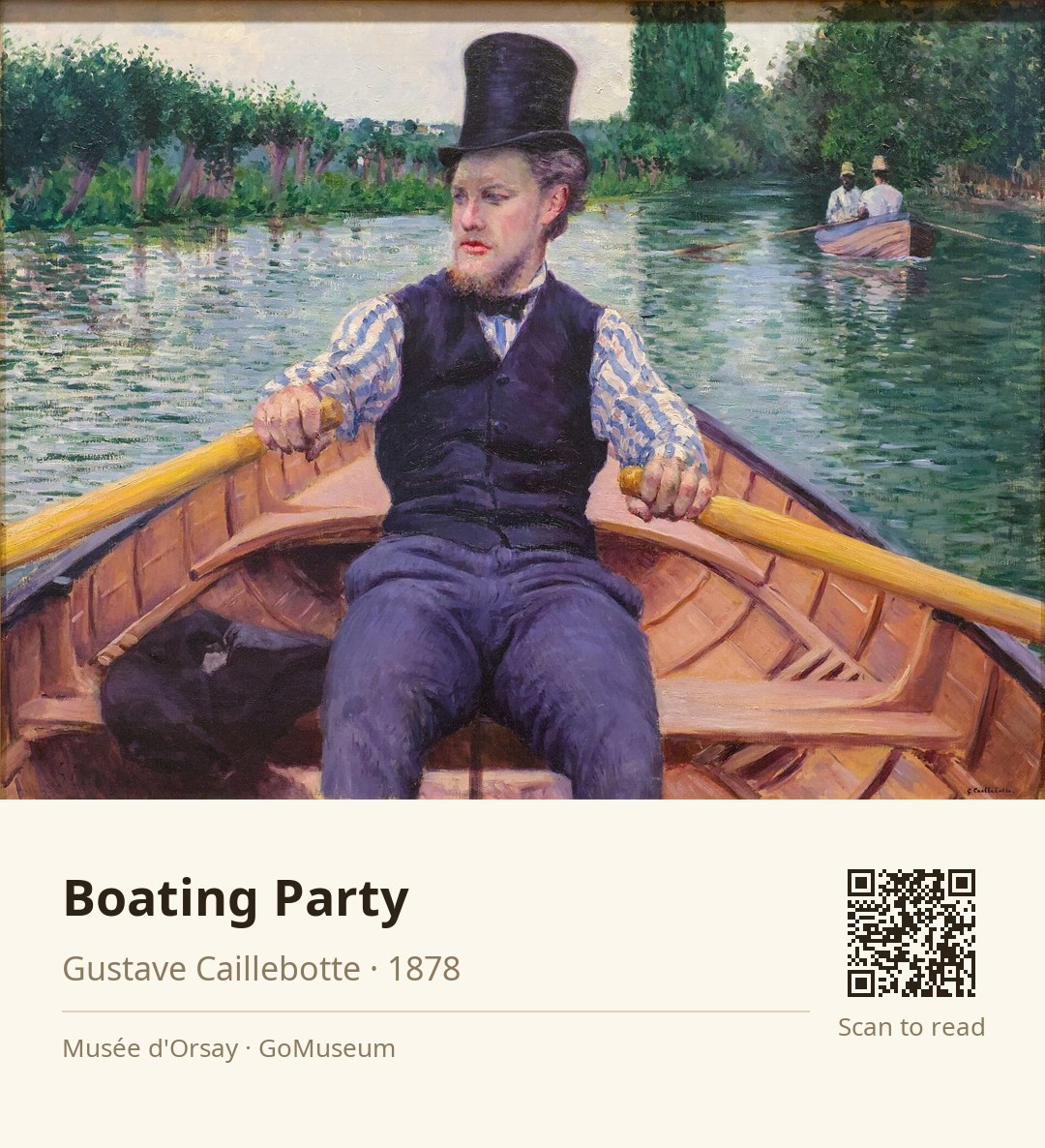
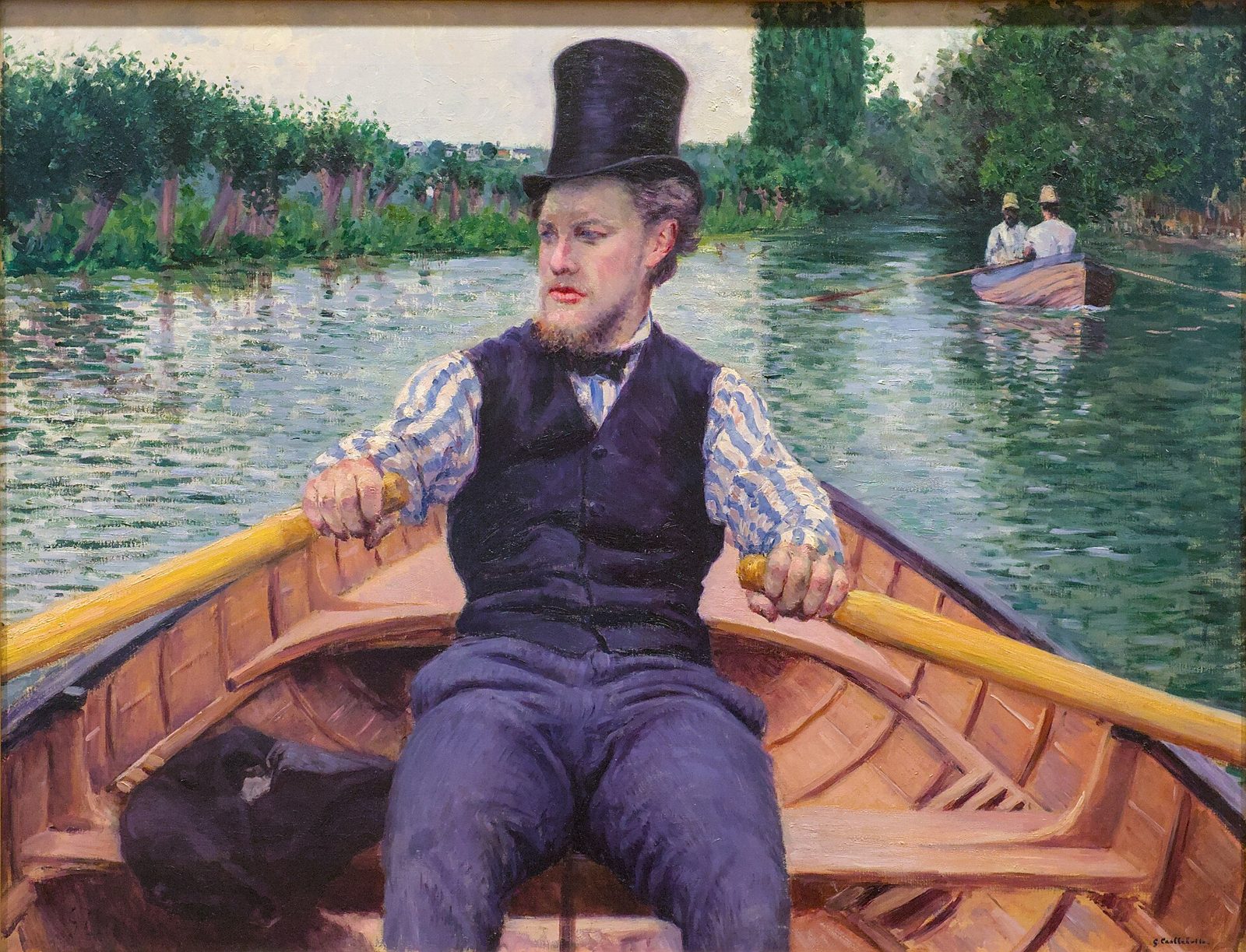
🎧 This work has audio narration — listen in the appTake a moment to really look at "Boating Party" by Gustave Caillebotte. Notice how the oarsman, dressed in a top hat, seems to glide effortlessly across the shimmering surface of the Yerres River. His jacket is casually folded beside him, hinting at a relaxed day on the water, yet he maintains that air of elegance typical of the urban upper class of the late 19th century.
What’s fascinating here is the perspective Caillebotte employs. Instead of a distant view, he brings us right into the action, almost as if we’re passengers in the boat ourselves. This close-up approach was quite unusual for large paintings at the time and gives the scene a dynamic, almost cinematic quality. You can feel the physical exertion of rowing, the splash of water, and the warmth of the sun reflecting off the surface.
Caillebotte painted this piece in 1878, during a time when he was deeply inspired by his own love for boating, having spent many summers at his family’s estate near the river. This personal connection adds layers of intimacy to the work, making it not just a depiction of leisure but a celebration of a lifestyle that was becoming increasingly popular among the Parisian elite.
As you stand here, think about how this painting captures a fleeting moment in time, a slice of life that invites you to reflect on your own experiences with nature and leisure. What memories does it evoke for you?
Gustave Caillebotte was a French painter born on August 19, 1848, into an affluent Parisian family. His upbringing afforded him the luxury of pursuing art, which he began seriously after serving in the Franco-Prussian War. Caillebotte's early works reflected a realistic style, often capturing contemporary life with a focus on urban scenes and laborers, as seen in his notable painting "The Floor Scrapers." His artistic journey was intertwined with the Impressionist movement, where he played a dual role as both a creator and a patron, supporting fellow artists like Monet and Degas.
Despite his contributions, Caillebotte's work was often overshadowed by his more famous contemporaries, and he did not receive significant recognition until long after his death on February 21, 1894. His collection of Impressionist works, bequeathed to the French state, became a cornerstone of the movement's legacy. Caillebotte's unique perspective, blending realism with the emerging Impressionist style, positioned him as a pivotal figure in art history, though it took a century for his contributions to be fully acknowledged through retrospectives and exhibitions. His legacy continues to resonate, illustrating the complexities of artistic recognition and the evolution of modern art.
Gustave Caillebotte's 'Boating Party' was unveiled in 1879 at the Fourth Impressionist Exhibition in Paris, a pivotal moment for the artist. This exhibition was particularly significant as it showcased a collection of his works focused on water sports and leisure, marking a high point in his career. The painting remained in Caillebotte's possession until his death in 1894, after which it was passed down through his family for over a century. It was finally acquired by the Musée d'Orsay in 2022, celebrated as a national treasure of France.
In 'Boating Party', Caillebotte employs a close-up perspective that immerses the viewer in the scene, a technique that was quite groundbreaking for its time. The brushwork is both meticulous and fluid, capturing the shimmering quality of the water with a sense of movement that feels almost alive. Notice how the light dances across the surface, creating reflections that enhance the realism of the moment. The composition is structured to draw your eye to the oarsman, with the diagonal lines of the boat and the rippling water leading you into the heart of the action. This dynamic arrangement not only emphasizes the physical exertion of rowing but also invites you to feel as if you are part of the experience, rather than a mere observer. Caillebotte's choice of scale, with the oarsman dominating the canvas, further amplifies this intimate connection, making the viewer feel the warmth of the sun and the splash of the water.
An intriguing tidbit about 'Boating Party' is that Caillebotte owned a staggering 32 boats, reflecting his deep passion for boating. This personal connection to the subject matter not only influenced his artistic choices but also positioned him uniquely among his Impressionist peers, who typically focused on broader landscapes rather than intimate, close-up depictions of leisure activities.
Caillebotte's family estate near the Yerres River was not just a backdrop for his leisure activities; it was a vital source of inspiration for many of his works. The estate allowed him to immerse himself in boating and nature, which deeply influenced his artistic focus on water-related themes.