Women in the Garden
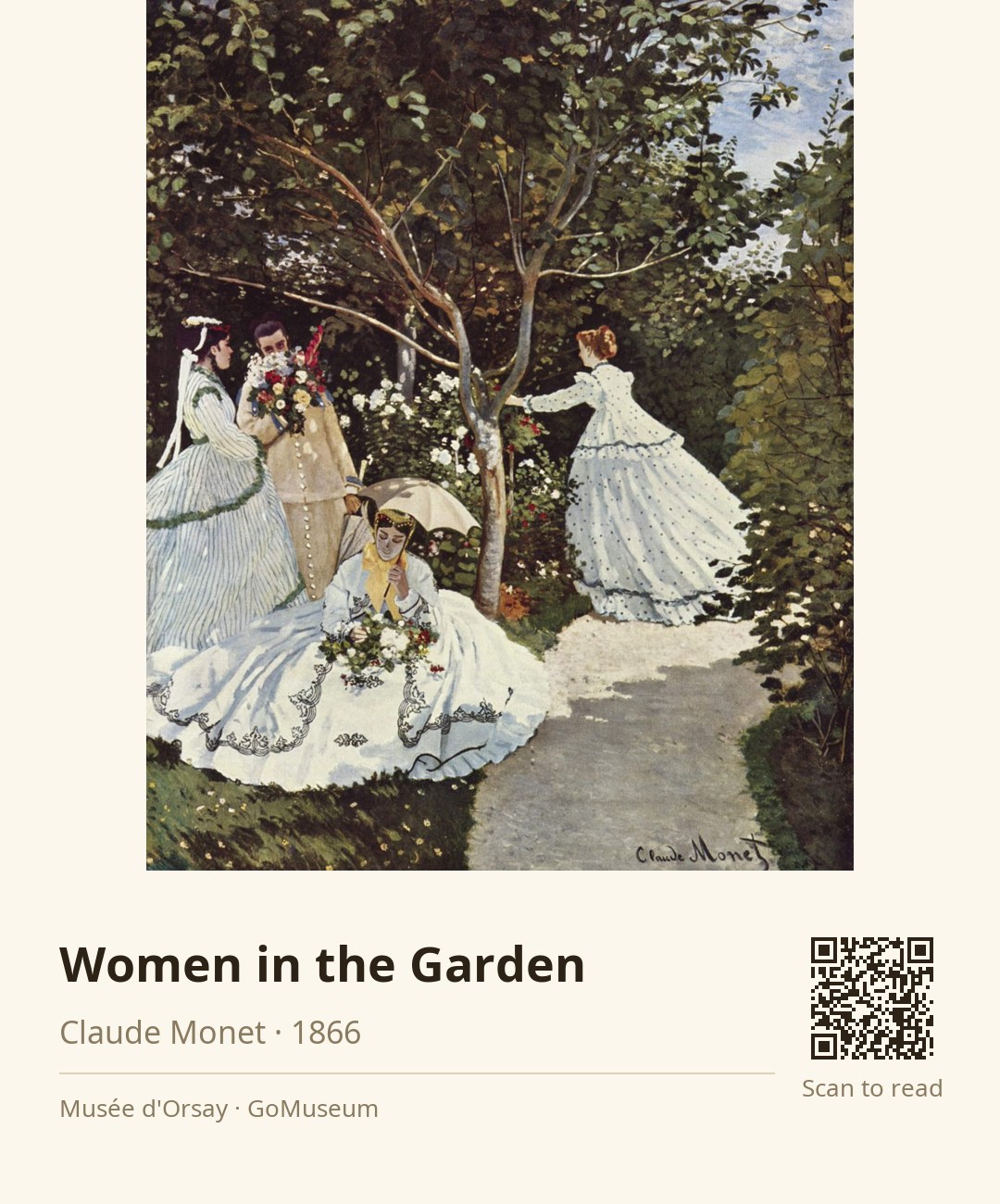
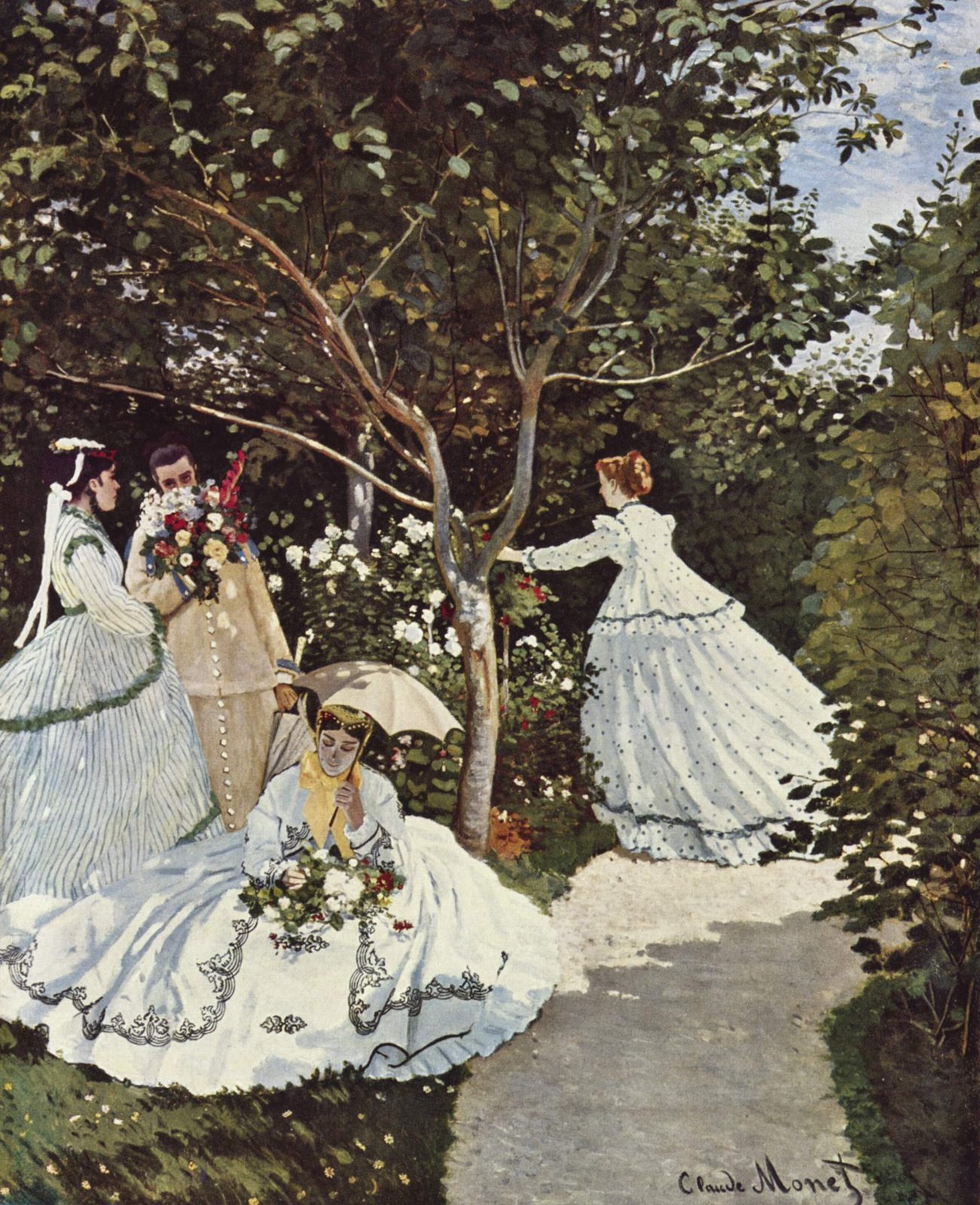
🎧 This work has audio narration — listen in the appTake a moment to really look at "Women in the Garden." Notice how the sunlight dances across the white dresses of the figures, creating a shimmering effect that almost makes them glow against the lush greenery. Monet painted this scene in 1866, and you can feel the warmth of that summer day captured on canvas.
Now, focus on the way the figures are positioned. They seem to float in the garden, almost as if they’re part of the landscape itself. This was a bold choice for Monet, who was experimenting with how light and shadow interact with color and form. It’s not just about the women; it’s about the atmosphere, the very essence of a moment in time.
At this point in his career, Monet was still finding his voice. He had faced rejection from the Salon for this piece, which was deemed lacking in narrative. But what he was really doing was pushing the boundaries of how we perceive light and nature, laying the groundwork for the Impressionist movement that would follow.
As you stand here, think about the challenges Monet faced—he even had to dig a trench to paint this large canvas from a consistent viewpoint. It’s a testament to his dedication and vision.
So, what do you feel when you see this interplay of light and figures? Does it transport you to that sunlit garden, or does it evoke something deeper about the fleeting nature of beauty?
Oscar-Claude Monet, born on November 14, 1840, in Paris, was a pioneering French painter and a founder of Impressionism, a movement that transformed the art world. Raised in Le Havre, he developed a passion for nature and painting early on, encouraged by his mother, while his father hoped he would pursue a business career. After his mother's death in 1857, Monet moved in with his aunt, who supported his artistic ambitions.
Monet's career began with caricatures, but he soon sought formal training, studying under Eugène Boudin, who introduced him to plein air painting. His breakthrough came in 1866 with "La Femme à la robe verte," which garnered attention at the Salon. The term "Impressionism" originated from his work "Impression, Sunrise," exhibited in 1874, marking a shift away from traditional art.
Throughout his life, Monet focused on capturing the essence of light and color in nature, creating series of paintings that depicted the same scenes under varying conditions, such as his famous haystacks and water lilies. He settled in Giverny in 1883, where he cultivated a beautiful garden that became his muse. Despite personal hardships, including the loss of loved ones and health issues, Monet's relentless dedication to his craft solidified his place in art history as a master of modernism, influencing countless artists and leaving a lasting legacy. He died on December 5, 1926, in Giverny, celebrated as one of the most significant figures in art.
Claude Monet's 'Women in the Garden' was painted in 1866, during a pivotal time in his artistic journey. Monet was just 26 years old and still grappling with his identity as an artist. He rented a small house near Ville d'Avray, where he created this large canvas, a work that would later be rejected by the Salon in 1867 for its perceived lack of narrative. This rejection was a significant moment, as it pushed Monet further into his exploration of light and atmosphere, laying the groundwork for the Impressionist movement. The painting was acquired by fellow artist Frédéric Bazille, who supported Monet financially during a time of struggle.
As you examine 'Women in the Garden,' pay attention to Monet's innovative technique. He painted en plein air, meaning he worked outdoors, capturing the fleeting effects of light and color directly from nature. The large canvas required him to dig a trench, allowing him to maintain a consistent viewpoint while painting the upper half. Notice the heavy brushstrokes that create a sense of movement and texture; they were considered radical at the time and would later become a hallmark of Impressionism. The interplay of light and shadow is masterfully rendered, with the white dresses of the figures almost glowing against the verdant backdrop. This technique not only emphasizes the vibrancy of the scene but also invites you to feel the warmth of that summer day, making the moment feel alive and immediate.
Claude Monet's 'Women in the Garden' is a pivotal work that marks his early experimentation with light and atmosphere, setting the stage for the Impressionist movement. Though initially rejected by the Salon, this painting showcased Monet's innovative approach to plein air painting and his bold brushwork, which would later become hallmarks of Impressionism. The way he captured the interplay of light on the figures and the surrounding garden hinted at the revolutionary path he would take in his career. This piece not only influenced his contemporaries but also inspired future generations of artists to explore new ways of seeing and depicting the world around them. Remember, this painting was a stepping stone that helped define a movement, pushing the boundaries of traditional art and inviting viewers to experience nature through Monet's eyes.
One intriguing aspect of 'Women in the Garden' is that Monet's companion and future wife, Camille Doncieux, posed for the figures in the painting. This personal connection adds an intimate layer to the work, as it not only reflects Monet's artistic ambitions but also his life and relationships at the time. Interestingly, the painting's rejection by the Salon was met with support from the writer Émile Zola, who praised its unique atmosphere, further solidifying Monet's reputation as an innovative artist.
The trench allowed Monet to maintain a consistent viewpoint while painting the upper half of the large canvas, showcasing his dedication to capturing the interplay of light and shadow in a single moment.
Although the painting was rejected by the Salon, this moment paradoxically enhanced Monet's reputation, as it drew support from influential figures like Émile Zola, who praised its unique atmosphere and helped solidify Monet's status as an innovative artist.
Camille Doncieux, Monet's companion and future wife, posed for the figures in the painting, adding a personal and intimate layer to the work that reflects both his artistic ambitions and his life at that time.