Dante and Virgil in Hell
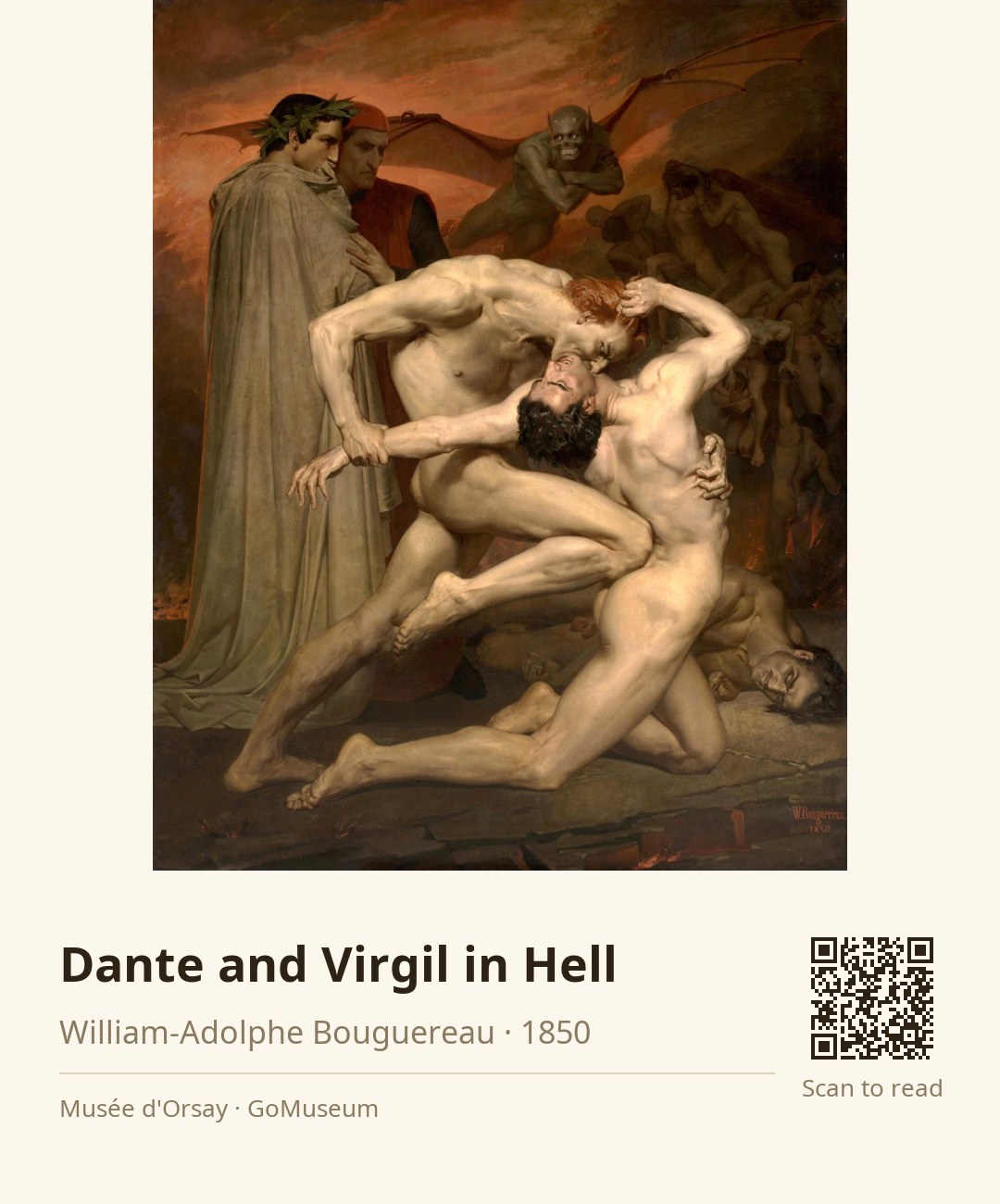
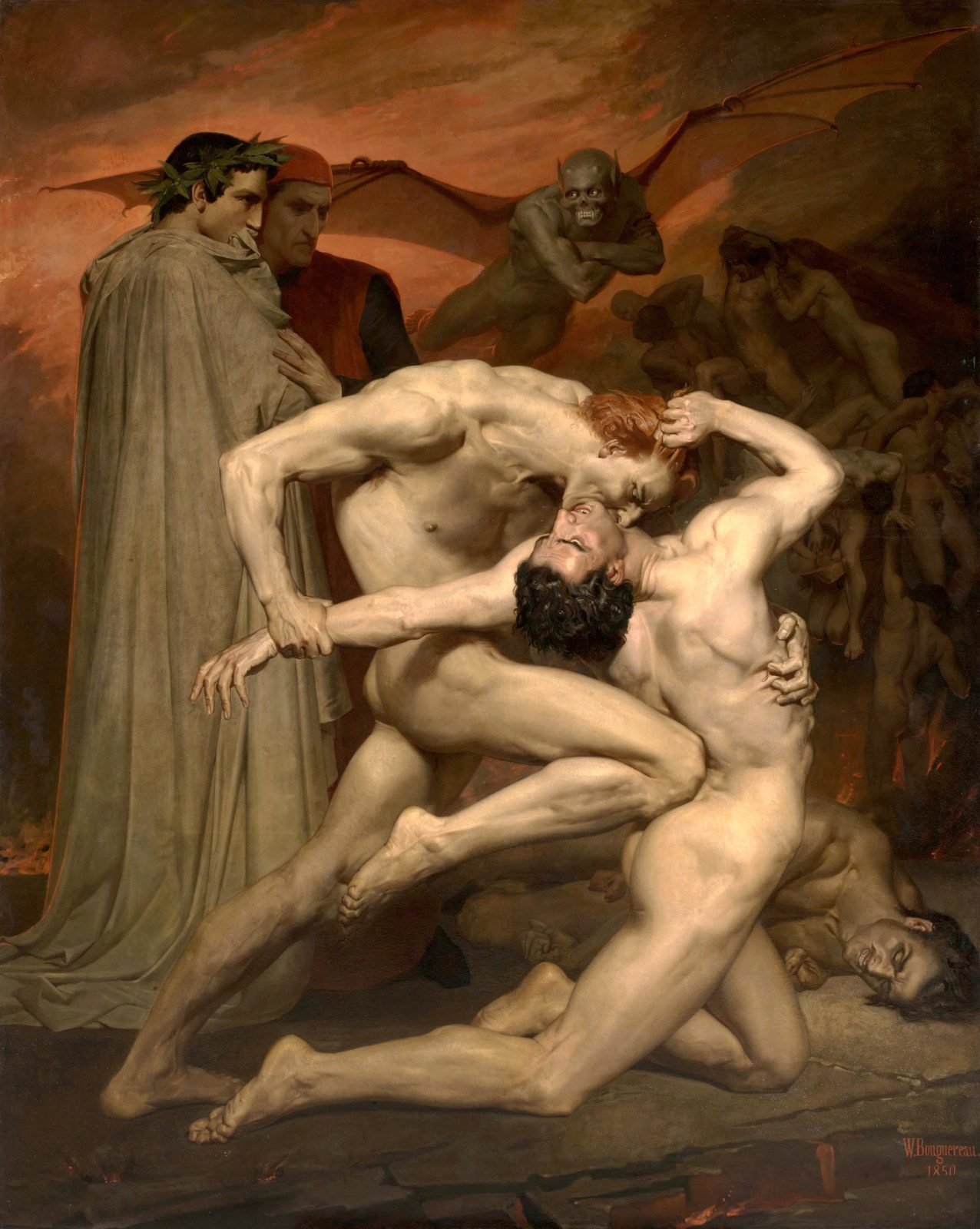
🎧 This work has audio narration — listen in the appTake a moment to really look at "Dante and Virgil in Hell." Notice the intense expressions on the faces of the two men locked in a fierce struggle. Their muscles ripple with tension, and you can almost feel the desperation of their eternal combat. Now, shift your gaze to the figures observing this chaos: Dante, dressed in red, and Virgil, in white, stand slightly apart, their faces a mix of horror and contemplation. These details matter because they capture the essence of Dante Alighieri's "Divine Comedy," illustrating not just a physical fight but a moral and philosophical struggle. Bouguereau chose this dramatic moment to explore themes of sin and punishment, inviting viewers to reflect on the consequences of one's actions. Created in 1850, this painting was Bouguereau's third attempt to win the prestigious Prix de Rome, a goal that defined much of his early career. While he didn’t win with this piece, it showcases his mastery of the human form and his ability to convey deep emotion, which would later earn him acclaim in the art world. As you stand here, consider this: what do you think Bouguereau wanted you to feel about the nature of sin and redemption? Let that question linger as you take in the powerful imagery before you.
William-Adolphe Bouguereau was a prominent French academic painter born on November 30, 1825, in La Rochelle. He grew up in a family of merchants and developed a passion for art at a young age. Bouguereau studied at the École des Beaux-Arts and won the prestigious Prix de Rome in 1850, which allowed him to immerse himself in the classical art of Italy. His work, characterized by realistic depictions of mythological themes and the female form, gained immense popularity in France and the United States during his lifetime.
Despite his success, he faced criticism from the Impressionist movement, which deemed his style overly traditional. By the early 20th century, changing tastes led to a decline in his popularity, but a revival in the 1980s rekindled interest in his work. Bouguereau completed 822 known paintings, many of which remain lost. His legacy as a master of academic painting endures, particularly for his sensitive portrayals of women and children, marking him as a significant figure in art history. He passed away on August 19, 1905, leaving behind a complex legacy that continues to provoke discussion and admiration.
William-Adolphe Bouguereau's "Dante and Virgil in Hell" was painted in 1850 and marked a pivotal moment in his early career as it was his third attempt to win the prestigious Prix de Rome. Although he didn't secure the prize with this piece, it was exhibited at the Salon of 1850 in Paris, where it garnered mixed reviews. The painting draws from Dante Alighieri's "Divine Comedy," specifically a scene where two damned souls, Capocchio and Gianni Schicchi, are locked in a fierce struggle. Bouguereau aimed to capture a moment of intense emotion and moral conflict, a theme that resonated with the Romantic ideals of the time. Critics like Théophile Gautier praised the raw energy and muscularity of the figures, while others, like Émile Zola, dismissed it as overly polished.
As you gaze at "Dante and Virgil in Hell," pay attention to Bouguereau's masterful brushwork. The way he layers paint creates a palpable tension in the figures, especially in the rippling muscles of the combatants. The use of light is striking; it illuminates the central struggle while casting the observers, Dante and Virgil, into shadow, emphasizing their horror and contemplation. The composition is dynamic, with the two fighting figures almost spilling out of the frame, drawing you into their chaotic world. Bouguereau's choice of color is equally deliberate; the deep reds and earthy tones contrast sharply with the lighter hues of Dante and Virgil, enhancing the drama of the scene. This careful handling of color and form not only showcases his technical skill but also evokes a visceral emotional response, making the viewer feel the weight of sin and punishment.
After the mixed reception of "Dante and Virgil in Hell," he found partial success later that year with another painting, which ultimately led to his victory in the competition. This win allowed him to study in Rome, where he deepened his understanding of classical art, further influencing his future works.
The painting received mixed reviews at the Salon, with some critics like Théophile Gautier praising its raw energy and muscularity, while others, including Émile Zola, dismissed it as overly polished and lacking modernity.
Bouguereau's desire to win the Prix de Rome, a prestigious art competition, motivated him to choose dramatic and morally complex subjects like this scene from Dante's 'Divine Comedy,' which he believed would appeal to the judges.
The painting features Dante Alighieri, the author of 'The Divine Comedy,' and his guide Virgil, both of whom observe the fierce struggle between the two damned souls, Capocchio and Gianni Schicchi.