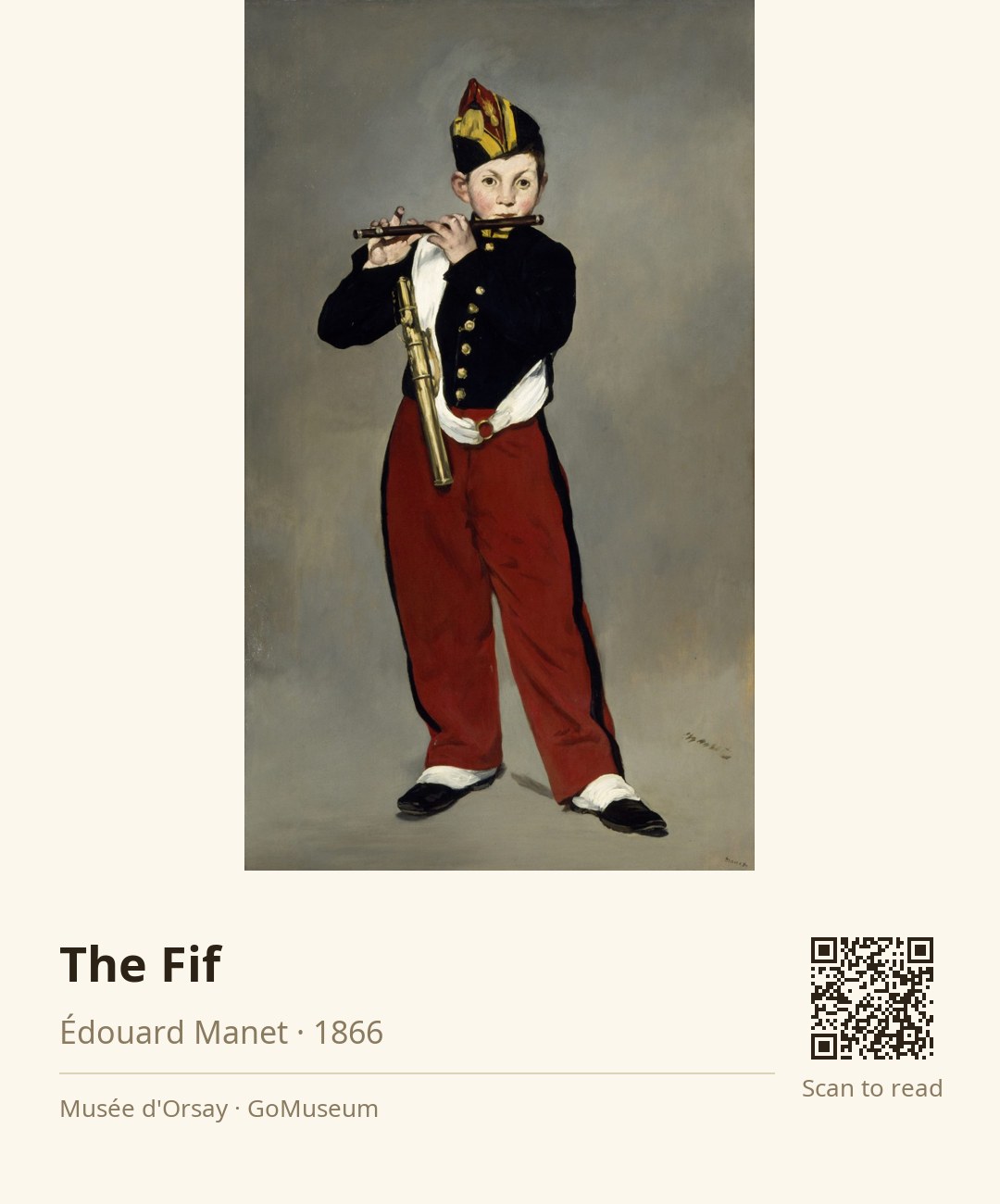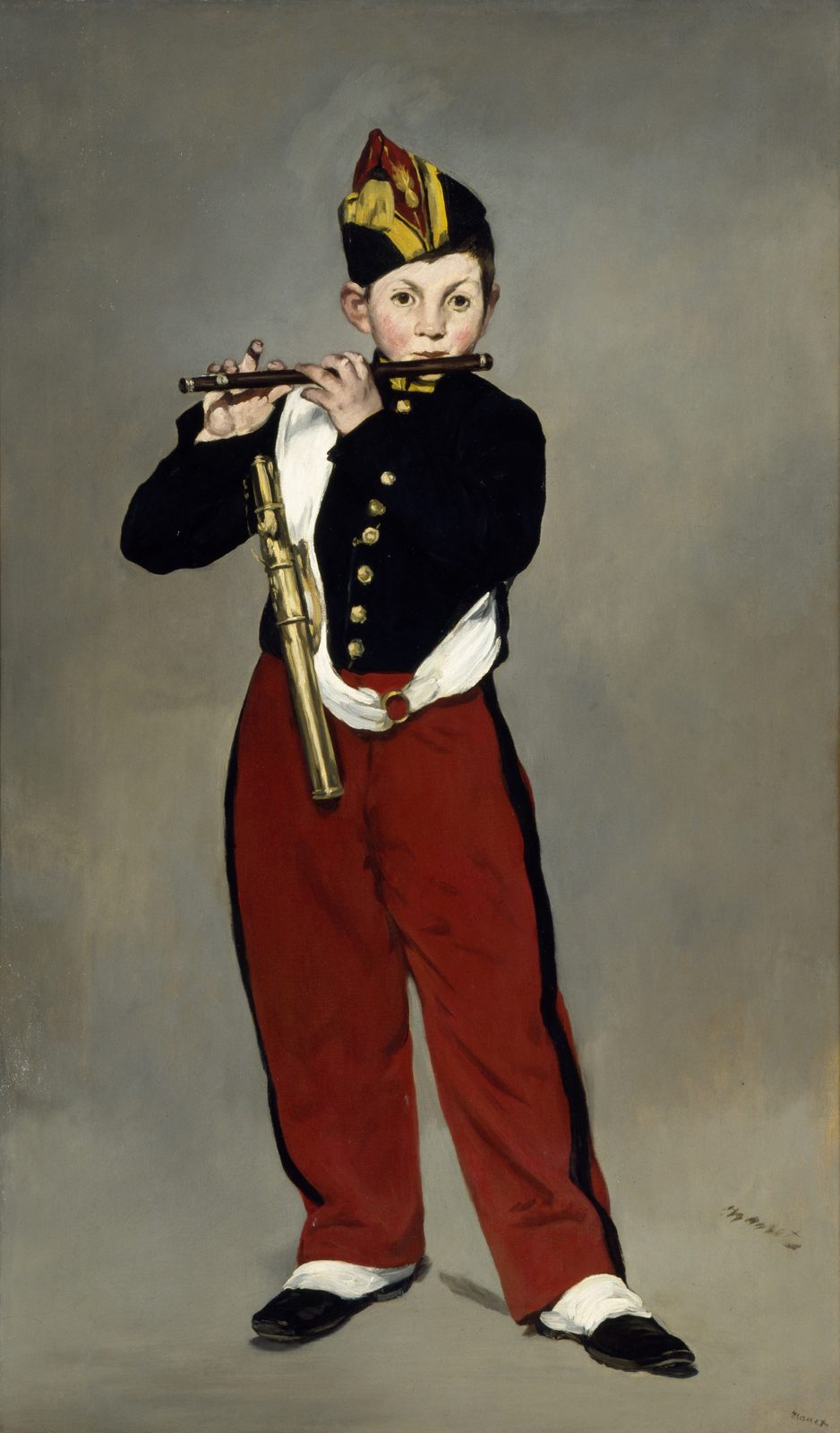
Take a moment to really look at "The Fifer" by Édouard Manet. Notice how the young boy stands confidently, his fluted instrument held firmly, dressed in that striking red and black uniform. The way his jacket contrasts against the muted background draws your eye right to him, doesn’t it? This isn’t just a portrait; it’s a bold statement. Manet deliberately flattens the space around the figure, almost like he’s challenging traditional perspectives in art. By doing this, he elevates the boy’s presence, making him feel both monumental and intimate. It’s a nod to the court portraits of Velázquez, yet here, the subject is an anonymous fifer, a common soldier rather than a royal figure. This inversion of expectations was revolutionary for its time. Created in 1866, this painting was initially rejected by the Salon, sparking outrage among supporters like Émile Zola, who championed Manet’s modern approach. It was a pivotal moment in art history, marking a shift towards recognizing everyday subjects as worthy of artistic dignity. So, as you stand here, think about what this young musician represents. In a world where the grand and the noble often took center stage, how does this simple boy with his fife challenge our understanding of art and significance?
Édouard Manet, born on January 23, 1832, in Paris, emerged as a pivotal figure in 19th-century art, bridging Realism and Impressionism. From an affluent family, he initially faced pressure to pursue a naval career but instead dedicated himself to painting, influenced by his uncle and the Old Masters. His early works, including "The Luncheon on the Grass" and "Olympia," sparked controversy and challenged traditional artistic norms, marking him as a revolutionary force.
Manet's style, characterized by loose brushwork and a focus on contemporary life, diverged from the meticulous techniques of his predecessors. He often depicted modern Parisian scenes, capturing the essence of leisure and social dynamics. Despite initial rejection from the art establishment, he gained recognition among progressive artists and became a mentor to the Impressionists.
Throughout his life, Manet formed connections with influential figures like Baudelaire and Zola, who defended him against critics. His later works, such as "A Bar at the Folies-Bergère," showcased his evolving style and mastery of color. Manet's contributions to art history are profound; he is celebrated not only for his innovative techniques but also for elevating still life and modern subjects to the forefront of artistic expression. He passed away on April 30, 1883, leaving behind a legacy that continues to inspire artists today.
Édouard Manet's 'The Fifer' was created in 1866, inspired by his visit to the Prado in Spain where he encountered the works of Diego Velázquez. This painting, depicting an anonymous regimental fifer, was a bold departure from traditional portraiture, showcasing a common soldier rather than a royal figure. However, it faced immediate backlash when it was rejected by the Salon of 1866, leading to public outrage. Émile Zola, a passionate supporter of Manet, defended the work in a series of articles, emphasizing its modernity and realism. Manet took matters into his own hands by organizing his own exhibition at the 1867 Exposition Universelle, where 'The Fifer' was displayed, albeit met with ridicule for its unconventional style. The painting changed hands several times before being accepted into the French national collection in 1911, eventually finding its home in the Musée d'Orsay in 1986 after a stint at the Louvre.
In 'The Fifer', Manet employs a striking technique that flattens the spatial depth, reminiscent of Velázquez's court portraits. Notice how the boy stands out against a monochromatic background, which enhances his vibrant red and black uniform. Manet's use of thick impasto creates a tactile quality, making the colors pop with life. The contours of the figure are bold and emphatic, drawing your eye directly to him. The composition is carefully structured, with the boy's stance and the positioning of his instrument creating a sense of both monumentality and intimacy. This juxtaposition of a common subject with grand artistic treatment challenges the viewer's expectations and invites a deeper reflection on the dignity of everyday life.
Édouard Manet's 'The Fifer' is a pivotal work that challenged the conventions of its time, merging the dignity of portraiture with the everyday subject of a young soldier. By presenting this anonymous boy in a striking military uniform against a flat, monochromatic background, Manet not only paid homage to Velázquez but also set the stage for modern art's evolution. This painting sparked debates about realism and representation, influencing future generations of artists who sought to break free from traditional hierarchies in art. Its rejection from the Salon ignited a firestorm of support from critics like Émile Zola, marking a turning point in Manet's career and the acceptance of modernist ideas in the art world.
One intriguing aspect of 'The Fifer' is the ambiguity surrounding the identity of the boy who posed for the painting. While some speculate he might be Léon Leenhoff, Manet's son, others suggest he was simply a young musician from the Imperial Guard, provided by a friend of Manet's. This uncertainty adds an extra layer of mystery to the artwork, highlighting the artist's focus on the universal rather than the individual.
When 'The Fifer' was first exhibited at the Salon in 1866, it was met with immediate rejection and ridicule, which sparked outrage among supporters like Émile Zola. This backlash highlighted the painting's unconventional style and subject matter, contrasting sharply with the traditional expectations of portraiture at the time.
Manet's visit to the Prado in Spain in 1865 was pivotal; he was profoundly inspired by Diego Velázquez's court portraits, which influenced his approach to depicting the fifer. This encounter led him to adopt a flattened spatial depth and a bold treatment of color, mimicking Velázquez while simultaneously inverting the traditional hierarchy of subject matter.
The identity of the boy who posed for 'The Fifer' remains ambiguous; some speculate he might be Léon Leenhoff, Manet's son, while others suggest he was a young musician from the Imperial Guard. This uncertainty adds a layer of intrigue to the painting, emphasizing Manet's focus on universal themes rather than individual identity.