The Bellelli Family
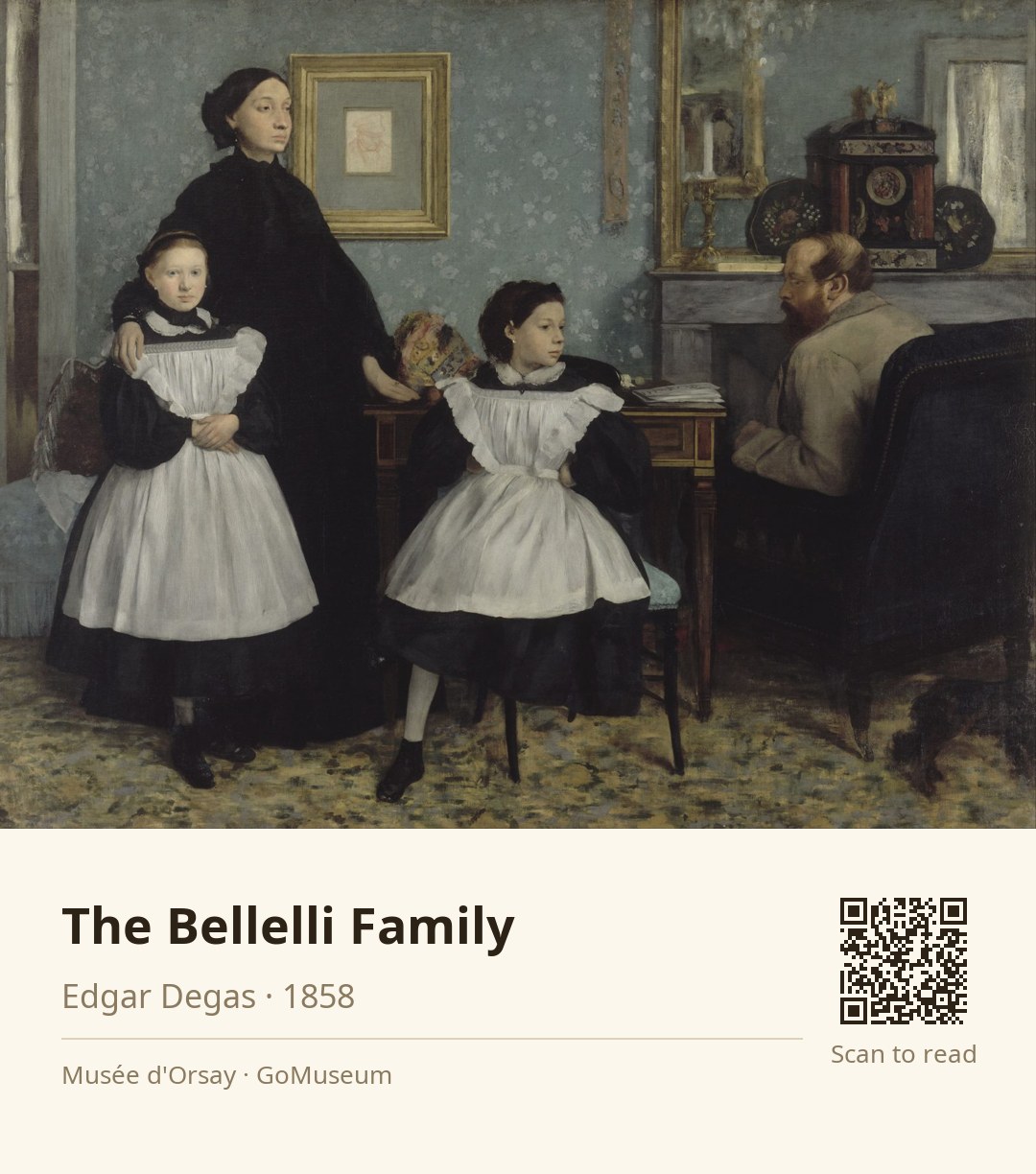
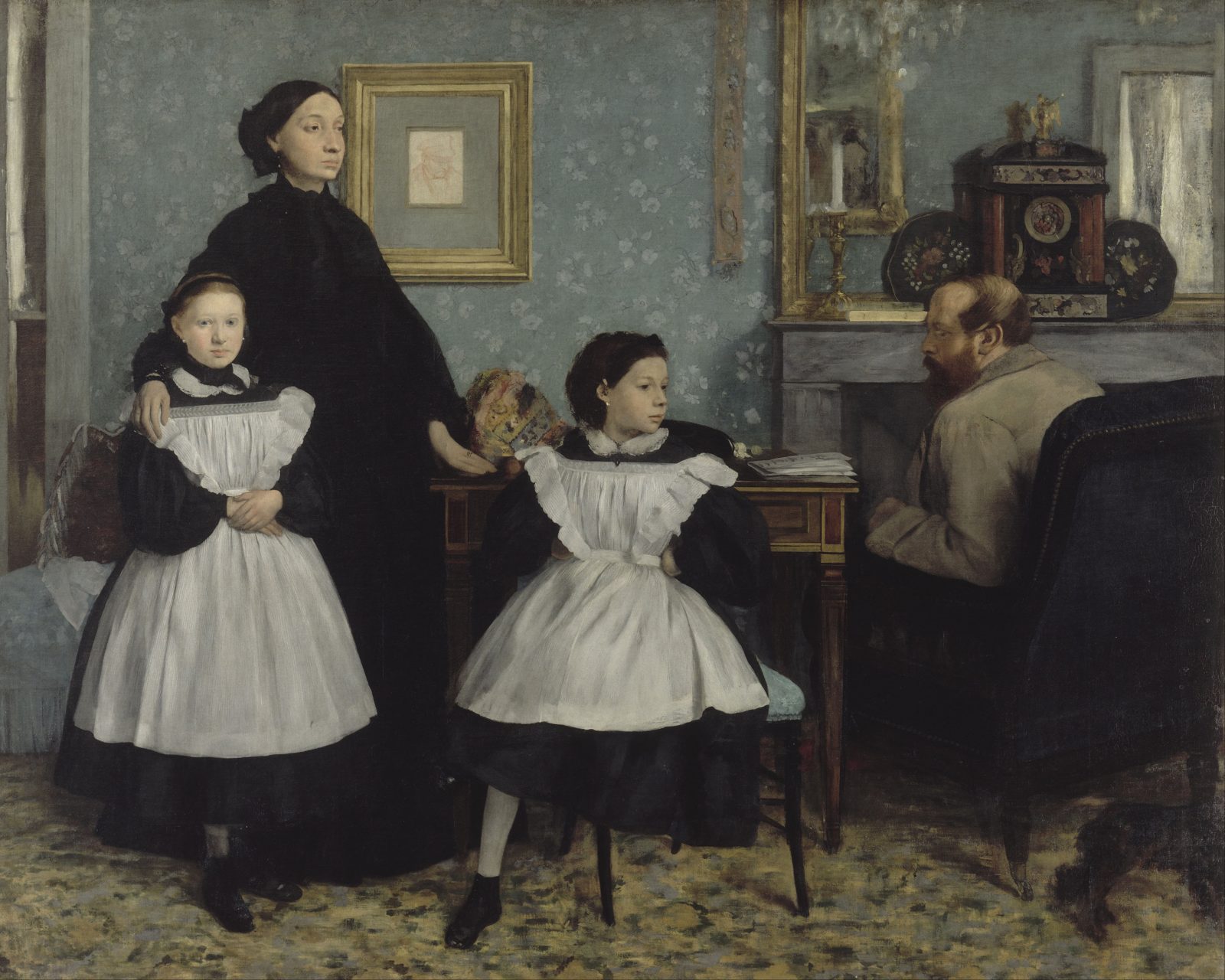
🎧 This work has audio narration — listen in the appTake a moment to really look at "The Bellelli Family" by Edgar Degas. Notice how the family members seem almost disconnected, each gazing in different directions. This isn’t just a portrait; it’s a snapshot of tension and isolation.
Look closely at Laura Bellelli, standing tall in her black dress, her expression distant. Behind her, the framed portrait of her deceased father adds a layer of mourning to the scene. This detail isn’t just decorative; it signifies the weight of grief she carries, which permeates the entire family dynamic.
Degas painted this piece during a time when he was witnessing the complexities of family life firsthand. His aunt's struggles with her husband, Gennaro, who is depicted aloof at his desk, hint at the domestic strife that Degas observed. It’s a reflection of the bourgeois life of the 19th century, but also a deeper commentary on emotional isolation.
Created between 1858 and 1867, this work showcases Degas's early mastery in capturing the subtleties of human relationships. He spent years refining this piece, and it became a cornerstone of his artistic journey.
As you stand here, consider: what stories are hidden in the gazes and postures of the Bellelli family? What emotions do you think they are trying to convey?
Edgar Degas, born on July 19, 1834, in Paris, was a pivotal figure in the Impressionist movement, though he preferred to be labeled a realist. Known for his exceptional skill in drawing, Degas focused on capturing movement, particularly in his depictions of dancers, which constitute over half of his oeuvre. His works also include racehorses and portraits that reveal psychological depth and human isolation.
Degas came from a cultured, affluent family; his mother was a Creole from New Orleans, and his father was a banker. After his mother's death, he pursued art against his father's wishes, studying at the École des Beaux-Arts and drawing inspiration from classical masters during his time in Italy. His early ambition to be a history painter shifted as he embraced contemporary subjects, influenced by artists like Édouard Manet.
Despite being a founding member of the Impressionists, Degas's approach diverged from his peers, as he often worked in his studio rather than en plein air. His innovative techniques and themes sparked debate among critics and continue to influence art history today. Degas passed away on September 27, 1917, leaving behind a legacy that challenges traditional boundaries in art.
Edgar Degas began working on 'The Bellelli Family' around 1858, during a pivotal time in his artistic development. He had just moved to Florence to stay with his aunt Laura Bellelli, who was experiencing significant personal turmoil. Her husband, Gennaro Bellelli, a political exile, was struggling with his own issues, which created a tense atmosphere in the household. This backdrop of familial strife deeply influenced Degas as he painted. The work was first exhibited at the Salon des artistes français in Paris in 1867, where it received mixed reviews, reflecting the complexities of the family dynamics it portrayed. Over the years, the painting changed hands, remaining with Degas until his death in 1917, after which it was acquired by the French state. It now resides in the Musée d'Orsay, a testament to its enduring significance in Degas's oeuvre.
As you gaze at 'The Bellelli Family,' pay attention to Degas's masterful use of color and light. The contrasting hues of blue and yellow create a dynamic tension within the composition, enhancing the emotional distance among the family members. Notice how the light falls on Laura Bellelli, illuminating her figure while casting Gennaro in shadow, emphasizing his isolation. The brushwork is meticulous yet expressive, capturing the textures of their clothing and the somber atmosphere of the room. Degas initially envisioned a more traditional vertical composition but ultimately opted for a horizontal layout that allows for a more complex interplay of figures. This decision enhances the sense of disconnect, as each family member occupies their own space, both physically and emotionally.
Painted during his formative years, this work showcases Degas' early mastery of composition and psychological depth, influencing generations of artists who followed. The way he captures the isolation of each family member, their distinct gazes and postures, speaks volumes about the human condition. This painting laid the groundwork for modern portraiture, shifting the focus from idealized representations to the raw, often uncomfortable truths of domestic life. Remember, this was a time when art was beginning to break free from tradition, and Degas was at the forefront, pushing boundaries that would resonate throughout art history.
One intriguing aspect of 'The Bellelli Family' is that Degas worked on it for nearly a decade, reflecting his dedication to perfecting the portrayal of his relatives. Interestingly, while he was painting this family scene, Degas was also influenced by the rise of photography, which was becoming more accessible at the time. This influence is evident in his composition, which captures a moment in time with a snapshot-like quality, a technique that would later become a hallmark of his work.
During the years he worked on 'The Bellelli Family,' Degas was living with his aunt Laura, who confided her domestic unhappiness to him, which likely shaped the emotional tension depicted in the painting.
The rise of photography during Degas's time influenced his composition, as he aimed to capture a moment with a snapshot-like quality, reflecting the new ways of seeing and representing life.