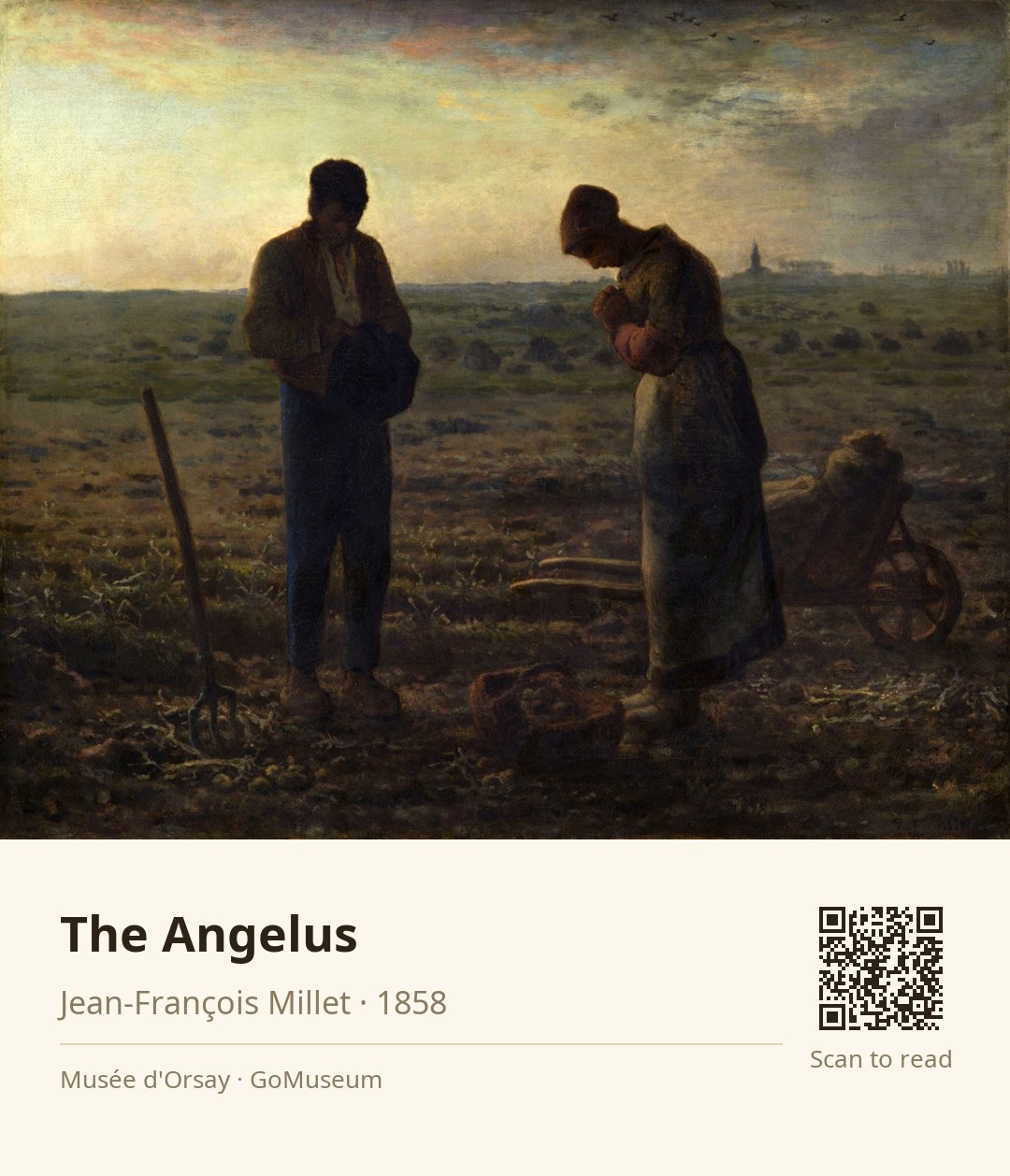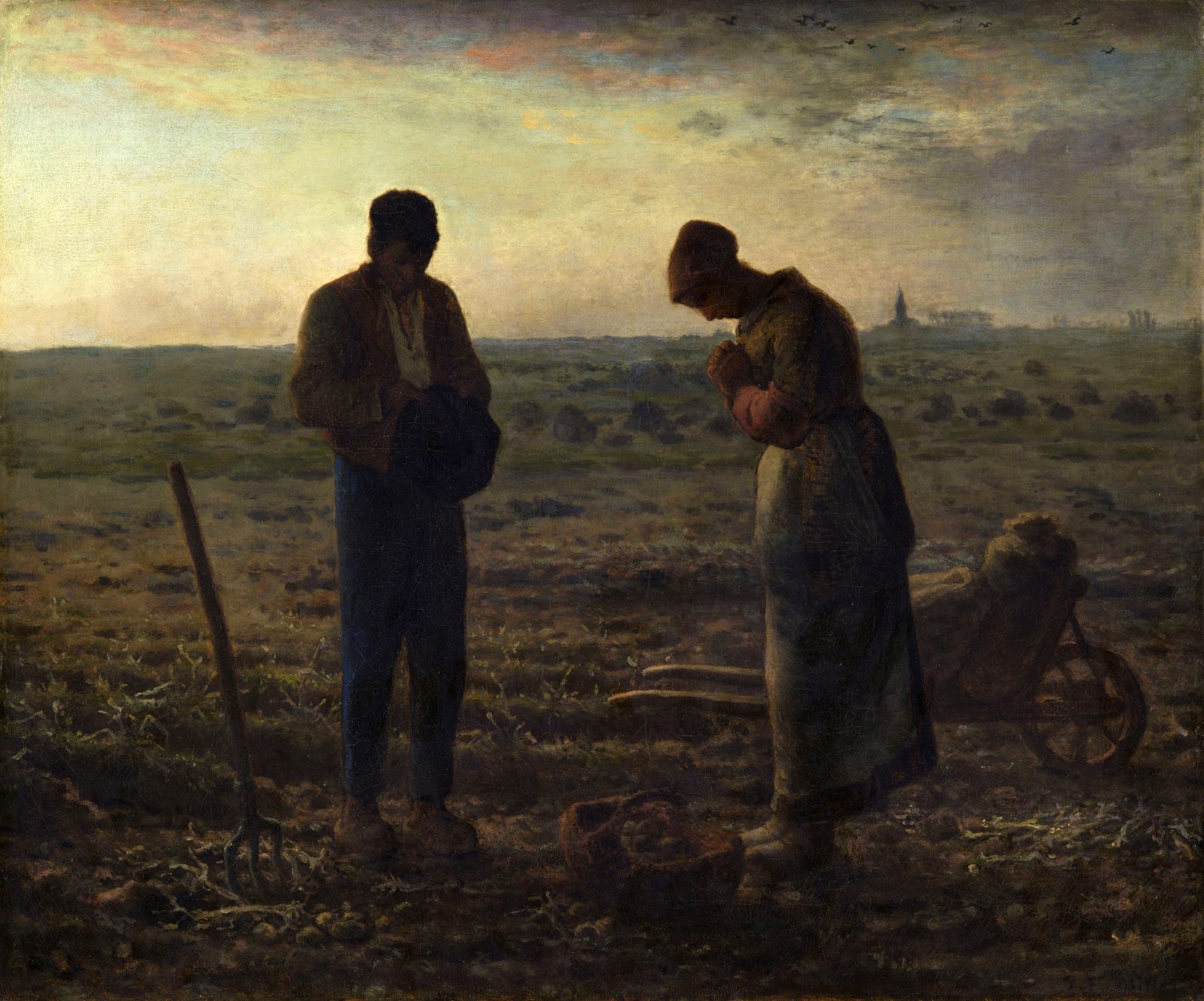
Take a moment to really look at "The Angelus" by Jean-François Millet. Notice how the two peasants are captured in a moment of stillness, heads bowed, hands clasped in prayer. The soft glow of the sunset casts a warm light over their figures, creating a serene contrast with the earthy tones of the field around them.
What’s striking here is the basket of potatoes at their feet, a symbol of their hard labor and the life they lead. This isn’t just a prayer; it’s a ritual that marks the end of their day, a moment of reflection amidst the toil of farming. The church steeple in the distance reminds us of the community and faith that underpin their lives.
Millet painted this scene in the late 1850s, drawing from his own childhood memories of pausing work to say the Angelus prayer when the church bell rang. This painting isn’t merely about religion; it speaks to the rhythm of rural life, the connection between labor and spirituality that was so vital in 19th-century France.
As you stand here, think about the significance of that prayer in their lives. What does it mean to pause, to reflect, and to connect with something greater than ourselves? How does that resonate with your own experiences today?
Jean-François Millet was a pivotal figure in 19th-century French art, born on October 4, 1814, in Gruchy, Normandy. As a founding member of the Barbizon school, he is celebrated for his profound depictions of peasant life, embodying the Realism movement. Millet's early years were steeped in agricultural labor, which deeply influenced his artistic themes. After studying under various artists, he moved to Paris, where he initially struggled but eventually gained recognition for his work.
Millet's paintings often highlighted the dignity of rural laborers, showcasing their struggles and connection to the land. His notable works, such as "The Gleaners" and "The Angelus," reflect a shift from idealized pastoral scenes to a more authentic representation of contemporary social conditions. Despite facing criticism early in his career, he found success in the mid-1850s, producing masterpieces that resonated with the public and critics alike.
Millet's legacy lies in his ability to elevate the everyday lives of farmers to the realm of fine art, influencing generations of artists and solidifying his place in art history as a champion of the working class. He passed away on January 20, 1875, in Barbizon, leaving behind a rich body of work that continues to inspire.
Jean-François Millet's 'The Angelus' was painted between 1857 and 1859, initially commissioned by American art collector Thomas Gold Appleton. However, Appleton never claimed the piece, leading Millet to modify it by adding a church steeple and renaming it from its original title, 'Prayer for the Potato Crop.' The painting was first exhibited at the Galerie Pierre Petit in Paris in 1865 and later showcased at the 1867 Exposition Universelle, where it garnered significant attention. After Millet's death in 1875, the painting changed hands numerous times, reflecting the growing appreciation for his work. Today, it resides in the Musée d'Orsay, a testament to its enduring legacy.
In 'The Angelus,' Millet employs a masterful blend of light and color to evoke a sense of tranquility and reverence. The warm hues of the sunset bathe the peasants in a soft glow, contrasting beautifully with the earthy tones of the field. Notice how the brushwork feels both deliberate and fluid, capturing the stillness of the moment while hinting at the labor that surrounds them. The composition is structured with the peasants at the forefront, their bowed heads drawing your gaze inward, while the distant church steeple anchors the scene in a rural landscape. The scale of the figures against the vastness of the field emphasizes their humble existence, and the basket of potatoes at their feet serves as a poignant reminder of their toil. This careful arrangement creates a powerful narrative of faith and labor, inviting you to reflect on the intersection of spirituality and daily life.
Jean-François Millet's portrayal of two peasants pausing to pray at dusk encapsulated the dignity of rural life, elevating the everyday to the realm of the sacred. This painting sparked a wave of admiration and set a new standard for the Barbizon school, influencing artists who sought to capture the essence of human labor and connection to the land. It became a symbol of national identity during turbulent times in France, resonating deeply with a society searching for unity and meaning.
One intriguing anecdote about 'The Angelus' involves Salvador Dalí, who was so captivated by the painting that he requested the Louvre to X-ray it. The X-rays revealed an 'oblong geometrical shape' beneath the surface, which Dalí suggested might be a coffin, hinting at a deeper narrative of mourning. While this interpretation is not widely accepted, it showcases the painting's ability to inspire varied and profound interpretations, even decades after its creation.
The painting was originally titled 'Prayer for the Potato Crop,' reflecting Millet's initial focus on agricultural themes before he added the church steeple and changed the title.
After its completion, 'The Angelus' significantly drove up the prices for artworks from the Barbizon school, reaching record amounts in the late 19th century, showcasing its impact on the art market.
Dalí's X-ray examination revealed an 'oblong geometrical shape' beneath the surface, which he suggested could be a coffin, hinting at a deeper narrative that is not widely accepted but adds an intriguing layer to the painting's interpretation.