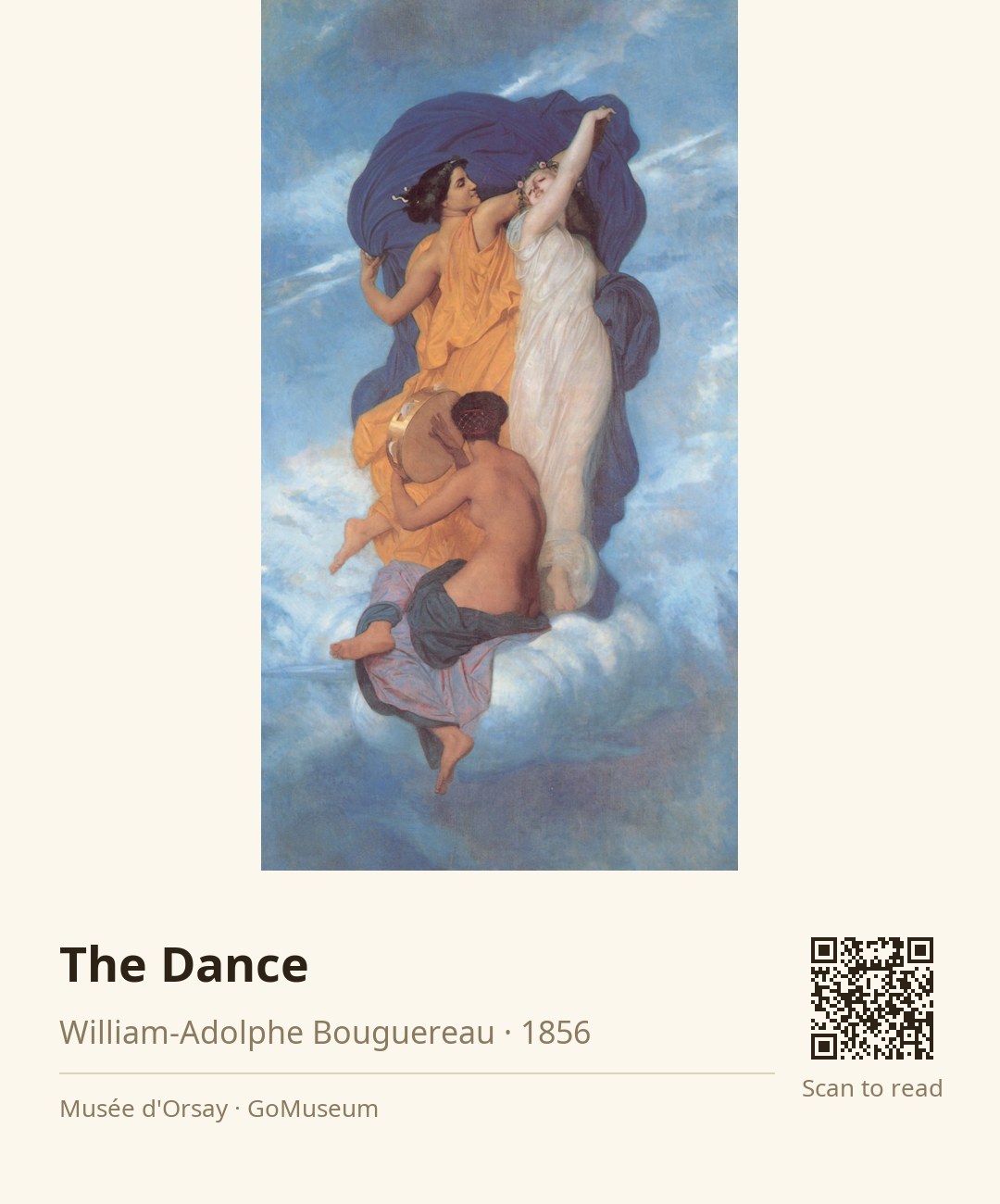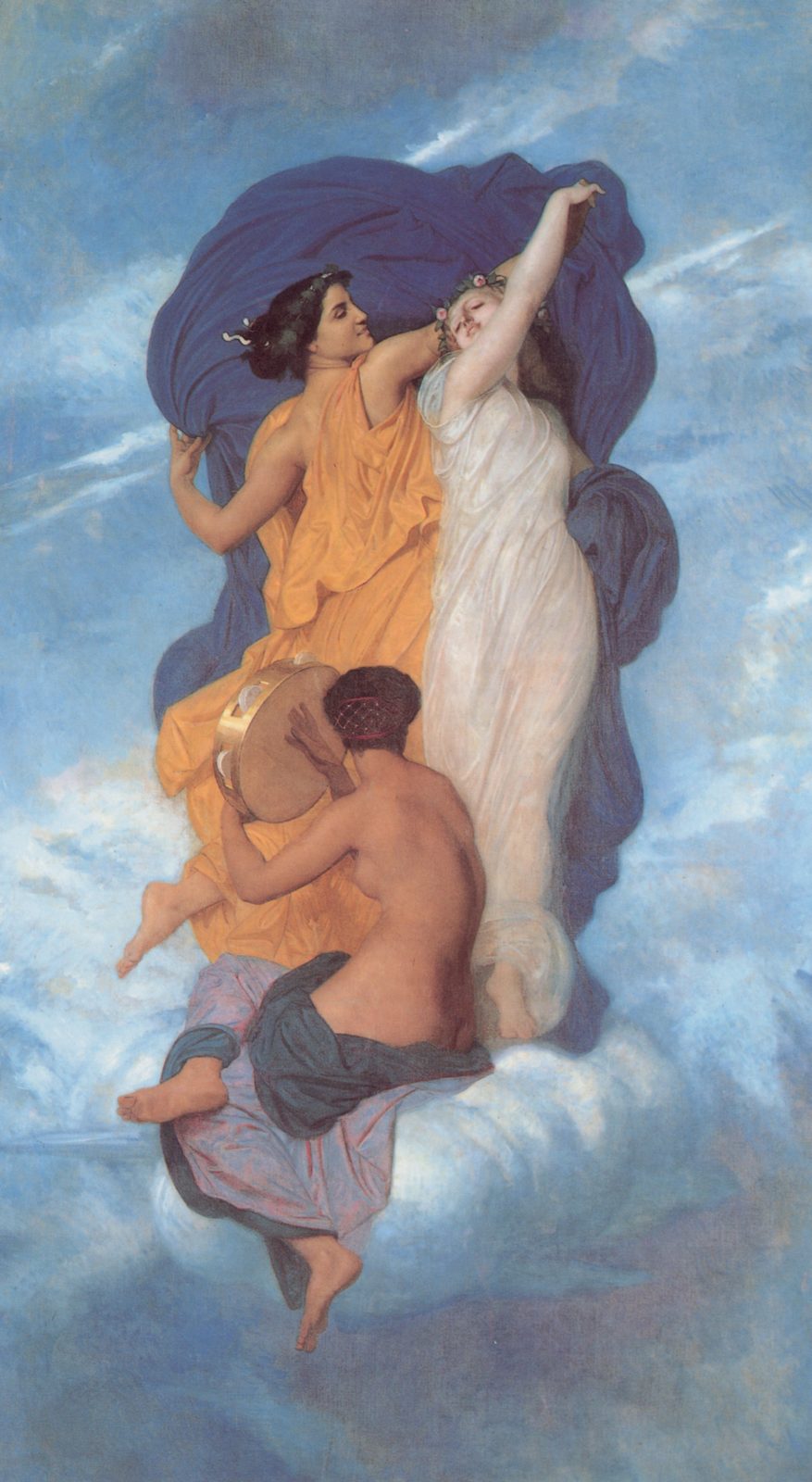
Take a moment to really soak in the energy of "The Dance" by William-Adolphe Bouguereau. Notice how the figures seem to leap off the canvas, their limbs entwined in a joyful whirl of movement. Look closely at the way the sunlight dances across their skin, illuminating the delicate textures of their bodies and the flowing fabric of their garments.
These details aren’t just for show; they capture the very essence of celebration and freedom. Bouguereau was a master of realism, and here, he uses light and shadow to create a sense of life and vitality. The way he paints the human form reflects his deep understanding of anatomy and movement, making each dancer feel almost alive, as if they could step right out of the frame.
Created in 1856, this piece was commissioned to adorn a Paris hotel, and it speaks to the era's fascination with beauty and allegory. Bouguereau was celebrated for his ability to blend classical themes with modern interpretations, and "The Dance" is a perfect example of that.
As you stand here, think about the joy and connection that dance brings to people across cultures and generations. What feelings does this artwork stir in you?
William-Adolphe Bouguereau was a prominent French academic painter born on November 30, 1825, in La Rochelle. He grew up in a family of merchants and developed a passion for art at a young age. Bouguereau studied at the École des Beaux-Arts and won the prestigious Prix de Rome in 1850, which allowed him to immerse himself in the classical art of Italy. His work, characterized by realistic depictions of mythological themes and the female form, gained immense popularity in France and the United States during his lifetime.
Despite his success, he faced criticism from the Impressionist movement, which deemed his style overly traditional. By the early 20th century, changing tastes led to a decline in his popularity, but a revival in the 1980s rekindled interest in his work. Bouguereau completed 822 known paintings, many of which remain lost. His legacy as a master of academic painting endures, particularly for his sensitive portrayals of women and children, marking him as a significant figure in art history. He passed away on August 19, 1905, leaving behind a complex legacy that continues to provoke discussion and admiration.
In 1855, Bouguereau was commissioned by Anatole Bartholoni to create 'The Dance' for a Paris hotel, aiming to enhance the elegance of its living room. This painting was part of a larger set, with other works now residing at the United States Embassy in Paris. It made its public debut at the Salon des artistes français in 1857, where it was well-received, showcasing Bouguereau's mastery of realism and allegorical themes. Over the years, the painting changed hands, eventually being donated by Captain Peter Moore to the Musée d'Orsay in 1981, where it was initially attributed to the Louvre before finding its permanent home. The journey of 'The Dance' reflects not only Bouguereau's prominence in the art world but also the evolving tastes of collectors and institutions throughout the decades.
The brushwork is meticulous, creating a smooth texture that enhances the lifelike quality of the figures. Notice how he employs light to sculpt the forms; the sunlight bathes the dancers, highlighting the contours of their bodies and the delicate drapery of their garments. The composition is dynamic, with swirling movement that draws your eye across the canvas, inviting you to feel the rhythm of the dance. Bouguereau's choice of a large scale—367 cm high and 180 cm wide—immerses you in the scene, making the figures feel larger than life. The vibrant colors, particularly the warm skin tones contrasted against the cooler background, evoke a sense of joy and celebration, capturing the essence of the dance itself.
William-Adolphe Bouguereau's 'The Dance' is a striking example of academic art, showcasing the beauty of the human form through allegorical representation. Painted in 1856, it reflects Bouguereau's mastery of oil and wax on canvas, a technique that gives his works a lifelike quality. This painting not only captivated audiences at the Salon of 1857 but also influenced generations of artists who admired his realistic style. Despite facing criticism from the avant-garde, Bouguereau's focus on mythological themes and the female body carved a niche in art history.
Interestingly, 'The Dance' was created as part of a larger decorative scheme for Bartholoni's hotel, which included other allegorical works. This collaborative approach to art was quite common in the 19th century, as artists often worked on commissions that required multiple pieces to create a cohesive aesthetic.
Upon closer inspection, the dancers' expressions convey a range of emotions, from joy to serenity, which adds depth to the celebration depicted. Their poses are not just about movement; they also suggest a narrative of connection and unity, inviting viewers to interpret the dance as a metaphor for life and relationships.