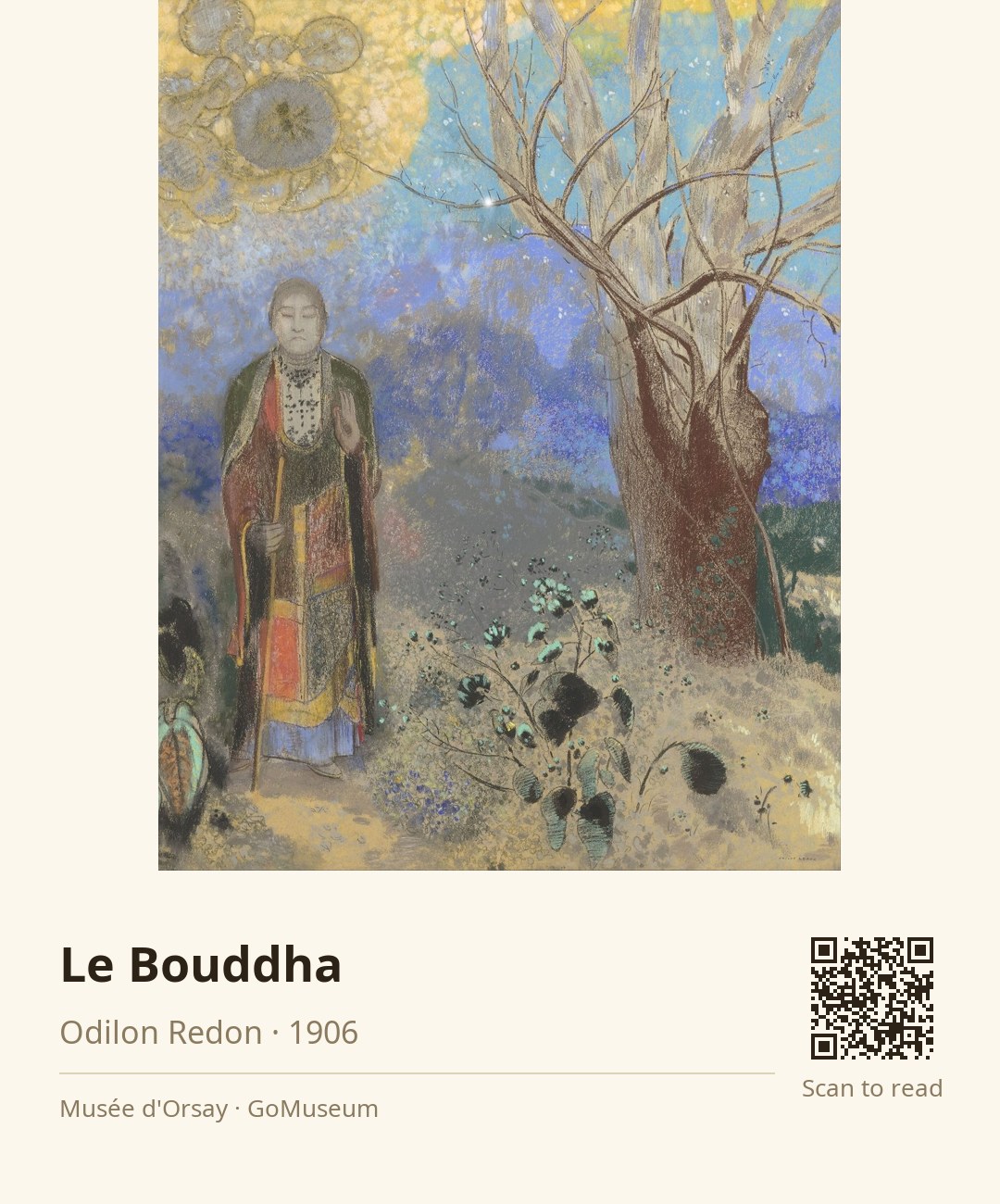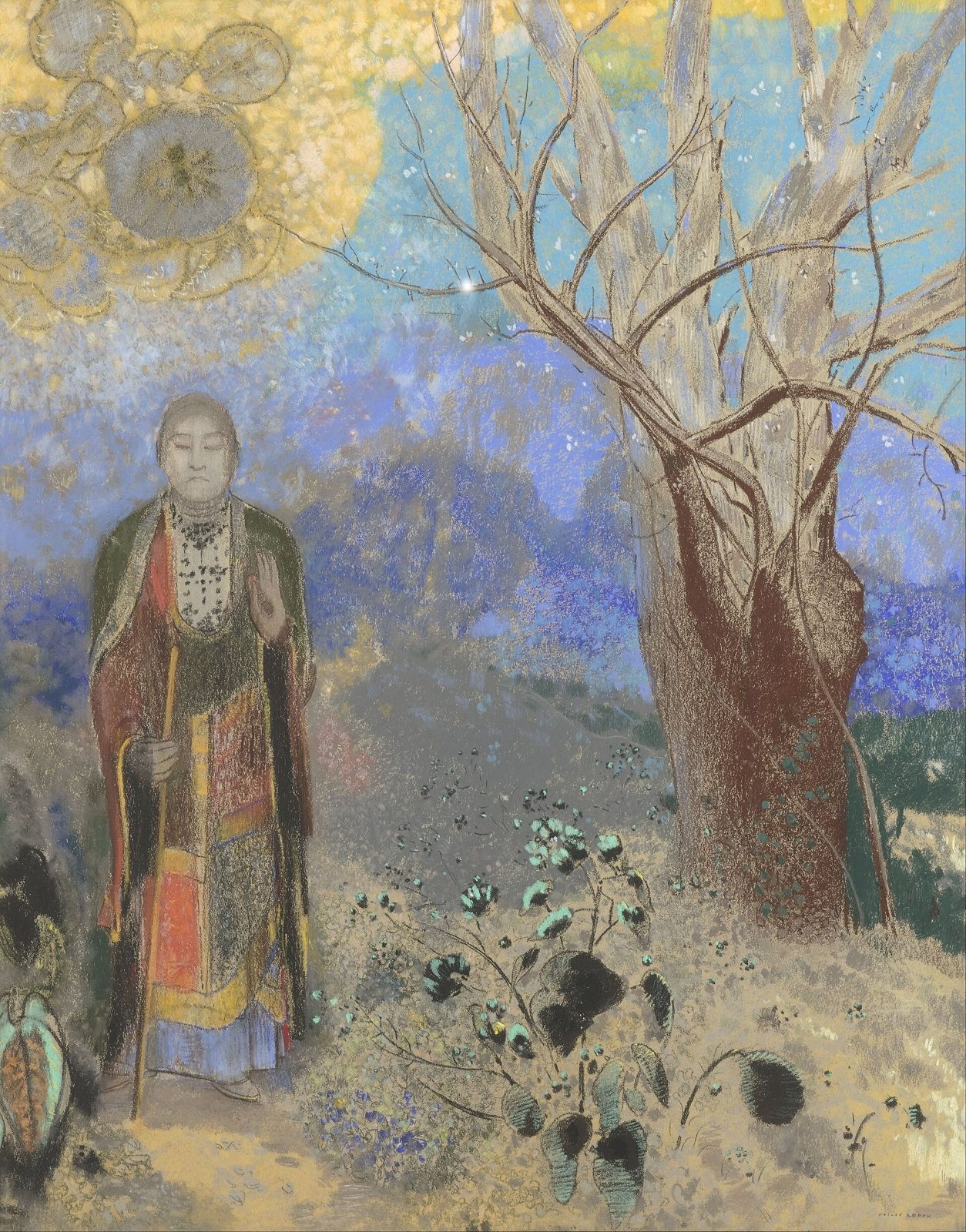
Take a moment to really look at "Le Bouddha" by Odilon Redon. Notice how the figure of Buddha stands tall, draped in flowing robes, with a serene expression that invites contemplation. His eyes are closed, suggesting a deep inner peace, while the delicate pastel colors create a dreamlike atmosphere around him. These details matter because they reflect Redon's fascination with spirituality and the subconscious. The soft hues and gentle lines evoke a sense of tranquility, transporting you to a meditative space. This artwork isn't just a representation; it's an invitation to explore the depths of your own thoughts and feelings. Created in 1906, during a period when Redon was deeply influenced by Eastern philosophies, this piece embodies his shift from darker themes to a more luminous, ethereal style. It’s a testament to his journey as an artist, moving from the shadows of his earlier works to the light of spiritual exploration. As you stand here, consider: what does peace look like to you? How does this serene figure resonate with your own search for tranquility?
Odilon Redon, born Bertrand Redon on April 20, 1840, in Bordeaux, was a French Symbolist artist known for his unique exploration of the subconscious. He began his artistic journey with charcoal and lithography, creating haunting works termed "noirs," which reflected his fascination with dreams and the darker aspects of the human psyche. His breakthrough came in 1884 when his art was featured in Joris-Karl Huysmans' novel, elevating his profile in the art world.
After the Franco-Prussian War, Redon shifted to pastel and oil, abandoning his earlier style by 1900. His later works, characterized by vibrant colors and dreamlike imagery, drew inspiration from Japanese art and Eastern philosophies, particularly Buddhism. This evolution marked him as a precursor to Surrealism, as he delved into the realms of the imagination and abstraction.
Redon's personal life was marked by a struggle with health issues, including epilepsy, which influenced his artistic vision. He married Camille Falte and had a son, Arï, who also became an artist. Redon's legacy endures, with his works celebrated for their ethereal quality and profound emotional depth, securing his place in the pantheon of modern art. He passed away on July 6, 1916, in Paris, leaving behind a rich tapestry of visionary art that continues to inspire.
Odilon Redon's 'Le Bouddha' was created in 1906, a pivotal time in the artist's life when he was fully embracing pastel as his medium of choice. This work, depicting Buddha standing amidst a lush landscape, reflects Redon's deepening interest in Hindu and Buddhist themes, which became increasingly prominent in his art during this period. The piece was eventually acquired by public collections in 1971, first residing at the Louvre before moving to the Musée d'Orsay in 1986, where it continues to be celebrated. Its journey through various collections highlights the evolving appreciation for Redon's unique vision, blending dreamlike qualities with spiritual motifs.
In 'Le Bouddha', Redon employs pastel to create a soft, dreamlike quality that envelops the figure of Buddha. Notice the delicate handling of color; the pastels blend seamlessly, giving the robes an almost floating appearance. The brushwork feels fluid and gentle, evoking a sense of tranquility. The composition is structured vertically, drawing your eye upwards, which mirrors the spiritual ascent associated with the figure. The closed eyes of Buddha invite contemplation, while the surrounding vegetation adds depth and a natural harmony. This interplay of light and color not only enhances the serene atmosphere but also reflects Redon's mastery in using pastels to convey emotion and spirituality.
As a child, he suffered from epilepsy, which led his parents to take him on a pilgrimage to a basilica in hopes of a miraculous cure. Remarkably, after a series of events during this pilgrimage, he was declared healed! This experience deeply influenced his artistic vision, as he often explored themes of the mystical and the unseen in his work, including this serene depiction of Buddha.
Redon's transition from charcoal to pastel marked a pivotal change in his artistic expression, allowing him to explore lighter, more ethereal themes. This shift reflected his growing interest in spirituality and the subconscious, as pastels enabled him to create softer, dreamlike atmospheres that aligned with his fascination for Eastern philosophies.
Redon's childhood was marked by a struggle with epilepsy and a deep connection to nature, which shaped his sensitivity to the emotional and spiritual aspects of life. His experiences of isolation and contemplation in the countryside inspired the dreamlike quality of his later works, including 'Le Bouddha', as he sought to express the inner workings of the mind and soul.
Redon's fascination with Buddhism and Eastern philosophies profoundly influenced 'Le Bouddha', as he sought to capture the essence of serenity and enlightenment associated with the figure. This interest not only informed the subject matter but also guided his use of color and composition, aiming to evoke a meditative state in the viewer.