 Image: Jebulon · Cristina Jonne · Daderot · Sortica
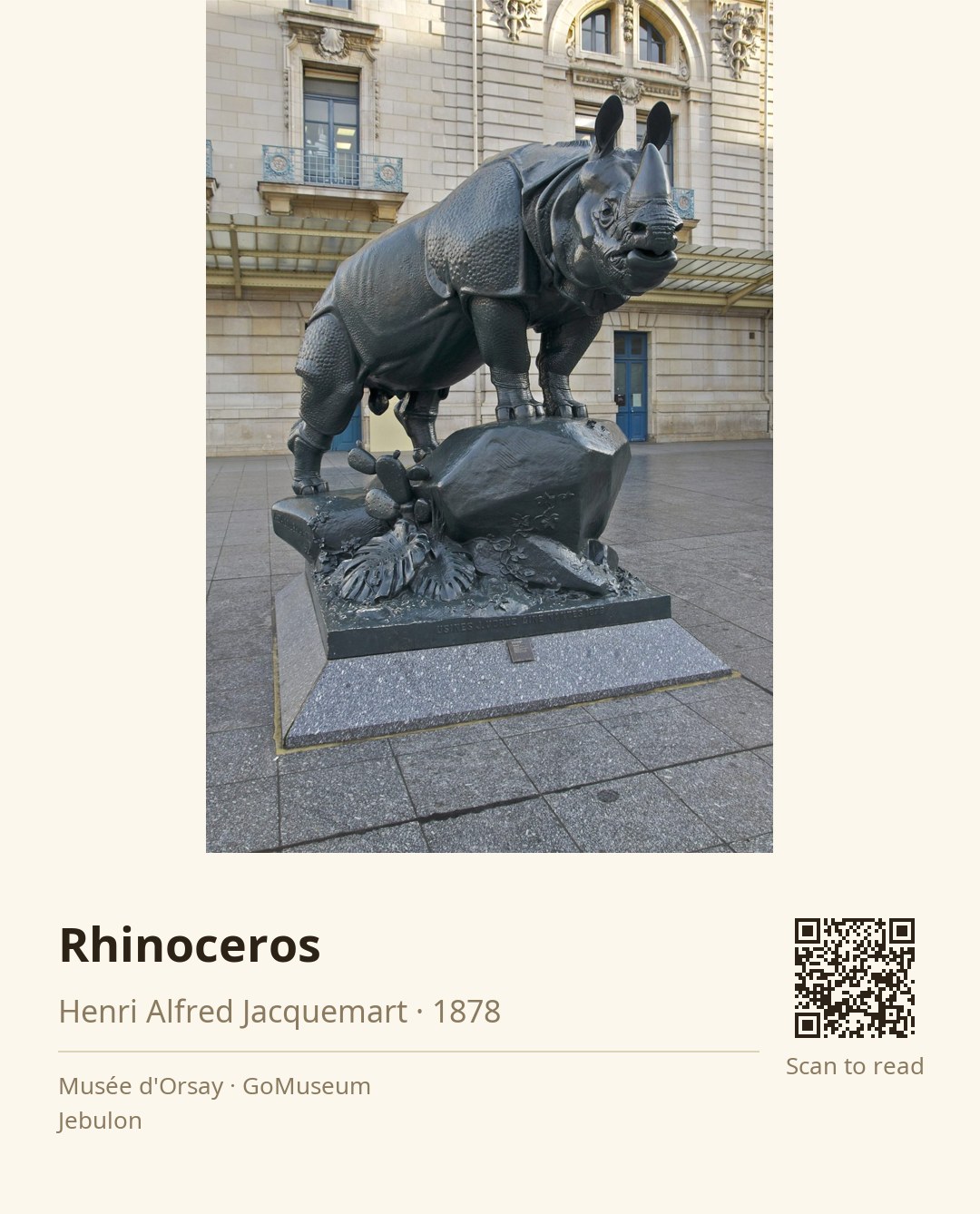
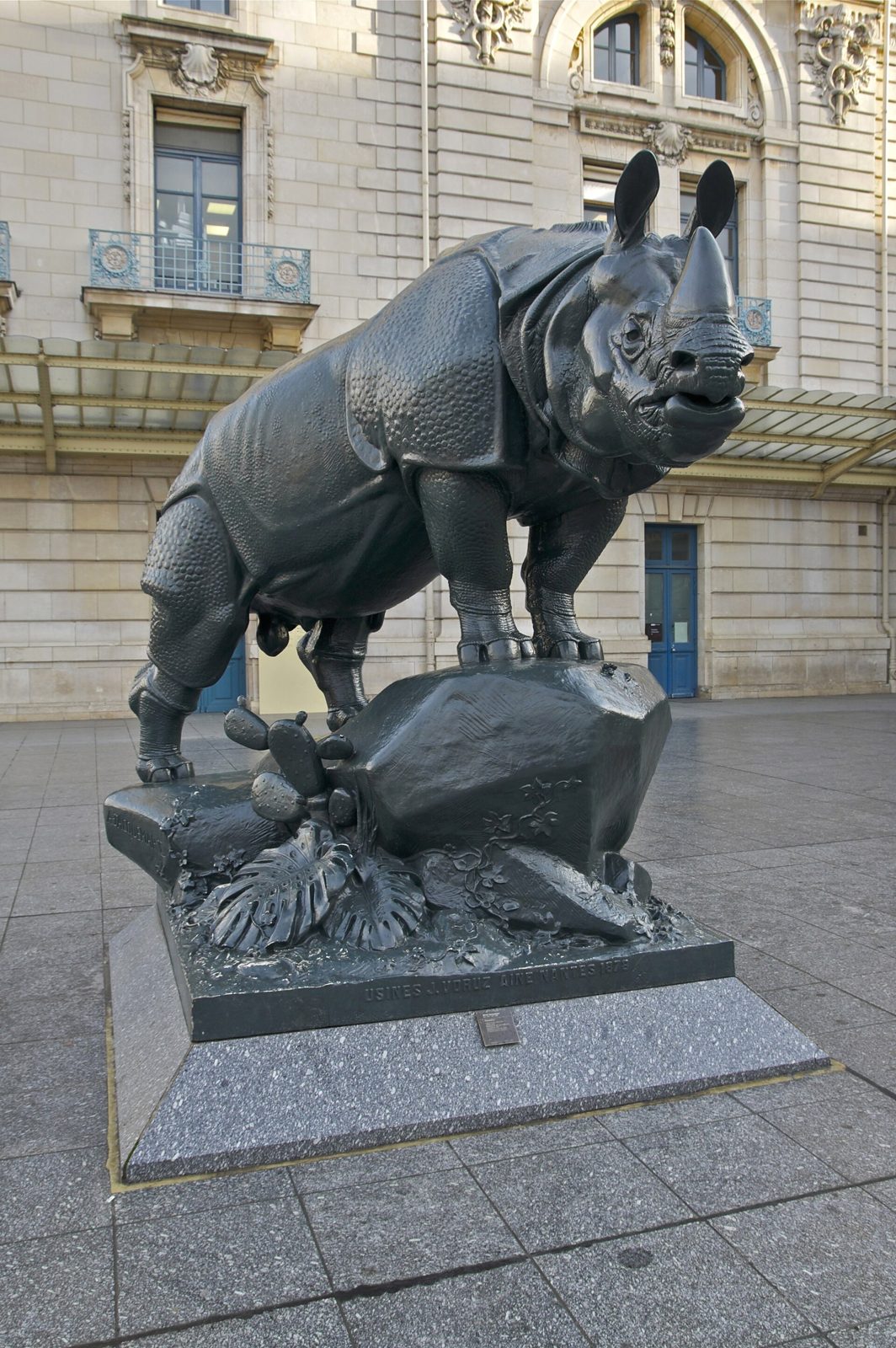
Take a moment to really look at this magnificent sculpture of a rhinoceros by Henri Alfred Jacquemart. Notice how the artist has captured the texture of the rhino's skin, with its rugged folds and creases that almost seem to breathe. And look at its stance—strong and solid, as if it’s ready to charge, yet there’s a certain calmness in its posture.
These details matter because they reflect Jacquemart's incredible skill in portraying not just the physicality of the animal, but also its spirit. This life-sized sculpture, created in 1878 for the Exposition Universelle in Paris, was a celebration of both artistry and the fascination with exotic animals during that era. Jacquemart’s meticulous attention to detail earned him praise, and it’s easy to see why; he made a massive creature feel both majestic and approachable.
Originally, this rhinoceros stood proudly at the Trocadéro Palace, surrounded by other animal sculptures, creating a lively scene for fairgoers. It was a time when the world was eager to marvel at the wonders of nature, and this piece was a centerpiece of that excitement.
As you stand here, consider what this rhino might have witnessed over the years. What stories do you think it could tell if it could speak?
Henri Alfred Marie Jacquemart, known as Alfred Jacquemart, was a prominent French sculptor born on February 24, 1824, in Paris. He studied under notable figures like Paul Delaroche and Jean Baptiste Jules Klagmann at the École des Beaux-Arts, where he honed his skills in sculpture. Jacquemart gained recognition for his animal sculptures, a genre that captivated the bourgeoisie in the 19th century, leading to a flourishing market supported by various foundries.
His career flourished with numerous exhibitions at the Paris Salon from 1847 to 1879, where he received several medals. His works, often cast in bronze, include iconic pieces like the Sphinxes at La Fontaine du Palmier and the monumental statue of Muhammad Ali in Alexandria. In 1870, he was honored as a Chevalier of the Légion d'honneur, marking his significant contributions to the art world.
Jacquemart's life was marked by a dedication to his craft, and he was described as a conscientious and knowledgeable artist. He passed away suddenly on January 4, 1896, leaving behind a legacy of exquisite animal sculptures that continue to be celebrated in public collections. Despite being somewhat forgotten at the time of his death, Jacquemart's work remains an important part of the history of 19th-century sculpture.
Take a closer look at the material of this sculpture: cast iron. This choice is significant, as it allowed Jacquemart to create a robust and detailed life-sized representation of the rhinoceros. The texture you see—the rugged skin and the intricate folds—was achieved through a meticulous casting process. Jacquemart worked with the Nantes foundry of J. Voruz the Elder, which was known for its high-quality ironwork. Notice how the surface catches the light, highlighting the contours and giving the rhino a lifelike presence. The gilding that followed the casting added a touch of elegance, making this formidable creature not just a representation of strength, but also a decorative piece worthy of admiration.
This sculpture was commissioned for the 1878 Exposition Universelle, a grand world's fair held in Paris, showcasing the marvels of industry and art. The urgency of the commission meant Jacquemart had to work quickly, completing the piece in time for the fair's opening. Originally, it was positioned at the Trocadéro Palace, one of the fair's main attractions, surrounded by other monumental animal sculptures. The reception was overwhelmingly positive; critics praised Jacquemart's technical skill and the sculpture's striking presence. However, in 1935, as the palace underwent remodeling for the 1937 Exposition Internationale, the rhinoceros was relocated to the gardens near the Porte de Saint-Cloud. It wasn't until 1985 that it found its current home at the Musée d'Orsay, after restoration work that preserved its grandeur for future generations to appreciate.
Commissioned for the 1878 Exposition Universelle, this piece showcased the burgeoning fascination with animal sculptures, capturing the imagination of a society eager for both artistic innovation and naturalistic representation. Its placement at the Trocadéro Palace, surrounded by other monumental works, helped elevate the status of animalier sculpture, influencing future generations of artists. Jacquemart's meticulous attention to detail and the use of cast iron not only highlighted the technical prowess of the time but also set a standard for large-scale public artworks that followed. Remember, this rhinoceros isn't just a statue; it's a testament to an era that celebrated the intersection of art, nature, and technology.
Did you know that this rhinoceros was one of four monumental animal sculptures created for the 1878 Exposition Universelle? Interestingly, it was said that the rhinoceros seemed to ponder 'some collective prehistoric memory,' a poetic observation made by Austrian sculptor Arnulf Rainer in 1988, highlighting the depth and character Jacquemart infused into this formidable creature.
The Trocadéro Palace was specifically built for the 1878 Exposition Universelle, making it a prime location for showcasing monumental art like Jacquemart's rhinoceros. This setting not only elevated the sculpture's status but also placed it among other significant works, enhancing its visibility and impact during the fair.