Portrait of a Seated Lady
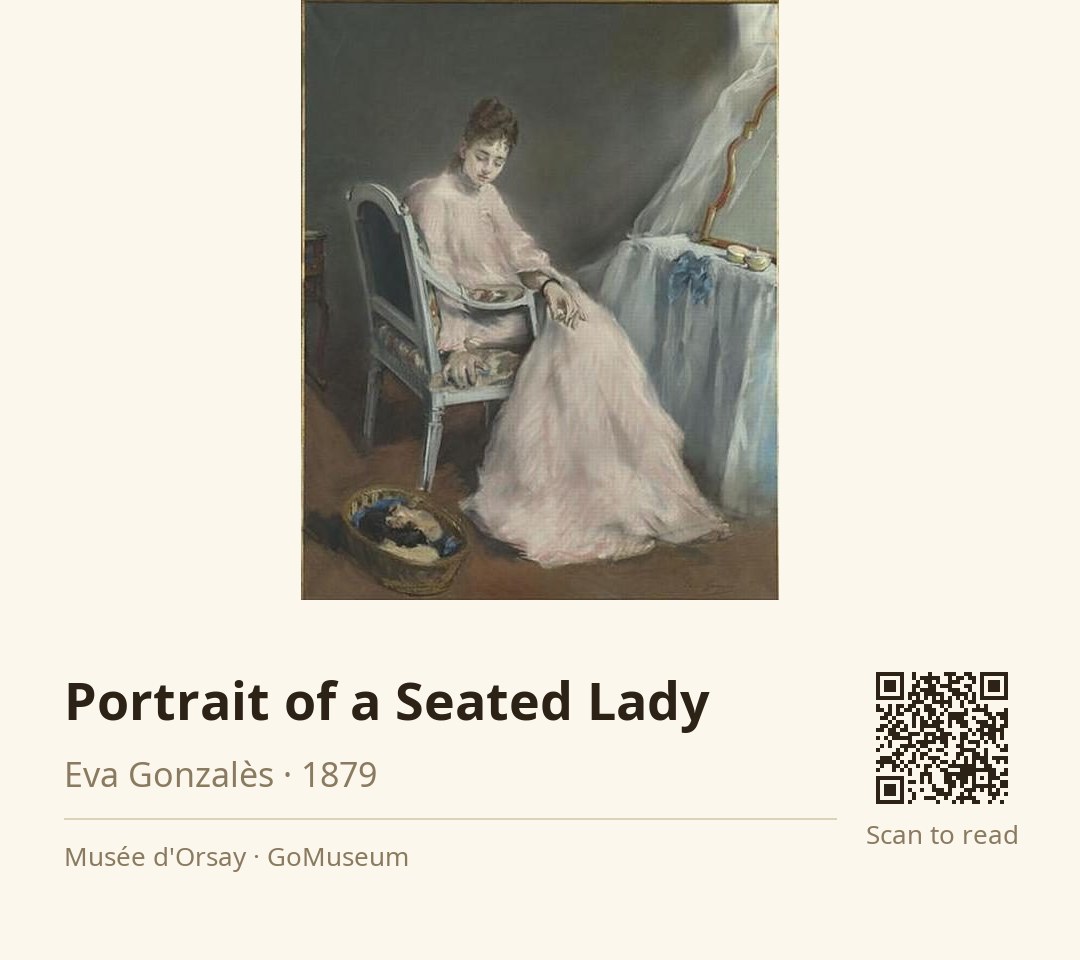
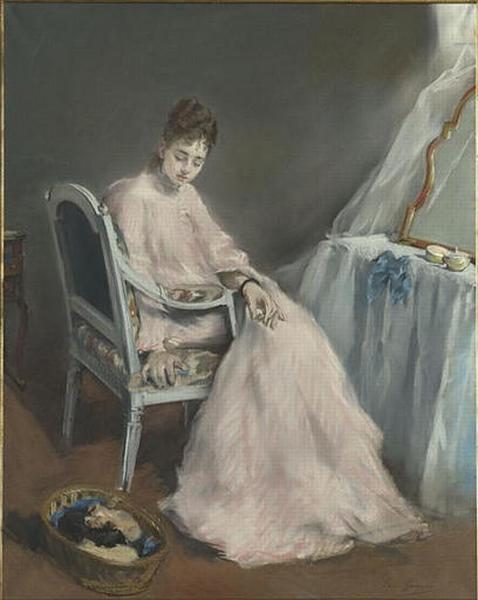
🎧 This work has audio narration — listen in the appThe seated lady in this pastel portrait exudes a quiet elegance, her flowing pink dress catching the light as she gazes thoughtfully downward. The floral upholstery of the chair complements her attire, while a small table nearby, draped in white and adorned with blue ribbons, hints at her personal space, perhaps filled with intimate belongings or cosmetics.
This delicate portrayal reflects Eva Gonzalès' mastery of texture and mood, creating an intimate atmosphere that invites contemplation. The muted gray background serves to enhance the softness of the scene, allowing the viewer to focus on the lady's serene expression and the gentle brushwork that brings her character to life. Gonzalès, a prominent figure among female Impressionists, often explored themes of femininity and domesticity in her work, which was influenced by her studies under Édouard Manet.
Born in Paris in 1847, Gonzalès began her artistic journey in the vibrant cultural circles of the city, eventually becoming Manet's only formal student. She married Henri Guérard in 1879, the same year she completed this portrait, and tragically passed away in childbirth just a few years later, leaving behind a legacy that continues to be celebrated in exhibitions today.
Eva Gonzalès was a pioneering French Impressionist painter born in Paris on April 19, 1847. Raised in an artistic environment, she was introduced to the cultural elite through her father, a writer. At sixteen, she began her formal art training, first with Charles Chaplin and later under Édouard Manet, who became a significant influence on her work. Gonzalès was the only formal student of Manet, and their relationship was both personal and professional, with her often serving as his model.
Her paintings, characterized by a blend of technical skill and an intuitive approach, earned her praise from critics like Émile Zola. Despite being part of the Impressionist movement, she did not exhibit in their exhibitions, yet her style aligned closely with theirs. Works such as "A Loge in the Théâtre des Italiens" showcased her unique perspective, blending feminine sensibility with bold themes.
Gonzalès married Henri Guérard in 1879 and had a son shortly before her untimely death in childbirth in 1883. Her legacy, though overshadowed during her lifetime, has gained recognition, with her works now celebrated in major collections, affirming her place in art history as one of the most notable female Impressionists of the 19th century.
Eva Gonzalès completed this pastel portrait in 1879, a pivotal year in her life as it marked her marriage to Henri Guérard, an artist and engraver who was also a close associate of Édouard Manet. This work was part of a broader trend where Gonzalès sought to carve out her identity as a female artist in a male-dominated art world. Although she was not a participant in the Impressionist exhibitions, her style aligned closely with that of her contemporaries. The portrait was well-received at the Salon, where critics praised her delicate technique and emotional depth. Following her untimely death in 1883, just days after giving birth, her work began to gain recognition, leading to retrospectives and exhibitions that celebrated her contributions to Impressionism. Today, her pieces are held in various prestigious collections, ensuring her legacy endures.
In this portrait, Gonzalès employs pastel to create a soft, ethereal quality that enhances the subject's gentle demeanor. The delicate brushwork captures the intricate textures of the flowing pink dress and the floral upholstery, inviting you to almost feel the fabric's softness. The muted gray background serves as a canvas that amplifies the warmth of the colors in the foreground, making the seated lady appear almost luminous. Gonzalès' choice of composition, with the figure slightly off-center and her gaze directed downward, evokes a sense of introspection and intimacy. The small table, adorned with blue ribbons, adds a personal touch, hinting at the woman's private world. The scale of the work, modest yet impactful, draws you into a quiet moment, allowing for a deeper connection with the subject.
Interestingly, Gonzalès was known to use her family members as models, including her sister Jeanne, who later became a painter herself. Her close ties to Manet and her marriage to Guérard further intertwined her personal and professional life, illustrating the collaborative spirit of the artistic community in which she thrived.
Eva Gonzalès often used her family members as models, particularly her sister Jeanne, who also pursued a career in painting.
Eva Gonzalès sought refuge in Dieppe during the Franco-Prussian War.
After her death, Eva Gonzalès' works were exhibited at the offices of the art review L'Art in 1882 and at the Galerie Georges Petit in 1883.